Use supplier lead-time variation to set realistic material dates
For procurement, stores and subcontract operations teams · Understand the problem
TL;DR — what you’ll learn
- Separate purchase-order release, supplier acknowledgement, dock receipt and quality release timestamps instead of storing a single static master-data lead time.
- Measure calendar days to usable stock in unrestricted stores rather than stopping the clock when the lorry reaches the receiving gate.
- Retain original promised dates alongside buyer-rescheduled dates so internal demand shifts are not misclassified as supplier lateness.
- Present the observed range and stage breakdown to the materials planner as evidence; changing master-planning parameters remains a human decision.

Illustrative factory raw-material stores and receiving counter; not a client facility.
An item master shows a 28-calendar-day lead time for a machined bearing housing (BH-402), yet assembly jobs still wait for the part. When procurement checks the five recent deliveries in the table below, PO-1058 and PO-1089 reached the receiving dock on calendar day 27 (1 to 2 days for supplier confirmation plus 25 to 26 days in transit), while incoming dimensional inspection took another 4 to 5 days—pushing usable stock availability to day 31 and day 32. On PO-1072, the supplier took 5 days to confirm and 27 days in transit to reach the dock on day 32, followed by 6 days in inspection before the lot became usable on day 38 (matching the 38-day usable total on buyer-deferred PO-1104, which docked on day 35). Using a single 28-day master figure hides both the supplier's confirmation spread and the internal receiving queue.
This guide covers a read-only stage breakdown built from existing purchasing, receiving and inspection timestamps. Deciding whether to adjust item-master lead times, hold buffer stock or split orders across vendors remains with the materials manager and procurement team.
Break total elapsed time into distinct handover stages
Consider an original illustrative dataset of five recent purchase-order deliveries for part BH-402 against a 28-day master-data assumption. Each row records calendar days from PO release to supplier confirmation, confirmation to gate receipt (GRN), cumulative days to dock GRN, and GRN to unrestricted quality release.
Scroll horizontally to see all columns.
| PO reference | Ordered qty (pcs) | PO release to confirmation (days) | Confirmation to dock GRN (days) | Cumulative days to dock GRN | Dock GRN to QC release (days) | Total days to usable stock | Variance vs 28-day master (days) | Recorded reschedule note |
|---|---|---|---|---|---|---|---|---|
| PO-1041 | 120 | 1 | 24 | 25 | 3 | 28 | 0 | No schedule change |
| PO-1058 | 120 | 2 | 25 | 27 | 4 | 31 | +3 | No schedule change |
| PO-1072 | 120 | 5 | 27 | 32 | 6 | 38 | +10 | Supplier tooling queue noted on confirmation |
| PO-1089 | 120 | 1 | 26 | 27 | 5 | 32 | +4 | Split receipt: 80 pcs and 40 pcs completed on day 27 |
| PO-1104 | 120 | 2 | 33 | 35 | 3 | 38 | +10 | Buyer deferred requested date by 7 days on revision 2 |
| Five-order summary (600 pcs) | 600 | 11 total (2.2 avg) | 135 total (27.0 avg) | 146 total (29.2 avg) | 21 total (4.2 avg) | 167 total (33.4 avg) | +27 net (+5.4 avg) | 4 unadjusted deliveries; 1 buyer-deferred order |
Across all five deliveries (600 pieces total), dock arrival averaged 29.2 calendar days and usable stock arrived in an average of 33.4 calendar days—5.4 days later than the 28-day planning parameter. Even on the four orders without a buyer deferral (PO-1041, PO-1058, PO-1072 and PO-1089), dock arrival ranged from day 25 to day 32 (111 cumulative dock days, or 27.75 days average) and total time to usable stock ranged from day 28 to day 38 (129 cumulative usable days, or 32.25 days average), with internal dock-to-stock inspection consuming 18 of those 129 elapsed days (4.5 days average). Treating PO-1104 as a 10-day supplier failure would also be misleading: the buyer pushed the requested delivery out by 7 days on revision 2, leaving a 3-day net variance against the revised promise.
ERP documentation for material requests in ERPNext, quality inspection records and Microsoft finite capacity planning shows how required dates, inspection steps and planning horizons interact. Those product pages describe system fields rather than prescribing what buffer a specific factory should carry.
Use supplier lead-time variation to set realistic material dates — reporting workflow
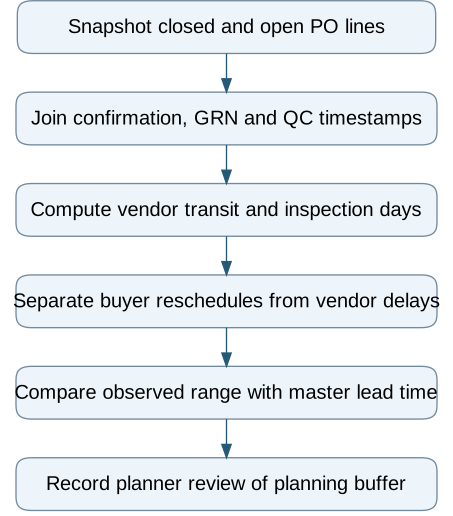
Follow the workflow below, or open its complete text version.
Read the complete workflow as text
- Snapshot closed and open PO lines → Join confirmation, GRN and QC timestamps
- Join confirmation, GRN and QC timestamps → Compute vendor transit and inspection days
- Compute vendor transit and inspection days → Separate buyer reschedules from vendor delays
- Separate buyer reschedules from vendor delays → Compare observed range with master lead time
- Compare observed range with master lead time → Record planner review of planning buffer
Keep partial receipts and revision history explicit
A stage report breaks down quickly if a partial receipt closes the line clock early or a PO amendment overwrites the original promise date. When an order for 120 pieces arrives in two shipments of 80 and 40 pieces, record both the first usable date and the full-completion date so the planner can see whether the initial batch covered the immediate assembly run. If the inspection timestamp is missing because the lot bypassed formal QC, label the stage as not_recorded rather than zero days.
Review the stage breakdown before changing MRP parameters
A spreadsheet export of the last five to ten receipts per critical item is enough to verify whether late availability comes from order acknowledgement, supplier manufacturing, transit or internal receiving inspection. If dock-to-QC release takes four days, inflating supplier lead time without fixing receiving priorities only brings material to the gate earlier to sit in the same inspection queue.
Start by extracting ten high-shortage components and comparing their master lead time against the 80th-percentile time to unrestricted stock. The materials manager can then record a dated planning-buffer adjustment where warranted, while keeping the raw transaction history unchanged.
Recognise this problem in your operation?
Tell us where the records or handovers break down. We can discuss the process, data and software questions worth examining first.
Sources and further reading
Sources checked 15 October 2026. Worked examples and workflow diagrams are original illustrations, not reported client results.
