Control blanket purchase-order releases when schedules change
For procurement, stores and subcontract operations teams · Compare approaches
TL;DR — what you’ll learn
- Maintain separate balances for blanket contract ceiling, firm released call-offs, supplier-acknowledged quantities and cumulative receipts.
- Version every schedule change so an unacknowledged pull-in or cancellation does not overwrite the last mutually confirmed delivery date.
- Check frozen-zone rules before transmitting a call-off reduction inside the supplier manufacturing window.
- Reconcile open call-off commitments before closing a blanket agreement or approving final invoice settlement.

Illustrative factory raw-material stores and receiving counter; not a client facility.
A factory signs a blanket purchase agreement for 2,400 stamped motor end-shields over six months at ₹310 per piece, with weekly call-offs and a 14-day frozen commitment window. In week three, the planner edits the existing spreadsheet line to reduce a 200-piece call-off to 120 pieces and pulls the next release forward by five days. The supplier delivers all 200 pieces on the original date because the revision arrived four days before dispatch and was never acknowledged. Receiving blocks the 80-piece difference, and accounts payable faces a quantity mismatch.
This guide covers a versioned commitment ledger that separates the blanket ceiling from individual release versions, supplier acknowledgements and goods receipts. Contract terms, liability for raw-material commitments and commercial settlement remain with procurement and legal owners.
Reconcile agreement ceiling, firm call-offs and acknowledged schedules
Consider an original illustrative ledger for blanket agreement BPA-2026-09 (contract ceiling: 2,400 pieces; cumulative received prior to October: 1,500 pieces; remaining ceiling before October releases: 900 pieces).
Scroll horizontally to see all columns.
| Release line & version | Requested delivery date | Requested qty (pcs) | Supplier acknowledged qty (pcs) | Posted GRN qty (pcs) | Open acknowledged commitment (pcs) | Unacknowledged delta (pcs) | Status & control note |
|---|---|---|---|---|---|---|---|
| REL-08 v1 | 2026-10-07 | 250 | 250 | 250 | 0 | 0 | Closed in full |
| REL-09 v1 → v2 | 2026-10-14 | 120 (revised from 200) | 200 (v1 confirmed; v2 inside 14-day freeze) | 150 | 50 | -80 | 50 pcs still open on v1; v2 reduction unaccepted |
| REL-10 v1 → v2 | 2026-10-21 (pulled from 10-26) | 300 | 220 (on 10-21); 80 (on 10-26) | 0 | 300 | 0 (date split) | Quantity confirmed across two delivery dates |
| REL-11 v1 | 2026-11-04 | 250 | 0 (pending ack) | 0 | 0 | +250 | Issued outside freeze; awaiting confirmation |
| October–November totals | — | 920 requested (1,000 on v1) | 750 acknowledged | 400 received | 350 open confirmed | +170 net delta | Remaining ceiling after v1 (1,000 pcs) would breach 900-pc limit by 100 pcs if REL-09 v2 is not accepted |
Look at how the separate columns prevent silent errors:
- Prior receipts (1,500 pcs) + October posted GRNs (400 pcs) = 1,900 pieces received to date.
- Open confirmed commitment: 50 pieces remaining on
REL-09 v1plus 300 pieces confirmed onREL-10= 350 pieces. - Pending unacknowledged release: 250 pieces on
REL-11 v1. - Ceiling check: 1,500 prior + 250 (
REL-08) + 200 (REL-09 v1) + 300 (REL-10) + 250 (REL-11 v1) = 2,500 pieces against a 2,400-piece blanket ceiling—a 100-piece over-release unlessREL-09is formally reduced by 80 pieces andREL-11is trimmed by 20 pieces, or the buyer raises a ceiling amendment.
Reference documentation on Microsoft purchase requisition workflows and three-way AP invoice matching explains how release lines and receipt matching operate in standard ERP modules.
Control blanket purchase-order releases when schedules change — reporting workflow
Follow the workflow below, or open its complete text version.
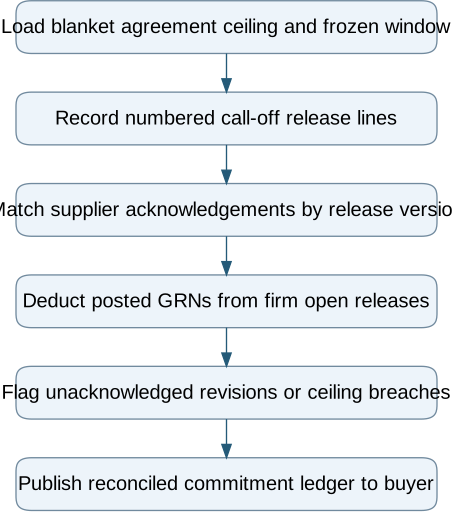
Read the complete workflow as text
- Load blanket agreement ceiling and frozen window → Record numbered call-off release lines
- Record numbered call-off release lines → Match supplier acknowledgements by release version
- Match supplier acknowledgements by release version → Deduct posted GRNs from firm open releases
- Deduct posted GRNs from firm open releases → Flag unacknowledged revisions or ceiling breaches
- Flag unacknowledged revisions or ceiling breaches → Publish reconciled commitment ledger to buyer
Keep unacknowledged schedule revisions visible as exceptions
When a planner transmits REL-09 v2 inside the 14-day frozen zone, the system or worksheet must keep REL-09 v1 (200 pieces) as the active supplier commitment until the supplier records an explicit acceptance reference. Overwriting the line with 120 pieces makes the receiving dock reject 80 pieces that the supplier produced under a valid confirmation, creating an avoidable invoice dispute.
Test call-off reconciliation on one active scheduling agreement
Start by auditing one high-volume blanket agreement over its last four release cycles. Check whether the buyer can state—from transaction records alone—how many units are received, how many are confirmed open, how many sit in unacknowledged revisions, and how much ceiling remains.
Compare this workflow with your current setup
Share the step that takes the most manual work, the systems involved and the exceptions your team handles. That gives us a concrete starting point for comparing approaches.
Sources and further reading
Sources checked 15 October 2026. Worked examples and workflow diagrams are original illustrations, not reported client results.
