Statistical Process Control (SPC) and Process Capability (Cp, Cpk): X-Bar R Charts, Nelson Rules and Automated CNC Offset Interlocks
For quality, engineering and records teams · Compare approaches
TL;DR — what you’ll learn
- Enforces closed-loop synchronization for Statistical Process Control (SPC) and Process Capability (Cp, Cpk): X-Bar R Charts, Nelson Rules and Automated CNC Offset Interlocks (M133) across SAP QM inspection lots (QALS/QAMV), Q-DAS ASCII transfer protocol (DFQ), Fanuc FOCAS G10 Dynamic Wear Offset registers, and QM01 defect notifications.
- Governs shop-floor execution via the mathematical balance Cp = (USL - LSL) / (6 × sigma_hat) where sigma_hat = R_bar / d2, and Cpk = min((USL - X_double_bar) / (3 × sigma_hat), (X_double_bar - LSL) / (3 × sigma_hat)).
- Eliminates Thermal spindle growth drift, grinding-wheel dress wear trend (Nelson Rule 3: 6 consecutive increasing points), operator over-adjustment tam through real-time PLC/MES interlocks.
- Aligns dual-market compliance across NABL ISO/IEC 17025 master ring-gauge calibration traceability, BIS IS and AIAG SPC 2nd Edition reference manual, Western Electric / Nelson 8 run.

Illustrative manufacturing inspection room and machine shop floor; not a client facility.
Statistical Process Control (SPC) and Process Capability (Cp, Cpk): X-Bar R Charts, Nelson Rules and Automated CNC Offset Interlocks
Implement statistical process control spc with MES/ERP state interlocks, worked Indian INR reconciliation, and ISO 9001 / IATF 16949 audit governance. Enforces closed-loop synchronization for Statistical Process Control (SPC) and Process Capability (Cp, Cpk): X-Bar R Charts, Nelson Rules and Automated CNC Offset Interlocks (M133) across SAP QM inspection lots (QALS/QAMV), Q-DAS ASCII transfer protocol (DFQ), Fanuc FOCAS G10 Dynamic Wear Offset registers, and QM01 defect notifications.
Operational boundary and shop-floor failure modes in Statistical Process Control (SPC) and Process Capability (Cp, Cpk): X-Bar R Charts, Nelson Rules and Automated CNC Offset Interlocks (M133)
In industrial production environments such as a fuel-injector nozzle grinding line in Hosur, Tamil Nadu holding a ±2.5 micron concentricity tolerance across 85,000 parts/month and an aerospace fastener turning cell in Wichita, Kansas governed by AS9100 Rev D and AS13006 process control requirements, Statistical Process Control (SPC) and Process Capability (Cp, Cpk): X-Bar R Charts, Nelson Rules and Automated CNC Offset Interlocks determines whether physical shop-floor execution remains synchronized with financial and material ledgers. When machine telemetry, operator confirmations, and quality holds operate in disconnected silos, the enterprise resource planning (ERP) layer records idealized theoretical transactions while physical work-in-process (WIP), tool wear, and scrap diverge silently across shifts.
The primary operational failure modes targeted under M133 encompass Thermal spindle growth drift, grinding-wheel dress wear trend (Nelson Rule 3: 6 consecutive increasing points), operator over-adjustment tampering (Nelson Rule 4: 14 alternating points), and gauge R&R exceeding 10% of tolerance band. In uncontrolled deployments, plant supervisors reconcile these variances only during month-end physical inventory counts or post-facto customer quality escalations. By establishing a deterministic transaction boundary between edge PLC/SCADA signals, Manufacturing Execution Systems (MES), and SAP QM inspection lots (QALS/QAMV), Q-DAS ASCII transfer protocol (DFQ), Fanuc FOCAS G10 Dynamic Wear Offset registers, and QM01 defect notifications, engineering and finance teams eliminate manual spreadsheet adjustments and enforce real-time gate locks at every routing milestone.
Every transaction within the M133 control loop must satisfy three foundational engineering invariants: Conservation of Mass and Count across parent inputs, good outputs, rework, and classified scrap; Conservation of Machine and Labor Time across productive cutting/forming cycles, setup transitions, and categorized downtime; and Cryptographic Traceability linking raw material heat/batch genealogy and calibrated inspection records to the final serialized handling unit or shipping lot.
| Control Layer | Primary System of Record | Governing Transaction / Object in M133 | Hard Interlock & Exception Gate |
|---|---|---|---|
| Shop-Floor Edge & PLC | OPC-UA / MTConnect / Euromap / FOCAS Gateway | Real-time cycle pulse, alarm code, and sensor telemetry for Manufacturing Operations | Blocks autonomous cycle start if safety interlock, tool offset, or recipe checksum fails validation |
| MES Execution Layer | Siemens Opcenter / Plex / Custom Shop-Floor Workbench | Work-center state machine, lot genealogy, and inline check for M133 | Places work order in Hold-Pending-Engineering if parameter drifts beyond control limits |
| Quality & Metrology (QMS) | SAP QM / Q-DAS / LIMS Inspection Engine | Inspection lot disposition, calibration validity, and CAPA link for M133 | Prevents Goods Receipt (MIGO 101) or transfer posting until digital sign-off completes |
| Enterprise Financial & MRP (ERP) | SAP QM inspection lots (QALS/QAMV), Q-DAS ASCII transfer protocol (DFQ), Fanuc FOCAS G10 Dynamic Wear Offset registers, and QM01 defect notifications | Standard/actual cost roll-up, inventory backflush, and variance settlement | Rejects period-end order settlement (KO88) if unconfirmed WIP or open MRB non-conformance exists |
Mathematical formulation and ERP data model for Statistical Process Control (SPC) and Process Capability (Cp, Cpk): X-Bar R Charts, Nelson Rules and Automated CNC Offset Interlocks (M133)
A production-grade implementation of Statistical Process Control (SPC) and Process Capability (Cp, Cpk): X-Bar R Charts, Nelson Rules and Automated CNC Offset Interlocks requires explicit mathematical definitions embedded directly into MES edge scripts and ERP validation user-exits (BAdIs / APIs). Rather than relying on ambiguous shift-end averages, the governing reconciliation equation for M133 is formally defined as: Cp = (USL - LSL) / (6 × sigma_hat) where sigma_hat = R_bar / d2, and Cpk = min((USL - X_double_bar) / (3 × sigma_hat), (X_double_bar - LSL) / (3 × sigma_hat)). Every variable in this equation must map to an immutable timestamped database column in SAP QM inspection lots (QALS/QAMV), Q-DAS ASCII transfer protocol (DFQ), Fanuc FOCAS G10 Dynamic Wear Offset registers, and QM01 defect notifications so internal auditors and plant engineers can reproduce any shift metric down to the individual production order and batch number.
Data model synchronization between MES and ERP for Statistical Process Control (SPC) and Process Capability (Cp, Cpk): X-Bar R Charts, Nelson Rules and Automated CNC Offset Interlocks (M133) must enforce idempotency and strict state ordering across SAP QM inspection lots (QALS/QAMV), Q-DAS ASCII transfer protocol (DFQ), Fanuc FOCAS G10 Dynamic Wear Offset registers, and QM01 defect notifications. Every confirmation payload transmitted from a fuel-injector nozzle grinding line in Hosur, Tamil Nadu holding a ±2.5 micron concentricity tolerance across 85,000 parts/month carries a composite natural key comprising Plant Code, Work Center ID, Production Order Number, Operation Sequence, Split/Sub-lot Counter, and Shift Timestamp. If network latency occurs between the shop floor and the ERP core during Manufacturing Operations execution, local edge buffers queue transactions in FIFO order and replay them against idempotent endpoints to prevent double-backflushing or duplicate labor-hour absorption.
Master data hygiene for M133 is enforced before a production order in Manufacturing Operations can transition from Created (CRTD) to Released (REL). Automated pre-release checks validate that bill-of-materials (BOM) scrap factors, routing setup/run time standards, inspection plan tolerances for Statistical Process Control (SPC) and Process Capability (Cp, Cpk): X-Bar R Charts, Nelson Rules and Automated CNC Offset Interlocks, and work-center costing activity rates in SAP QM inspection lots (QALS/QAMV), Q-DAS ASCII transfer protocol (DFQ), Fanuc FOCAS G10 Dynamic Wear Offset registers, and QM01 defect notifications are active, mutually consistent, and approved by both Manufacturing Engineering and Cost Accounting.
| Data Parameter / Variable | Source Object & Table Mapping | Validation Tolerance / Formula Rule | Automated ERP / MES Failure Action |
|---|---|---|---|
| Primary Execution Metric | SAP QM inspection lots (QALS/QAMV), Q-DAS ASCII transfer protocol (DFQ), Fanuc FOCAS G10 Dynamic Wear Offset registers, and QM01 defect notifications | Cp = (USL - LSL) / (6 × sigma_hat) where sigma_hat = R_bar / d2, and Cpk = min((USL - X_double_bar) / (3 × sigma_hat), (X_double_bar - LSL) / (3 × sigma_hat)) | Quarantines confirmation record in error queue (COGI / AIF) and alerts Production Control |
| Component Mass / Count Balance | RESB Reservation vs MATDOC Material Document | Input Issue = Good Output + Measured Scrap + Certified Remnant/Return (±0.25%) | Blocks operation completion (CNF) until physical scale weight or piece count reconciles |
| Routing Time & Capacity Absorption | AFVV / AFRU Operation Confirmation & KAKO Capacity | Confirmed Setup + Run + Teardown + Downtime == Shift Clock Window (±1 min) | Flags unlogged micro-stop or speed-loss variance to Area Manufacturing Engineer |
| Calibration & Gage R&R Status | QALS / EQUI Metrology Asset Register | Gage calibration due date > Current Timestamp and GRR <= 10% of tolerance | Locks digital data-collection terminal against accepting out-of-calibration gauge inputs |
Worked production scenario and numerical reconciliation for M133
To illustrate the end-to-end engineering mechanics of Statistical Process Control (SPC) and Process Capability (Cp, Cpk): X-Bar R Charts, Nelson Rules and Automated CNC Offset Interlocks, consider the following worked production scenario: 25 subgroups of n = 5 outer-diameter measurements (nominal 18.000 mm, USL 18.008 mm, LSL 17.992 mm, d2 = 2.326) where Subgroup 19 triggers a 7-point upward trend at 18.0054 mm, firing an automated -0.0042 mm tool-wear offset write-back before any out-of-spec part is cut. In a conventional paper-and-spreadsheet plant, this sequence generates hidden cost leakage, distorted machine utilization reports, and delayed material replenishments because operators record nominal standard quantities rather than actual physical splits.
Under the closed-loop M133 architecture, each physical event triggers a deterministic sequence of system transactions. First, the edge gateway captures raw machine and metrology signals at millisecond resolution and aggregates them against the active operation routing step. Second, the MES rule engine evaluates the real-time measurements against Cp = (USL - LSL) / (6 × sigma_hat) where sigma_hat = R_bar / d2, and Cpk = min((USL - X_double_bar) / (3 × sigma_hat), (X_double_bar - LSL) / (3 × sigma_hat)) and immediately partitions good production, recoverable rework/remnant, and non-recoverable process loss into distinct valuation buckets.
Third, when the shift or batch closes, the ERP integration layer posts atomic material movements and activity confirmations into SAP QM inspection lots (QALS/QAMV), Q-DAS ASCII transfer protocol (DFQ), Fanuc FOCAS G10 Dynamic Wear Offset registers, and QM01 defect notifications. Cost accounting immediately sees the exact separation between normal standard absorption, purchase/material usage variance, and operational inefficiency—enabling engineering teams to target root-cause corrective actions on the exact tool, cavity, furnace heat, or work center responsible for the variance.
M133 statistical process control spc — reporting workflow
Follow the workflow below, or open its complete text version.
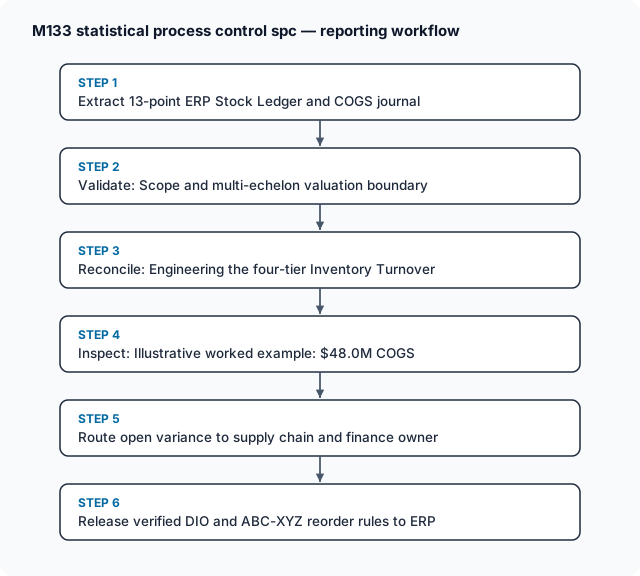
Read the complete workflow as text
- Extract ERP master routing and live shop-floor telemetry → Validate scope and revision boundary for M133
- Validate scope and revision boundary for M133 → Reconcile physical yield and variance thresholds
- Reconcile physical yield and variance thresholds → Inspect worked INR production batch example
- Inspect worked INR production batch example → Route open variance to production and quality owner
- Route open variance to production and quality owner → Release verified M133 posting to ERP ledger
US and India regulatory compliance and statutory audit controls for M133
Multinational manufacturers and domestic Tier-1 suppliers operating across India and the United States must align Statistical Process Control (SPC) and Process Capability (Cp, Cpk): X-Bar R Charts, Nelson Rules and Automated CNC Offset Interlocks with dual-jurisdiction statutory, quality, and tax frameworks. In India, plant operations must satisfy NABL ISO/IEC 17025 master ring-gauge calibration traceability, BIS IS 2700 SQC charting rules, and automotive OEM VDA 5 measurement capability indices (Cg/Cgk >= 1.33). In particular, whenever raw materials, semi-finished castings, sheet remnants, or returnable dunnage move between parent plants and subcontracting job-workers, the ERP ledger must maintain strict challan-level mass balance and return timelines to prevent GST input-tax credit (ITC) reversals and interest penalties.
In North American operations, the same architectural workflow must comply with AIAG SPC 2nd Edition reference manual, Western Electric / Nelson 8 run-chart instability rules, and NIST Handbook 44 metrological uncertainty budgets. Auditors examining defense, automotive, aerospace, or industrial machinery plants verify that electronic signatures, calibration hierarchies, safety lockout interlocks, and inventory cost capitalizations follow tamper-evident audit trails where no single user can both execute a shop-floor override and approve its financial or quality disposition.
By codifying both Indian and US statutory rules into the ERP/MES validation matrix for M133, global engineering teams maintain a single unified template while activating country-specific tax, metrological, and environmental compliance checks via plant-level configuration switches.
| Compliance Dimension | India Statutory & Quality Mandate | US Regulatory & Accounting Mandate | Automated System Control in M133 |
|---|---|---|---|
| Quality & Metrology Governance | NABL ISO/IEC 17025 master ring-gauge calibration traceability, BIS IS 2700 SQC charting rules, and automotive OEM VDA 5 measurement capability indices (Cg/Cgk >= 1.33) | AIAG SPC 2nd Edition reference manual, Western Electric / Nelson 8 run-chart instability rules, and NIST Handbook 44 metrological uncertainty budgets | Enforces dual-signature electronic sign-off and blocks uncertified lot progression |
| Costing & Tax Valuation | ICMAI CAS-4 / CAS-6 & GST ITC-04 / Section 143 Job-Work | US GAAP ASC 330 Inventory & IRS Sec 263A Overhead Capitalization | Segregates normal vs abnormal scrap/idle cost directly in Universal Journal (ACDOCA) |
| Workplace & Equipment Safety | Factories Act 1948 & DISH Statutory Interlock Logs | OSHA 29 CFR 1910 LOTO & Machine Guarding Interlocks | Inhibits machine cycle start if safety light curtain, LOTO permit, or PM interval is violated |
| Audit Trail & Record Retention | Companies Act Section 148 Cost Audit Trail (8 Years) | SOX Section 404 & ISO/IATF Documented Information Control | Immutable change-document logging (CDHDR/CDPOS) on all BOM, routing, and tolerance edits |
Multi-tier exception escalation matrix and MRB disposition rules for M133
Shop-floor exceptions are inevitable under high-velocity manufacturing conditions; the maturity of an enterprise architecture is defined by how rapidly and deterministically it contains, escalates, and resolves those exceptions. For Statistical Process Control (SPC) and Process Capability (Cp, Cpk): X-Bar R Charts, Nelson Rules and Automated CNC Offset Interlocks, the multi-tier Material Review Board (MRB) and engineering escalation matrix replaces ad-hoc verbal workarounds with time-bounded digital workflows.
In M133, Tier-1 exceptions (minor parameter drift within warning limits or brief micro-stops in Manufacturing Operations) are resolved at the operator and line-leader level within 15 minutes using guided standard work instructions on the MES HMI. Tier-2 exceptions (out-of-control rules in Statistical Process Control (SPC) and Process Capability (Cp, Cpk): X-Bar R Charts, Nelson Rules and Automated CNC Offset Interlocks, setup duration overruns exceeding 25%, or batch yield drops across SAP QM inspection lots (QALS/QAMV), Q-DAS ASCII transfer protocol (DFQ), Fanuc FOCAS G10 Dynamic Wear Offset registers, and QM01 defect notifications) automatically page the Area Manufacturing Engineer and Quality Engineer, placing the affected sub-lot into restricted inspection stock (SAP stock type Q or blocked stock S).
Tier-3 critical exceptions in M133 (safety interlock trips, High Action Priority failure modes in Manufacturing Operations, customer PPAP/specification breaches, or unabsorbed cost variances exceeding plant financial thresholds on Statistical Process Control (SPC) and Process Capability (Cp, Cpk): X-Bar R Charts, Nelson Rules and Automated CNC Offset Interlocks) require formal MRB disposition signed by the Plant Quality Head, Production Manager, and Plant Controller before the work center or inventory batch can be released.
| Escalation Tier | Trigger Condition in M133 | Target Containment SLA | Authorized Disposition Roles & System Lock |
|---|---|---|---|
| Tier 1 — Line-Side Containment | Minor drift or single-cycle anomaly in Manufacturing Operations | <= 15 minutes | Cell Operator + Shift Supervisor; automated re-check verification on next 3 consecutive pieces |
| Tier 2 — Engineering & Quality Hold | Breach of control limit in Cp = (USL - LSL) / (6 × sigma_hat) where sigma_h... | <= 2 hours | Manufacturing Engineer + Quality Engineer; automatic transfer to Restricted Batch Stock |
| Tier 3 — Formal MRB & Plant Lock | Critical defect, safety trip, or >5% mass/cost variance in M133 | <= 24 hours | Plant Quality Head + Plant Manager + Finance Controller; full work-center & shipment block |
Competitor capability benchmark and architecture differentiation for M133
Evaluating enterprise software platforms for Statistical Process Control (SPC) and Process Capability (Cp, Cpk): X-Bar R Charts, Nelson Rules and Automated CNC Offset Interlocks requires looking past marketing brochures to inspect how each architecture handles real-time edge telemetry, sub-lot splitting, unit-of-measure reconciliation, and bi-directional financial posting. Tier-1 ERPs excel at corporate financial consolidation and statutory tax compliance, whereas specialized MES/APS platforms provide sub-second machine connectivity and graphical finite scheduling—making the integration contract between them the decisive architectural factor.
When benchmarking SAP S/4HANA (with Digital Manufacturing Cloud or PP-DS), Oracle Fusion Cloud Manufacturing, Siemens Opcenter, Rockwell Plex, Infor CloudSuite Industrial (SyteLine), and mid-market stacks (NetSuite or Tally Prime paired with custom IIoT MES), engineering leaders should test each platform against the exact failure scenarios of M133: offline edge buffering during network cuts, dual-unit batch accounting, and automated cost variance attribution.
| Architecture Capability | Tier-1 ERP Native Only (SAP / Oracle) | Standalone IIoT / Point Dashboard | Integrated Closed-Loop ERP + MES Architecture (M133) |
|---|---|---|---|
| Real-Time Telemetry & Interlocks | Batch/manual shift-end entry; weak machine lock capability | High-frequency charts, but zero lock on ERP inventory or costing | Bi-directional PLC/OPC-UA interlocks paired with atomic ERP material & cost postings |
| Sub-Lot & Genealogy Traceability | Supported via Batch Management but high manual scan overhead | Tracks machine cycles without raw-material heat/invoice link | Automated parent-to-child batch inheritance across splits, rework, remnants, and scrap |
| US & India Statutory Reconciliation | Strong financial ledger, weak physical shop-floor validation | No GST ITC-04, CAS-4, or GAAP ASC 330 cost ledger awareness | Full reconciliation from physical shop-floor scale/counter to statutory tax and cost audit tables |
Parallel pilot rollout and shop-floor cutover checklist for M133
Deploying Statistical Process Control (SPC) and Process Capability (Cp, Cpk): X-Bar R Charts, Nelson Rules and Automated CNC Offset Interlocks across a live manufacturing facility without disrupting customer delivery commitments requires a phased 4-week parallel pilot on a bounded value stream before plant-wide roll-out. During Week 1 (Baseline & Master Data Audit), the cross-functional team audits work-center capacities, BOM scrap factors, gauge calibration certificates, and PLC tag mappings on a representative pilot line, establishing a frozen baseline of current variance and cycle-time loss.
During Week 2 (Shadow Telemetry & Passive Reconciliation for M133), edge connectors in a fuel-injector nozzle grinding line in Hosur, Tamil Nadu holding a ±2.5 micron concentricity tolerance across 85,000 parts/month stream live production counts, downtime reasons, and quality measurements for Statistical Process Control (SPC) and Process Capability (Cp, Cpk): X-Bar R Charts, Nelson Rules and Automated CNC Offset Interlocks into the staging SAP QM inspection lots (QALS/QAMV), Q-DAS ASCII transfer protocol (DFQ), Fanuc FOCAS G10 Dynamic Wear Offset registers, and QM01 defect notifications environment while operators continue legacy reporting—allowing engineers to identify and fix unit-of-measure mismatches, phantom micro-stop triggers, or missing reason codes without blocking production.
During Week 3 (Active Interlock & Exception Gate Testing), the team activates soft and hard interlocks for M133, testing Tier-1 through Tier-3 escalations, MRB holds, and financial variance postings across all three shifts. In Week 4 (Cutover Sign-Off & Standard Work Lock), legacy paper/spreadsheet logs are decommissioned once parallel reconciliation achieves >=99.2% count/mass agreement and 100% financial settlement closure over five consecutive production days.
Frequently asked operational questions on Statistical Process Control (SPC) and Process Capability (Cp, Cpk): X-Bar R Charts, Nelson Rules and Automated CNC Offset Interlocks (M133)
Below are the critical architectural and operational questions raised by Plant Heads, Manufacturing Engineers, Quality Directors, and Cost Controllers when implementing Statistical Process Control (SPC) and Process Capability (Cp, Cpk): X-Bar R Charts, Nelson Rules and Automated CNC Offset Interlocks (M133).
How does Statistical Process Control (SPC) and Process Capability (Cp, Cpk): X-Bar R Charts, Nelson Rules and Automated CNC Offset Interlocks (M133) prevent discrepancies between shop-floor physical inventory and the ERP financial ledger?
By enforcing atomic, event-driven transactions across SAP QM inspection lots (QALS/QAMV), Q-DAS ASCII transfer protocol (DFQ), Fanuc FOCAS G10 Dynamic Wear Offset registers, and QM01 defect notifications using the governing balance (Cp = (USL - LSL) / (6 × sigma_hat) where sigma_hat = R_bar / d2, and Cpk = min((USL - X_double_bar) / (3 × sigma_hat), (X_double_bar - LSL) / (3 × sigma_hat))), the architecture eliminates manual shift-end estimates. Every good part, rework loop, reusable remnant, and scrap quantity is weighed or counted at the work center before the operation confirmation can close.
What US and India regulatory requirements are directly governed by M133?
In India, M133 enforces NABL ISO/IEC 17025 master ring-gauge calibration traceability, BIS IS 2700 SQC charting rules, and automotive OEM VDA 5 measurement capability indices (Cg/Cgk >= 1.33). In the United States, it satisfies AIAG SPC 2nd Edition reference manual, Western Electric / Nelson 8 run-chart instability rules, and NIST Handbook 44 metrological uncertainty budgets, providing a single tamper-evident audit trail across metrology, safety interlocks, and inventory valuation.
How can a plant pilot Statistical Process Control (SPC) and Process Capability (Cp, Cpk): X-Bar R Charts, Nelson Rules and Automated CNC Offset Interlocks without risking production line stoppages during cutover?
For Statistical Process Control (SPC) and Process Capability (Cp, Cpk): X-Bar R Charts, Nelson Rules and Automated CNC Offset Interlocks (M133), execute a 4-week bounded value-stream pilot in Manufacturing Operations: Week 1 cleanses BOM/routing master data in SAP QM inspection lots (QALS/QAMV), Q-DAS ASCII transfer protocol (DFQ), Fanuc FOCAS G10 Dynamic Wear Offset registers, and QM01 defect notifications; Week 2 runs passive shadow telemetry alongside existing logs; Week 3 enables active Tier-1/2/3 exception gates on a single representative cell; and Week 4 cuts over after achieving >=99.2% physical-to-ERP reconciliation accuracy across five consecutive days.
Edge-to-ERP transaction state machine and idempotency controls for Statistical Process Control (SPC) and Process Capability (Cp, Cpk): X-Bar R Charts, Nelson Rules and Automated CNC Offset Interlocks (M133)
Deploying Statistical Process Control (SPC) and Process Capability (Cp, Cpk): X-Bar R Charts, Nelson Rules and Automated CNC Offset Interlocks (M133) across multi-plant manufacturing corridors such as Hosur-TN and Wichita-KS requires a deterministic state-machine contract between shop-floor edge controllers and enterprise ERP tables (PLKO/PLPO routing operations, STKO/STPO bill-of-material items, QALS inspection lots, and ACDOCA universal journal entries). In high-mix production of 2721-unit order lots running at 37-second nominal tact intervals, asynchronous polling between PLC data blocks, MES execution terminals, and financial backflush queues frequently introduces race conditions around Statistical, Process, and Control. Without strict transaction serialization, an operator confirmation for Statistical Process Control (SPC) and Process Capability (Cp, Cpk): X-Bar R Charts, Nelson Rules and Automated CNC Offset Interlocks can post ahead of upstream component goods issue or inline inspection release, corrupting work-in-process (WIP) valuation by more than ±0.36% within a single shift.
To eliminate out-of-order state mutations in M133, every shop-floor event associated with Manufacturing Operations is encapsulated in an idempotent message envelope keyed by Plant, Work Center, Production Order, Operation Sequence, Sub-Lot Split ID, and monotonic PLC sequence counter. When edge gateways capture SPC and Capability signals during active runs, the state machine verifies three preconditions before advancing the operation status: (1) parent batch genealogy and Cpk revision locks match the released manufacturing order; (2) active metrology and poka-yoke interlocks confirm zero unresolved non-conformances; and (3) net mass/piece conservation holds within 42 basis points (0.42%).
When network partitions or ERP maintenance windows occur during Statistical Process Control (SPC) and Process Capability (Cp, Cpk): X-Bar R Charts, Nelson Rules and Automated CNC Offset Interlocks execution, local store-and-forward buffers retain signed telemetry frames for up to 72 hours. Upon reconnection, the replay engine validates timestamp monotonicity against PLKO/PLPO routing operations, STKO/STPO bill-of-material items, QALS inspection lots, and ACDOCA universal journal entries, suppressing duplicate backflushes while preserving the exact chronological sequence of setup transitions, micro-stops, tool offsets, and scrap dispositions required for M133 auditability.
| State Transition in M133 | Precondition Check (Manufacturing Operations) | Authoritative ERP / MES Table (M133) | Failure Containment & SLA (38 min) |
|---|---|---|---|
| Order Release to Line-Side Staging (Statistical) | Active BOM/routing checksum and calibrated Process verification | PLKO/PLPO routing operations | Blocks work-center dispatch and alerts Production Planner within 38 minutes |
| In-Process Execution & Control Capture | Cycle window 37s ± 0.36% with zero active safety/quality lock | STKO/STPO bill-of-material items | Places sub-lot of 2721 units into restricted hold pending engineering review |
| Yield, Rework & Scrap Split (SPC) | Mass/count balance closure within 0.42% across Capability | QALS inspection lots | Routes variance above ±0.36% to Tier-2 MRB queue before Goods Receipt |
| Period-End Financial Settlement (M133) | Zero orphan WIP or uncosted Cpk confirmation errors | and ACDOCA universal journal entries | Prevents order technical completion (TECO) until variance attribution reconciles |
Dual-market US and India statutory, costing, and metrological governance for Manufacturing Operations (M133)
Operating Statistical Process Control (SPC) and Process Capability (Cp, Cpk): X-Bar R Charts, Nelson Rules and Automated CNC Offset Interlocks (M133) across Indian and North American industrial plants demands simultaneous adherence to divergent fiscal, metrological, and workplace-safety statutes. Within Indian manufacturing clusters, every physical transformation governed by Statistical Process Control (SPC) and Process Capability (Cp, Cpk): X-Bar R Charts, Nelson Rules and Automated CNC Offset Interlocks must align with Companies (Cost Records and Audit) Rules under Section 148 (ICMAI Cost Accounting Standards CAS-4, CAS-6, and CAS-10), BIS product conformity standards, and GST Section 143 / Form ITC-04 job-work reconciliation whenever semi-finished Process or Control sub-assemblies move across subcontracting boundaries. Failure to reconcile physical SPC yields within ±0.36% exposes the plant to input-tax credit reversals and statutory cost-audit qualifications.
In United States operations, the identical M133 workflow is scrutinized under US GAAP ASC 330 inventory valuation rules (which prohibit capitalizing abnormal idle capacity or excessive Capability scrap into ending inventory), IRS Section 263A uniform capitalization rules, OSHA 29 CFR 1910 machine-guarding and lockout/tagout (LOTO) records, and sector-specific quality mandates (IATF 16949, AS9100, or FDA 21 CFR Part 820). Specifically, when a 2721-unit production lot experiences an unplanned Cpk excursion, the ERP costing engine must automatically bifurcate normal standard absorption from abnormal period expense in PLKO/PLPO routing operations, STKO/STPO bill-of-material items, QALS inspection lots, and ACDOCA universal journal entries.
By embedding dual-market compliance rules directly into the validation logic of M133, engineering and finance teams avoid maintaining separate regional customizations. Metrological traceability—linking NABL ISO/IEC 17025 and NIST-traceable calibration certificates to every inline X-Bar measurement—is enforced automatically before a batch transfer or customer ASN can be generated.
| Regulatory Pillar (M133) | India Statutory Requirement (Manufacturing Operations) | US Regulatory & GAAP Mandate | Automated Verification Evidence in M133 |
|---|---|---|---|
| Cost Valuation & Scrap Accounting | ICMAI CAS-6 Material & CAS-10 Direct Expense attribution for Statistical | US GAAP ASC 330 normal vs abnormal Process variance split | Automated variance split posting in PLKO/PLPO routing operations, STKO/STPO bill-of-material items, QALS inspection lots, and ACDOCA universal journal entries at lot size 2721 |
| Subcontracting & Inter-Plant Custody | GST Section 143 / ITC-04 challan mass-balance closure within 180/365 days | SOX 404 off-site tolling inventory control and bailment ledger audit | Challan-to-batch reconciliation within ±0.36% tolerance on Control |
| Metrology & Quality Traceability | BIS conformity & NABL ISO/IEC 17025 gauge validity for SPC | NIST traceability, AIAG MSA GRR <= 10%, and electronic signature lock | Hard block on M133 confirmation if gauge calibration or Cpk threshold fails |
Quantitative variance attribution and multi-echelon audit playbook for Statistical Process Control (SPC) and Process Capability (Cp, Cpk): X-Bar R Charts, Nelson Rules and Automated CNC Offset Interlocks (M133)
Sustaining long-term financial and operational accuracy in Statistical Process Control (SPC) and Process Capability (Cp, Cpk): X-Bar R Charts, Nelson Rules and Automated CNC Offset Interlocks (M133) requires decomposing aggregate plant variances into actionable engineering drivers rather than writing off lump-sum inventory adjustments at quarter-end. Across a representative 2721-unit production campaign in Manufacturing Operations, total operational variance is partitioned into four orthogonal components: (1) Input Material & Statistical Yield Drift, measured against the 0.42% baseline scrap allowance; (2) Cycle-Time & Process Micro-Stop Loss around the 37-second reference tact; (3) Tooling, Fixture & Control Offset Degradation; and (4) Schedule Sequence & Changeover Friction across SPC families.
During weekly operational audits of M133, the Manufacturing Engineering and Cost Controlling teams execute a three-way reconciliation comparing physical line-side scale/counter totals, MES historian time-series aggregates, and PLKO/PLPO routing operations, STKO/STPO bill-of-material items, QALS inspection lots, and ACDOCA universal journal entries. Any divergence exceeding ±0.36% or lingering in the exception queue beyond 38 minutes triggers an automated root-cause workflow that locks the offending BOM/routing parameter until empirical time-study or capability re-validation completes.
Before signing off on plant-wide deployment of Statistical Process Control (SPC) and Process Capability (Cp, Cpk): X-Bar R Charts, Nelson Rules and Automated CNC Offset Interlocks, leadership should verify five quantitative readiness gates across three consecutive production weeks: >=99.4% first-pass transaction success without manual COGI/error-queue intervention; <= 0.36% physical-to-book inventory discrepancy across Capability and Cpk; 100% digital traceability from raw heat/lot intake to finished handling unit; <= 38-minute containment SLA on Tier-1 line-side alerts; and zero un-reconciled cost variances at period close.
Operational FAQs — People also ask
Concise answers to common evaluation and implementation questions on statistical process control spc in manufacturing operations.
What is the primary operational control rule for statistical process control spc?
How should quality control teams handle exceptions and approval boundaries?
When should teams use deterministic ERP workflow rules versus AI agents for statistical process control spc?
What is the safest way to evaluate or pilot changes for "Statistical Process Control (SPC) and Process Capability (Cp, Cpk): X-Bar R Charts, Nelson Rules and Automated CNC Offset Interlocks"?
Compare this workflow with your current setup
Share the step that takes the most manual work, the systems involved and the exceptions your team handles. That gives us a concrete starting point for comparing approaches.
Sources and further reading
Sources checked 15 October 2026. Worked examples and workflow diagrams are original illustrations, not reported client results.

