Compare manufacturing quotations on the same technical and commercial basis
For procurement, stores and subcontract operations teams · Compare approaches
TL;DR — what you’ll learn
- Verify drawing revision, material grade and finishing scope before ranking quotations by unit price.
- Normalise one-time tooling, freight and minimum order quantities against the stated evaluation volume while keeping raw supplier figures visible.
- Flag omitted operations or unconfirmed tolerances as explicit open questions rather than plugging in an assumed cost.
- Keep technical eligibility with engineering and quality reviewers; the comparison worksheet prepares the commercial and scope matrix.

Illustrative factory raw-material stores and receiving counter; not a client facility.
Three vendors quote on a sheet-metal control enclosure (ENC-210, Revision C) for an initial requirement of 500 units. Vendor A quotes ₹1,420 per unit, Vendor B quotes ₹1,510 per unit, and Vendor C quotes ₹1,360 per unit. A price-only summary ranks Vendor C first. Reading the footnotes reveals that Vendor C quoted against obsolete Revision B, excluded powder coating, and stipulated a 1,000-unit minimum order quantity (MOQ).
This guide describes a structured comparison worksheet that separates technical scope verification from commercial normalisation. Engineering and quality reviewers retain authority over material or revision concessions, and procurement retains commercial award sign-off.
Separate scope completeness from normalised batch cost
Consider an original illustrative comparison for 500 units of ENC-210 (Revision C, cold-rolled steel with 60-micron powder coat and captive fasteners installed).
Scroll horizontally to see all columns.
| Comparison dimension | RFQ baseline requirement | Vendor A quote | Vendor B quote | Vendor C quote | Normalisation & scope status |
|---|---|---|---|---|---|
| Drawing revision quoted | Rev C | Rev C | Rev C | Rev B (superseded) | Vendor C technical mismatch |
| Quoted MOQ (units) | 500 | 500 | 250 | 1,000 | Vendor C requires 2× volume commitment |
| Ex-works piece price (₹/unit) | — | ₹1,420 | ₹1,510 | ₹1,360 | Raw piece prices not directly comparable |
| Finishing & hardware scope | Powder coat + fasteners | Included in piece price | Included in piece price | Excluded (raw formed shell only) | Vendor C missing two routed operations |
| Inbound freight for 500 units (₹) | Delivered plant | ₹15,000 (₹30/unit) | Included (₹0) | ₹20,000 (at 1,000-unit lot) | Added to comparable batch total |
| Dedicated fixture / NRE charge (₹) | Customer-owned fixture | ₹65,000 | ₹25,000 | ₹0 (existing Rev B tool) | Amortised over 500 units for initial batch comparison |
| 500-unit comparable batch cash outlay (₹) | 500 complete Rev C units | ₹7,90,000 (₹1,580/unit) | ₹7,80,000 (₹1,560/unit) | Incomplete scope (₹13,80,000 MOQ outlay before coating) | Vendor B lowest complete 500-unit cost; Vendor C blocked |
The arithmetic makes the commercial and technical trade-offs explicit:
- Vendor A (complete scope): 500 × ₹1,420 = ₹7,10,000, plus ₹15,000 freight and ₹65,000 dedicated fixture = ₹7,90,000 total (₹1,580 per unit over 500 units).
- Vendor B (complete scope): 500 × ₹1,510 = ₹7,55,000, plus ₹0 freight and ₹25,000 fixture = ₹7,80,000 total (₹1,560 per unit over 500 units). If a second 500-unit batch is ordered later without repeat tooling, Vendor A's recurring landed cost (₹1,450/unit) drops below Vendor B's (₹1,510/unit), so the break-even volume is 667 units (₹40,000 NRE delta ÷ ₹60/unit recurring delta).
- Vendor C (incomplete scope): Quoted against Rev B without powder coating or fasteners, and its 1,000-unit MOQ demands ₹13,60,000 plus ₹20,000 freight (₹13,80,000 cash commitment) for unfinished parts. It remains ineligible until re-quoted to Rev C.
Documentation for Microsoft purchase requisition workflows and engineering change management illustrates how requisition lines and active engineering revisions are governed in ERP systems.
Compare manufacturing quotations on the same technical and commercial basis — reporting workflow
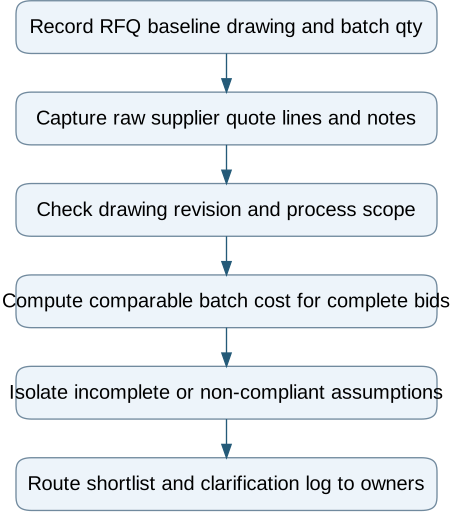
Follow the workflow below, or open its complete text version.
Read the complete workflow as text
- Record RFQ baseline drawing and batch qty → Capture raw supplier quote lines and notes
- Capture raw supplier quote lines and notes → Check drawing revision and process scope
- Check drawing revision and process scope → Compute comparable batch cost for complete bids
- Compute comparable batch cost for complete bids → Isolate incomplete or non-compliant assumptions
- Isolate incomplete or non-compliant assumptions → Route shortlist and clarification log to owners
Preserve raw supplier numbers alongside normalised totals
Never overwrite a supplier's quoted unit price with an estimated surcharge for missing plating or heat treatment. If a buyer plugs in an internal guess to force a total, a downstream reviewer cannot tell what the supplier actually committed to deliver. Keep missing scope rows marked as clarification_required and withhold a normalised total until the supplier issues a revised quotation or the buyer attaches an approved subcontract quote for the omitted operation.
Validate the comparison template on recent multi-quote RFQs
Before embedding quotation comparison into an ERP portal or workflow tool, test the layout on five recent RFQs that involved tooling charges, tiered MOQs or drawing revisions. Confirm that another buyer and an engineering reviewer can independently reconstruct the 500-unit outlay and break-even quantity from the saved table without opening email attachments.
Compare this workflow with your current setup
Share the step that takes the most manual work, the systems involved and the exceptions your team handles. That gives us a concrete starting point for comparing approaches.
Sources and further reading
Sources checked 15 October 2026. Worked examples and workflow diagrams are original illustrations, not reported client results.
