Reconcile a manufacturing job cost sheet before comparing margin
For finance, costing and accounts teams · Understand the problem
TL;DR — what you’ll learn
- Treat the cost basis, rates and included amounts as supplied inputs.
- Check source identifiers and overlapping components before adding the figures.
- Label a management comparison so readers can see its exclusions.
- Preserve the earlier statement when late inputs change the calculation.
A job-cost sheet looks precise until someone discovers that a subcontract amount includes material already counted elsewhere. The useful first task is to reconcile the supplied figures. Choosing an accounting policy and adding numbers correctly are different pieces of work.
This article covers the latter: a management worksheet built from externally supplied, valued amounts. It does not prescribe valuation, overhead rates, revenue recognition or statutory reporting treatment.
Add the stated components once
The following original illustration takes ₹150,000 as a supplied comparison basis and assumes the four cost components do not overlap. Tax, financing, selling costs and other company-level costs are excluded.
Scroll horizontally to see all columns.
| Supplied component | Stated calculation or amount | Included cost |
|---|---|---|
| Materials | ₹86,000 issues less ₹6,000 return | ₹80,000 |
| Labour | Supplied valued amount | ₹25,000 |
| Subcontract service | Supplied amount excluding material above | ₹15,000 |
| Overhead | Supplied allocation | ₹10,000 |
| Total included cost | Sum of the four rows | ₹130,000 |
The stated comparison difference is ₹150,000 − ₹130,000 = ₹20,000, or 13.33% of the supplied ₹150,000 basis after rounding. Call it the margin on this stated management basis. It is not a conclusion about company profit or when revenue should be recognized.
The arithmetic assumes that the supplied return reduces this view by ₹6,000 and that labour and overhead do not overlap. If either assumption is unresolved, display it as an unresolved input. Do not silently choose a treatment to produce a final-looking percentage.
Microsoft's production-order analysis distinguishes component, routing and indirect costs in its own reporting model. That is a useful source-system example, not a prescribed accounting policy for this worksheet. Microsoft production-order cost analysis.
Reconcile a manufacturing job cost sheet before comparing margin — reporting workflow
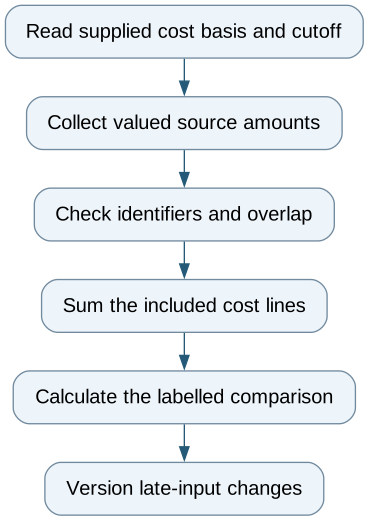
Follow the workflow below, or open its complete text version.
Read the complete workflow as text
- Read supplied cost basis and cutoff → Collect valued source amounts
- Collect valued source amounts → Check identifiers and overlap
- Check identifiers and overlap → Sum the included cost lines
- Sum the included cost lines → Calculate the labelled comparison
- Calculate the labelled comparison → Version late-input changes
Trace each amount to its source
Retain job identifier, source line, currency, supplied valuation basis, event date, reporting cutoff and correction reference. Do not add purchase commitments to actual-cost inputs unless the supplied view explicitly includes them as a separately labelled category.
A duplicate import is a data problem; an uncertain overhead allocation is a policy input requiring its owner. Keep those exception types separate. The worksheet can detect two identical source keys but cannot decide whether two differently named cost components represent the same economic cost without a definition from their owner.
Show what a late input changes
Suppose the owner supplies an additional ₹4,000 subcontract charge for inclusion in a revised version of this same comparison. The new included cost is ₹134,000 and the difference is ₹16,000. Preserve the previous ₹130,000 statement and show the added source reference.
This arithmetic says nothing about closed-period posting or accrual treatment. Those choices are outside the worksheet. A pending charge can appear as an unresolved item without being invented as a valued transaction.
Use a worksheet to establish the first reconciliation. Native ERP reports may already supply most of the figures. Integration is useful when source completeness and versioning repeatedly fail; the linked job-cost import article covers that separate problem.
Test a duplicate line, material return, overlapping component and late charge. The result should explain every change from the source rows and keep unresolved assumptions visible before anyone uses the figure for a commercial decision.
Recognise this problem in your operation?
Tell us where the records or handovers break down. We can discuss the process, data and software questions worth examining first.
Sources and further reading
Sources checked 15 October 2026. Worked examples and workflow diagrams are original illustrations, not reported client results.