Plan imported-component milestones around usable factory stock
For procurement, stores and subcontract operations teams · Compare approaches
TL;DR — what you’ll learn
- Single-date purchase order tracking hides international transit bottlenecks until a shipment misses its plant dock window; decomposing import lead time into 5 explicit milestones exposes schedule drift 10 to 20 days before assembly starvation.
- Goods Receipt Notes (GRNs) should post using finance-approved provisional landed-cost accruals (FOB base, freight/insurance, non-recoverable import duties, broker/terminal charges, and inland haulage) rather than raw foreign-currency unit price.
- Recoverable import tax credits should follow the entity finance owner's tax sub-ledger policy rather than inflating inventory unit cost, while avoidable container demurrage is isolated as an exception variance.
- In a reconciled 500-unit servo drive import (IMP-PO-2026-104), tracking stage-level milestones surfaces a +5-day net transit slip (28 planned vs 33 actual days) and reconciles a ₹57,80,000 settled landed cost against a ₹57,00,000 provisional accrual (+1.40% variance).

Illustrative factory raw-material stores and receiving counter; not a client facility.
Why single-date PO tracking fails international component supply
When a domestic purchase order slips by forty-eight hours, a buyer can usually expedite a truck and recover the assembly schedule within the same week. Imported electronics, precision bearings, magnetics and specialty hydraulic cartridges operate under a different failure regime. A thirty-day import lead time is a chain of handoffs across the supplier's export dock, origin forwarder, ocean carrier, destination port terminal, customs broker, container freight station (CFS) and domestic transporter.
Most ERP setups store a single header-level Promised Delivery Date on the purchase order and value the item at its foreign-currency unit price until accounting manually posts freight and broker bills weeks later. That design creates two operational blind spots:
- Late visibility of upstream milestone slips: If a supplier finishes pre-shipment inspection two days late in Osaka and misses the weekly vessel cut-off in Kobe, the shipment is already delayed by a sailing cycle—yet the ERP still shows the original Pune dock receipt date as green for another three weeks.
- Distorted inventory valuation at receipt: If the storekeeper posts the Goods Receipt Note (GRN) at the raw FOB price of
₹10,080/unitso production can issue the parts immediately, work-in-progress (WIP) absorbs understated material cost, while subsequent duty and terminal bills land in unallocated variance accounts.
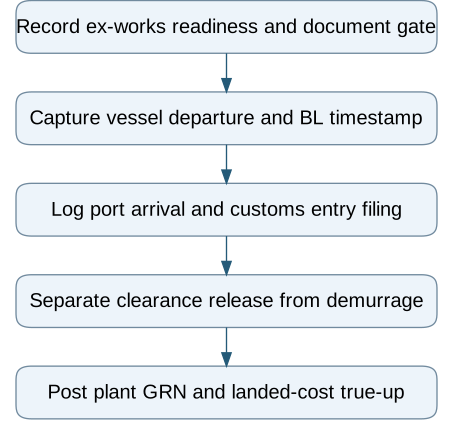
Plan imported-component milestones around usable factory stock — reporting workflow
Follow the workflow below, or open its complete text version.
Read the complete workflow as text
- Record ex-works readiness and document gate → Capture vessel departure and BL timestamp
- Capture vessel departure and BL timestamp → Log port arrival and customs entry filing
- Log port arrival and customs entry filing → Separate clearance release from demurrage
- Separate clearance release from demurrage → Post plant GRN and landed-cost true-up
Five-stage milestone and landed-cost control architecture
To keep Material Requirements Planning (MRP) and inventory costing aligned, an import procurement workflow links physical transit milestones with finance-approved accrual buckets:
Stage 01 — Ex-works readiness and pre-shipment inspection (PSI)
Before the supplier books origin pickup, purchasing verifies the commercial invoice, packing list, tariff classification, certificate of origin and inspection certificates. Currency translation locks at the provisional booking rate and updates according to the finance owner's customs-entry exchange policy.
Stage 02 — Origin port gate-in and Bill of Lading (BL) confirmation
Once the consignment clears export formalities and boards the vessel, the forwarder records the Bill of Lading number, vessel/voyage ID and actual departure date (ATD). At this gate, the planning report recalculates downstream arrival dates from the transit table and accrues ocean freight plus marine insurance.
Stage 03 — Destination port arrival and customs entry filing
When the customs broker files the import entry, the cost sheet separates levies according to company accounting policy:
- Inventoriable non-recoverable duties: Illustrative basic customs duty and surcharge lines that attach to item landed cost.
- Recoverable tax credits: Illustrative recoverable import tax lines that route to the tax credit sub-ledger rather than inflating inventory unit cost.
Stage 04 — Customs clearance release and CFS gate-out
If a consignment is held for physical examination or a technical catalogue query, the shipment incurs extra storage and detention days. Separating routine agency and terminal handling charges (THC) from avoidable demurrage lets procurement distinguish structural landed cost from documentation-delay penalties.
Stage 05 — Inland haulage, plant GRN and landed-cost true-up
When the vehicle reaches the factory gate and passes incoming inspection, stores posts the GRN using the Stage 01–05 provisional landed-cost sheet. When final broker and transporter invoices settle, finance posts the landed-cost variance adjustment across remaining on-hand stock and open WIP orders.
Worked example: 500 imported servo drives (IMP-PO-2026-104)
Consider an illustrative industrial automation manufacturer in Pune importing 500 units of 400W AC servo drives (PART-SRV-400W) from Osaka under FOB Kobe terms on purchase order IMP-PO-2026-104:
- Base FOB invoice value:
500 units × $120.00/unit = $60,000.00. At an illustrative customs exchange rate of₹84.00/$, the base merchandise value is ₹50,40,000 (₹10,080.00/unit). - Standard provisional landed accrual: ₹57,00,000 (
₹11,400.00/unit), representing a 13.10% landed uplift over FOB across a planned 28-day door-to-door lead time. - Recoverable import tax credit (excluded from inventory cost): Under the entity's tax policy, an illustrative
18%recoverable tax on(Assessable CIF ₹52,25,000 + non-recoverable duty ₹4,31,063) = ₹56,56,063equals ₹10,18,091, posted to the tax credit receivable ledger rather than inventory value.
The table below reconciles the planned versus actual schedule and inventoriable landed cost across all five milestones:
Scroll horizontally to see all columns.
| Milestone ID & stage | Planned duration (cum. day) | Actual duration (cum. day) | Schedule drift | Cost component | Planned accrual (₹) | Actual settled (₹) | Cost variance (₹) |
|---|---|---|---|---|---|---|---|
STAGE-01 Ex-works readiness & PSI |
0d (Day 0) | 2d (Day 2) | +2d slip | Base FOB invoice ($60,000 @ ₹84) |
50,40,000 | 50,40,000 | 0 |
STAGE-02 Origin port & BL departure |
5d (Day 5) | 5d (Day 7) | +0d stage (+2d cum.) | Ocean freight & marine insurance | 1,60,000 | 1,85,000 | +25,000 |
STAGE-03 Port arrival & customs filing |
18d (Day 23) | 19d (Day 26) | +1d stage (+3d cum.) | Non-recoverable customs duty (8.25% of CIF) | 4,29,000 | 4,31,063 | +2,063 |
STAGE-04 Clearance release & CFS gate-out |
3d (Day 26) | 5d (Day 31) | +2d stage (+5d cum.) | Broker fee, THC & 2-day CFS demurrage | 46,000 | 98,937 | +52,937 |
STAGE-05 Inland haulage & plant GRN |
2d (Day 28) | 2d (Day 33) | +0d stage (+5d cum.) | Container transport (port to Pune plant) | 25,000 | 25,000 | 0 |
| Total reconciled shipment | 28d (Day 28) | 33d (Day 33) | +5d net slip | Total inventoriable landed cost (500 units) | 57,00,000 | 57,80,000 | +80,000 (+1.40%) |
Operational and financial takeaways from the ledger
- Early schedule re-alignment: Because
STAGE-01recorded a+2dslip on Day 2 andSTAGE-03updated vessel arrival on Day 26, planners shifted dependent panel-wiring work orders five days earlier than a dock-only tracker, allowing production to advance domestic cabinet fabrication without idle assembly labour. - Exact unit valuation: The settled landed cost is ₹57,80,000 across 500 units, or ₹11,560.00/unit (a 14.68% uplift over the
₹10,080.00/unitFOB price). Valuing the receipt at FOB alone would understate stock value by ₹7,40,000 (₹1,480.00/unit). - Root-cause variance isolation: Of the +₹80,000 landed-cost variance (
₹160.00/unit), ₹25,000 came from a carrier surcharge (driving an automatic +₹2,063 increase in ad-valorem duty on CIF), while ₹52,937 resulted from a two-day customs catalogue query—prompting purchasing to attach signed technical data sheets prior to vessel arrival.
Implementation checklist for ERP import workflows
- Pre-alert document gate: Require commercial invoice, packing list, tariff code and inspection documents before confirming vessel dispatch.
- Milestone-driven date propagation: Recalculate expected usable-stock dates at each milestone update (
ATD, revisedETA, entry filing, clearance release) and flag pegged work orders whose buffer drops below zero. - Finance-approved apportionment rules: Apportion freight, marine insurance, non-recoverable duties and broker charges using rules signed off by the finance owner.
Compare this workflow with your current setup
Share the step that takes the most manual work, the systems involved and the exceptions your team handles. That gives us a concrete starting point for comparing approaches.
Sources and further reading
Sources checked 15 October 2026. Worked examples and workflow diagrams are original illustrations, not reported client results.