Keep customer-owned material separate from company stock
For stores, inventory control and production teams · Compare approaches
TL;DR — what you’ll learn
- Receiving customer-supplied free-issue material (FIM) into standard valuated inventory inflates the contract manufacturer's balance-sheet inventory assets and distorts conversion gross margins.
- Customer-owned inventory should sit in a non-valuated (₹0 asset) ownership partition that still records unit memorandum value for plant insurance coverage and customer challan reconciliation.
- Shop-floor rejects on customer-supplied stock must separate pre-existing raw-blank defects (customer fault) from process scrap within the contractual allowance and excess process scrap rechargeable to the manufacturer.
- In a 400-unit titanium valve machining contract (JW-2026-118), ownership segregation reconciles all 400 physical forgings (₹34,00,000 memorandum value at ₹0 company asset cost) and settles the net conversion billing of ₹4,80,950.

Illustrative factory raw-material stores and receiving counter; not a client facility.
Why standard inventory valuation breaks on customer-supplied stock
In precision machining, automotive tier-supply and electronics contract manufacturing, OEM customers frequently buy high-value castings, forgings or proprietary integrated circuits directly and supply them as Free-Issue Material (FIM) (also called customer-owned or bailment stock). The contract manufacturer provides machine time, tooling and inspection, billing only a conversion fee per finished piece.
When a plant lacks a dedicated customer-ownership partition, storekeepers often receive those parts using a standard Goods Receipt Note at either a dummy price of ₹1 or the customer's declared challan price. Both workarounds create operational and financial errors:
- Valuated receipt at customer challan price: Overstates company-owned raw material assets, creates a phantom payable to the customer and distorts gross-margin percentages when the finished part ships at a conversion-only price.
- Dummy
₹1receipt in shared bins: Hides the ₹34,00,000 bailment custody exposure sitting on the shop floor, fails to prevent cross-allocation to another customer's order when part numbers match, and leaves finance without a ledger when machining scrap exceeds the contractual allowance.
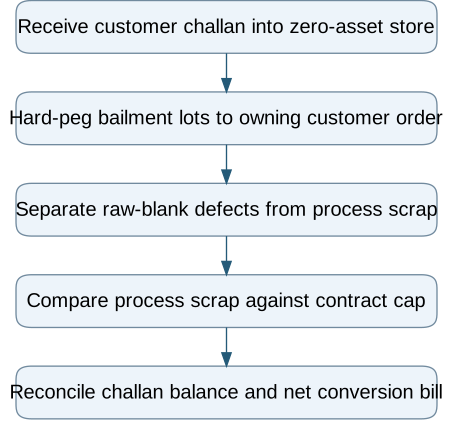
Keep customer-owned material separate from company stock — reporting workflow
Follow the workflow below, or open its complete text version.
Read the complete workflow as text
- Receive customer challan into zero-asset store → Hard-peg bailment lots to owning customer order
- Hard-peg bailment lots to owning customer order → Separate raw-blank defects from process scrap
- Separate raw-blank defects from process scrap → Compare process scrap against contract cap
- Compare process scrap against contract cap → Reconcile challan balance and net conversion bill
Four pillars of customer-owned inventory governance
1. Zero-asset balance-sheet isolation with memorandum valuation
Every customer-supplied receipt carries ownership = CUSTOMER_BAILMENT and company_asset_value = ₹0.00. Simultaneously, the receipt stores the customer's declared unit value (memo_unit_value = ₹8,500) in an off-balance-sheet memorandum register used for plant insurance declarations and contractual scrap-exposure reporting.
2. Hard customer-order pegging
Even when two OEM customers supply physically identical bearings, connectors or alloy blanks, the ERP reservation rule hard-pegs each inward lot to its owning customer_id and inward challan number. Material planning never nets one customer's bailment stock against another customer's demand or internal make-to-stock jobs.
3. Three-way reject classification at inspection
When a customer-supplied forging fails during machining, quality inspection classifies the reject into one of three disposition buckets before closing the operation:
- Raw material / inclusion defect (
MRB-CUST-FAULT): Internal porosity, crack or dimensional short-fill present in the customer's raw blank uncovered during initial roughing. Returned to the customer without scrap penalty (and billed for agreed rough-machining proof-cut recovery where specified by contract). - Contractual allowance scrap (
SCRAP-FIM-ALLOW): Normal setup and tool-wear rejects within the contractually agreed allowance cap (for example, up to2.00%of inward batch quantity). - Excess process scrap (
SCRAP-FIM-EXCESS): Operator or fixture errors above the contractual allowance cap, which trigger a material debit at the contractually agreed replacement value.
4. Piece-by-piece challan conservation
Customer audit rules and commercial job-work controls require 100% quantity conservation against every inward challan: Dispatched Good Units + Certified Open WIP + Raw Defect Returns + Scrap Units Returned = Total Challan Units Received.
Worked example: 400 free-issue titanium valve bodies (JW-2026-118)
Illustrative OEM customer CUST-AERO-07 ships 400 raw forged Ti-6Al-4V valve bodies (FIM-TI-6AL4V) on inward challan CH-IN-8821 for 5-axis CNC machining under contract JW-2026-118:
- Customer declared memorandum value:
₹8,500/unit(₹34,00,000 total custody exposure; ₹0 on the manufacturer's balance-sheet asset ledger). - Contractual conversion fee:
₹1,400/unitfor completed machined valves, plus₹350/unitOperation-10 proof-cut recovery when a raw forging is rejected for subsurface casting porosity. - Contractual process scrap allowance: 2.00% of inward quantity (8 units across the 400-unit challan); any process scrap above 8 units is debited at the agreed ₹8,500/unit forging value.
At month-end settlement, the reconciliation report accounts for all 400 physical units and their billing impact:
Scroll horizontally to see all columns.
| Stock disposition bucket | Physical units | Share of challan (%) | Off-balance-sheet memo value (₹) | Company asset ledger (₹) | Conversion billing / penalty impact (₹) | Challan & physical disposition |
|---|---|---|---|---|---|---|
Dispatched good machined units (DC-OUT-401..404) |
360 | 90.00% | 30,60,000 | 0 | +5,04,000 (360 × ₹1,400) | Shipped on return delivery challans |
Certified active WIP at CNC & CMM (WIP-LOC-B2) |
22 | 5.50% | 1,87,000 | 0 | 0 (billed upon dispatch) | Open balance on challan CH-IN-8821 |
Raw forging porosity hold (MRB-CUST-09) |
7 | 1.75% | 59,500 | 0 | +2,450 (7 × ₹350 Op-10 cut) | Returned on customer-fault defect challan |
Allowed process scrap (SCRAP-FIM-ALLOW, ≤ 2.00% cap) |
8 | 2.00% | 68,000 | 0 | 0 (within 8-unit allowance) | Red-tagged bodies returned to customer |
Excess process scrap (SCRAP-FIM-EXCESS, above 2.00% cap) |
3 | 0.75% | 25,500 | 0 | -25,500 (3 × ₹8,500 debit) | Red-tagged bodies returned; credit note issued |
Total reconciled challan (JW-2026-118) |
400 | 100.00% | 34,00,000 | 0 | +4,80,950 net settlement | 400 / 400 units 100% accounted for |
Why this reconciliation protects margin and customer audits
- Clean financial statements: Throughout the month, the contract manufacturer's inventory asset ledger remains ₹0, while the custody report tracks the remaining ₹1,87,000 (22 units) of open customer property on the shop floor.
- Protected defect attribution: Because the 7 porous forgings (
MRB-CUST-09) were isolated at Operation 10 with inspection evidence and excluded from the process-scrap counter, the plant avoided an erroneous ₹59,500 material penalty and recovered ₹2,450 for the initial proof cuts. - Exact net billing: Out of 11 total machining rejects (
8 + 3), the report applies the 8-unit contractual allowance and deducts only the 3 excess fixture-error units (-₹25,500), yielding a reconciled net invoice of ₹4,80,950 (₹5,04,000 + ₹2,450 - ₹25,500).
Implementation checklist for customer-owned stock control
- Dedicated non-valuated store code: Route all customer-supplied receipts into
WH-FIM-CUSTwhere general-ledger inventory asset posting is disabled. - Configurable challan aging alerts: Set automated review alerts (for example at
60,90and120 daysaccording to contract and finance policy) so planners reconcile open challans on time. - Mandatory inspection evidence on raw defects: Require inspection records on every
MRB-CUST-FAULTdisposition before excluding the unit from the process-scrap calculation.
Compare this workflow with your current setup
Share the step that takes the most manual work, the systems involved and the exceptions your team handles. That gives us a concrete starting point for comparing approaches.
Sources and further reading
Sources checked 15 October 2026. Worked examples and workflow diagrams are original illustrations, not reported client results.