Reconcile job-work material through partial returns and process loss
For procurement, stores and subcontract operations teams · Plan implementation
TL;DR — what you’ll learn
- Give each dispatch and return a stable identity, quantity basis and link to the subcontract operation.
- Reconcile processing outcomes and physical custody separately; classified scrap may still be at the supplier.
- Pilot one operation and supplier group before expanding to more complex transformations.
- Keep stock adjustments, loss acceptance and tax treatment with their authorised owners.
A subcontractor returns part of a job, sends a processing invoice and reports that the rest is nearly finished. The factory's spreadsheet reduces the open balance by the invoice quantity. A week later, rejected pieces come back and nobody can explain what material remains outside.
Job work software should maintain a physical material account independently of the service bill. A return can be received, rejected or awaiting inspection; an invoice can be disputed. Those facts must stay connected without being treated as interchangeable evidence.
Start with a balance that preserves unresolved material
In this illustrative one-for-one operation, 240 blanks are dispatched. The same piece unit applies throughout; the process does not combine or split blanks.
| Accounted outcome | Pieces | Evidence |
|---|---|---|
| Accepted processed returns | 180 | Linked receipt and quality decision |
| Rejected pieces physically returned | 12 | Receipt into controlled rejection status |
| Confirmed scrap still at supplier | 6 | Approved scrap classification; return or disposal still pending |
| Processing outcome outstanding | 42 | Balance requiring supplier/location confirmation |
| Total | 240 | Equals the dispatch quantity |
This processing account totals 240, but only 192 pieces have physically returned: 180 + 12. The supplier-custody ledger still carries 48: six confirmed scrap pieces plus 42 with processing outcome outstanding. Scrap classification alone does not prove disposal or remove the material from custody accountability. Retain the six until an authorised return or disposal event is evidenced.
If the supplier confirms only 30 of the 42 outstanding pieces, 36 are confirmed at the supplier including the six scrap pieces, and 12 remain unexplained. The 48-piece ledger balance is not proof of the location of all 48. Do not add the 30 as another outcome: it is a breakdown of the 42. An expected loss allowance cannot replace evidence of actual scrap and its approved treatment.
For operations involving weight change, splits or combined inputs, use an approved conversion/yield model and reconcile each required quantity basis. Do not apply the one-for-one formula indiscriminately.
ERPNext documents subcontract material transfers, receipts and consumption settings. Those features provide a starting model to test in the deployed version; they do not establish the factory's loss or tax policy. ERPNext subcontracting.
Reconcile processing and custody separately
Scroll horizontally to explore the full diagram, or open the text version below.
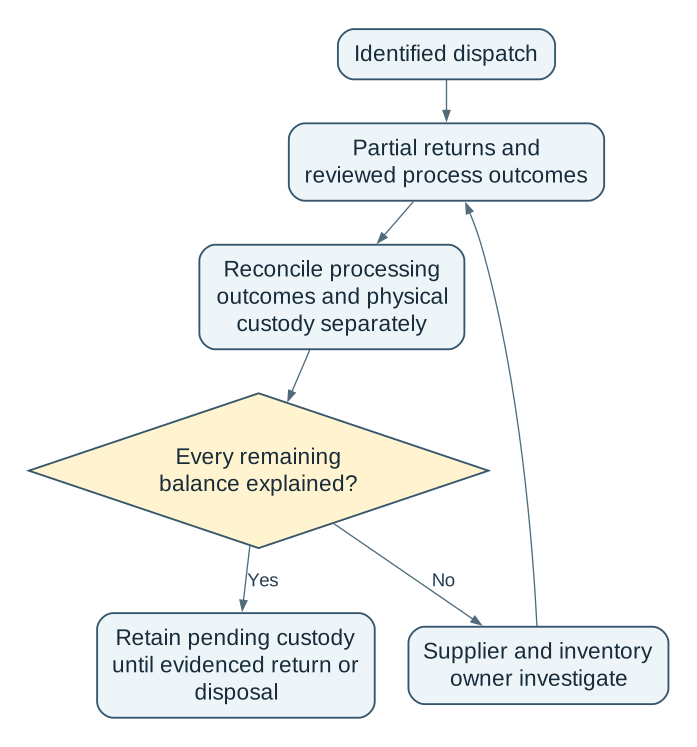
Read the complete workflow as text
- Identified dispatch → Partial returns and reviewed process outcomes
- Partial returns and reviewed process outcomes → Reconcile processing outcomes and physical custody separately
- Reconcile processing outcomes and physical custody separately → Every remaining balance explained?
- Every remaining balance explained? → No: Supplier and inventory owner investigate
- Every remaining balance explained? → Yes: Retain pending custody until evidenced return or disposal
- Supplier and inventory owner investigate → Partial returns and reviewed process outcomes
Bound the pilot around one outside operation
Choose one plant, one subcontract operation and a small supplier group. Include dispatch, partial return, quality status, approved loss, rework movement and period-end reconciliation. Leave tax filing and automatic stock adjustment outside the pilot unless separately specified and reviewed.
Required records include subcontract order, source job/BOM revision, dispatch line, material identity, quantity/unit, supplier location, receipt, inspection/disposition and correction reference. Preserve customer-owned versus company-owned material where relevant. Link the processing bill as a separate financial record.
Stores owns physical dispatch and return evidence. Production validates the operation and consumption basis. Quality owns rejection/disposition; procurement pursues supplier explanations; inventory control and finance approve adjustments within policy. An unexplained balance should have an owner and age, not an automatic scrap code.
Make partial returns and reversals repeatable
Use immutable source event identifiers and a reviewed correction mechanism. A duplicate receipt upload must not reduce the outstanding balance again. A cancelled dispatch should not be reversed if material has already left and a different correction is required. The source owner resolves that conflict.
When rejected pieces are sent out for rework, link the new movement to the rejection and original material identity. Keep the first processing pass and second pass distinguishable. Otherwise rework can look like a new raw-material supply or an extra finished return.
Integrate ERP stock/work orders with dispatch and return capture through supported interfaces. If the supplier reports progress in a portal or file, label it as supplier-reported until the relevant event is confirmed. AI can extract a delivery document for review; it should not approve a disputed loss.
Establish the baseline and exit evidence
Before changing the process, measure unexplained outstanding quantity, ageing and reconciliation effort over at least one representative completed return cycle. Record which quantities are confirmed, estimated or unresolved. A shorter report does not prove better control if it simply writes off the open balance.
Run a shadow ledger alongside approved records. Test both balances in the 240-piece example, duplicate receipt, wrong unit, rejected return, scrap awaiting disposal, disputed loss and corrected dispatch. Require source totals and the pilot ledger to reconcile; every remaining difference must retain an owner and reason.
Agree exit criteria around those invariants and locally chosen operating measures. For this bounded pilot, all seeded duplicate/correction cases should preserve quantity once, and no stock adjustment should occur without the required approval. Improvement targets follow the baseline rather than a promised savings percentage.
If reconciliation fails, retain the existing source ledger and manual review process. Pause new automated postings, preserve the event queue and resolve differences before replay. Any posted financial or stock correction follows its approved reversal procedure.
A dependable job-work account explains both the processing outcome and who still holds the material. The 48-piece custody balance stays visible even though six pieces already have an approved scrap classification.
- Reconstruct one completed subcontract cycle by dispatch and material identity.
- Agree quantity bases and ownership of loss, rejection and unexplained balance.
- Shadow the bounded ledger through partial returns and corrections before enabling postings.
NextEdge Labs can help scope that reconciliation across your ERP and supplier records. Share the operation, system names and typical exception pattern to begin.
Scope this automation around your operation
Tell us your current systems, transaction volume and the exception you need to resolve. We can discuss a focused first release, its review controls and how to measure the result.
Sources and further reading
Sources checked 15 October 2026. Worked examples and workflow diagrams are original illustrations, not reported client results.