Release engineer-to-order work in stages without losing design control
For production managers, planners and plant leaders · Compare approaches
TL;DR — what you’ll learn
- Waiting for 100% engineering completion before releasing an Engineer-to-Order (ETO) Bill of Materials makes on-time delivery impossible when servo drives and indexers carry 8-to-10-week supplier lead times, while releasing preliminary drawings wholesale floods the machine shop with rework.
- Progressive Gate Release partitions the project BOM into four independent release packages (G1 Long-Lead Buy, G2 Base Structural Frame, G3 Precision Part-Contact Tooling, and G4 Electrical Harness & FAT Integration), each unlocked by a named freeze artifact.
- Each release gate defines permitted downstream work and blocks finish CNC machining on customer-interface geometry until golden-sample or General Arrangement (GA) sign-off is recorded.
- On a ₹1,20,00,000 custom rotary indexing machine (ETO-PRJ-2026-08 with a ₹75,00,000 cost budget across 180 BOM lines), holding Gate G3 until golden-sample validation intercepted a 4.0 mm customer housing change (ECO-CUST-04) before hardening 8 precision nests, avoiding ₹3,80,000 in scrapped tooling.

Illustrative manufacturing inspection room and machine shop floor; not a client facility.
The ETO release dilemma: schedule compression versus rework scrap
In Engineer-to-Order (ETO) manufacturing—custom automation lines, special-purpose machinery, industrial furnaces and process skids—the total contract window (often 14 to 18 weeks) is shorter than the sum of detailed mechanical/electrical design (8–10 weeks), long-lead component procurement (8–10 weeks) and shop-floor fabrication/assembly (6–8 weeks).
Plants that manage ETO projects with a single monolithic BOM release status (DRAFT versus RELEASED) fall into one of two failure modes:
- Late monolithic release: Engineering holds the entire 180-item BOM until every sensor bracket and cable gland is detailed in Week 9, causing purchasing to order 8-week cam indexers two months too late.
- Uncontrolled early release: Project managers pressure engineering to release the entire preliminary BOM in Week 3 so the shop starts cutting metal. Two weeks later, when the customer updates their part geometry, the shop has already welded the frame or hardened precision nests that must now be scrapped.
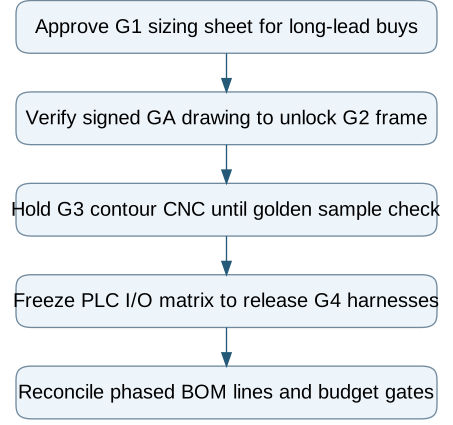
Release engineer-to-order work in stages without losing design control — reporting workflow
Follow the workflow below, or open its complete text version.
Read the complete workflow as text
- Approve G1 sizing sheet for long-lead buys → Verify signed GA drawing to unlock G2 frame
- Verify signed GA drawing to unlock G2 frame → Hold G3 contour CNC until golden sample check
- Hold G3 contour CNC until golden sample check → Freeze PLC I/O matrix to release G4 harnesses
- Freeze PLC I/O matrix to release G4 harnesses → Reconcile phased BOM lines and budget gates
Four-gate progressive BOM release architecture
To overlap procurement and fabrication safely, PLM and ERP workflows manage ETO release at the BOM sub-tree and package level across four formal gates:
1. Gate G1 — Long-lead commercial & catalogue procurement (Week 2)
Releases only catalogue items whose lead times govern the critical path (heavy rotary indexers, servo drives, ballscrews, PLC racks, vision cameras) while structural and tooling CAD models remain in WIP.
- Mandatory gate artifact: Approved cycle-time calculation, torque/inertia sizing sheet and preliminary electrical load list.
2. Gate G2 — Structural frame, base plates and guarding (Week 5)
Releases heavy laser-cut base plates, stress-relieved welded machine frames and perimeter guarding extrusions whose overall footprint and mounting interfaces are fixed.
- Mandatory gate artifact: Customer-signed General Arrangement drawing (
GA-REV-B) and structural deflection review.
3. Gate G3 — Part-contact tooling and station sub-assemblies (Week 8)
Releases precision CNC machined nests, gripper jaws, ultrasonic horns and test probes that directly contact the customer's product geometry.
- Mandatory gate artifact: Physical receipt and dimensional check of the customer's golden sample parts plus 3D clearance review. Raw tool-steel blanks may be pre-ordered in G2, but finish contour CNC release is blocked until G3 passes.
4. Gate G4 — Electrical harnesses, pneumatic manifolds and FAT kits (Week 11)
Releases custom wire lengths, terminal marker strips, pneumatic tubing kits and Factory Acceptance Test (FAT) consumables once station locations and sensor counts are locked.
- Mandatory gate artifact: Frozen PLC I/O assignment matrix and final panel layout.
Worked example: 4-station rotary indexing machine (ETO-PRJ-2026-08)
An illustrative special-purpose machinery builder executes contract ETO-PRJ-2026-08 (₹1,20,00,000 contract price, 16-week delivery schedule) carrying a manufacturing and procurement budget of ₹75,00,000 across 180 BOM line items.
The table below tracks the progressive release of all 180 BOM lines and ₹75,00,000 budget across Gates G1 through G4:
Scroll horizontally to see all columns.
| Release gate & schedule milestone | BOM lines released | Share of BOM lines (%) | Gate budget committed (₹) | Cumulative budget committed (₹) | Budget share (%) | Mandatory freeze prerequisite & operational outcome |
|---|---|---|---|---|---|---|
GATE-G1 Long-lead buy (Week 2) |
18 | 10.00% | 24,00,000 | 24,00,000 | 32.00% | Torque/load sheet signed; 8-week cam indexer & servos ordered on Day 12 |
GATE-G2 Base frame & weldments (Week 5) |
42 | 23.33% | 16,50,000 | 40,50,000 | 22.00% | Customer signed GA-08-REV-B; base frame welded & stress-relieved by Week 8 |
GATE-G3 Precision tooling & nests (Week 8) |
75 | 41.67% | 22,50,000 | 63,00,000 | 30.00% | Golden sample check caught ECO-CUST-04 (+4.0 mm boss shift) before cutting 8 hardened nests (₹3,80,000 scrap avoided) |
GATE-G4 Harnesses, piping & FAT (Week 11) |
45 | 25.00% | 12,00,000 | 75,00,000 | 16.00% | Frozen PLC I/O matrix IO-08-REV-C; zero harness re-termination during Week 14–15 debug |
Total reconciled project (ETO-PRJ-2026-08) |
180 | 100.00% | 75,00,000 | 75,00,000 | 100.00% | Shipped Week 16 on budget; ₹0 tooling scrap |
How Gate G3 prevented ₹3,80,000 in scrapped tooling
In Week 7, the customer's product engineering team issued ECO-CUST-04, shifting a locating boss on their plastic housing by 4.0 mm. Because the ETO workflow separated Gate G2 (machine base frame, already welded) from Gate G3 (8 hardened D2 tool-steel part nests worth ₹3,80,000 and 140 CNC/EDM hours), the nests had not yet been released to finish machining—only raw pre-squared blocks worth ₹45,000 were sitting in staging. Engineering updated the 3D CAD nest cavities in six hours, released Gate G3 on schedule in Week 8 and avoided ₹3,80,000 in scrapped tooling.
Implementation checklist for ETO release governance
- Line-item gate tags in PLM/ERP: Assign every WBS/BOM node a mandatory
release_gate = G1 | G2 | G3 | G4attribute so MRP explodes only the gates whose prerequisite sign-off checklist is markedAPPROVED. - Two-stage blank versus contour work orders: For long-lead machined tooling, allow Gate G2 to issue raw material sawing/squaring orders while placing a hold on Operation 20 (finish CNC profiling) until Gate G3 clears.
- Customer change cut-off records: Link commercial change-order triggers to Gates G2 and G3 so any customer geometry change after Gate G3 approval reopens cost and schedule impact review.
Compare this workflow with your current setup
Share the step that takes the most manual work, the systems involved and the exceptions your team handles. That gives us a concrete starting point for comparing approaches.
Sources and further reading
Sources checked 15 October 2026. Worked examples and workflow diagrams are original illustrations, not reported client results.
