Build serial genealogy that survives component replacement
For stores, inventory control and production teams · Compare approaches
TL;DR — what you’ll learn
- Recording component consumption only at the work-order header level forces a plant to quarantine 100% of a production batch whenever a supplier reports a defect in a single component reel or lot.
- Practical discrete genealogy combines 1:1 serial-to-serial bindings for calibrated sub-assemblies with M:1 lot-to-serial bindings for reel-fed electronics, bearings and curing adhesives.
- Bench rework must record an explicit UNBIND and REBIND event history rather than overwriting the original component ID, preserving both the historical test-failure record and the current as-repaired configuration.
- In a 60-unit electric actuator batch (WO-ASM-2026-309, worth ₹27,00,000), component-to-serial genealogy isolates a defective rotary encoder lot (LOT-ENC-09B) to 18 parent serials (₹8,10,000), clearing 42 unaffected units (₹18,90,000) without delay.

Illustrative factory raw-material stores and receiving counter; not a client facility.
Why work-order backflushing fails surgical containment
In many discrete assembly plants, the ERP backflushes components against the work-order header when the finished batch is reported complete. If a work order produces 60 finished actuators and consumes three 20-unit reels of optical encoders, the ERP knows that all three reels were consumed somewhere inside the 60-unit batch—but it cannot tell which specific finished serial number received an encoder from Reel B.
Two weeks later, when the encoder supplier issues a quality alert for rotor-magnet delamination on Reel B (LOT-ENC-09B), the plant faces an expensive dilemma: quarantine and tear down all 60 actuators, or risk a field failure at a customer site. Event-driven assembly serial genealogy removes that guesswork by capturing an immutable parent-child link when each component is married to the parent serial on the line—and by updating that link through structured rework events whenever a component is replaced.
Build serial genealogy that survives component replacement — reporting workflow
Follow the workflow below, or open its complete text version.
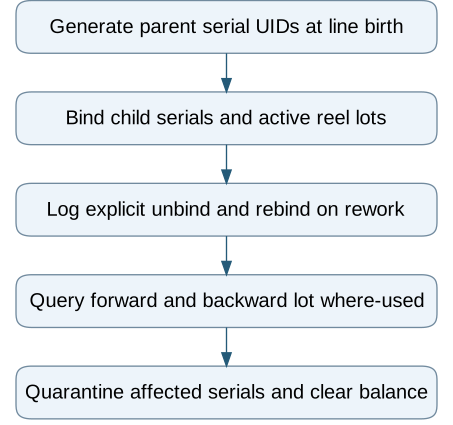
Read the complete workflow as text
- Generate parent serial UIDs at line birth → Bind child serials and active reel lots
- Bind child serials and active reel lots → Log explicit unbind and rebind on rework
- Log explicit unbind and rebind on rework → Query forward and backward lot where-used
- Query forward and backward lot where-used → Quarantine affected serials and clear balance
Designing a three-tier genealogy data model
Serializing every washer and cable tie slows shop-floor operators without improving recall precision. High-reliability industrial plants partition Bill of Materials (BOM) components into three traceability tiers:
1. Tier 1 — Serial-to-serial (1:1) binding
Applied to high-value, individually calibrated or life-limited sub-assemblies (stators, gearheads, PCBA controllers, pressure transducers). The station scanner verifies that the child serial has passed its upstream sub-assembly test and is not already bound to another active parent.
2. Tier 2 — Lot/reel-to-serial (M:1) binding
Applied to components supplied in homogeneous lots, trays or feeder reels (encoders, bearings, structural adhesives, high-tensile fastener batches). Instead of scanning every piece, the operator scans the active reel or container barcode at station setup (ACTIVE_CONTAINER_BIND). Every parent serial passing through that station inherits that lot ID until the reel count reaches zero or the operator scans a changeover reel.
3. Tier 3 — Rework UNBIND and REBIND event history
Genealogy databases most frequently break at the repair bench. If actuator SN-ACT-26018 fails end-of-line torque testing and a technician swaps its stator from SN-STA-9018 to SN-STA-9061, the system must never overwrite the original row in place. Instead, it appends an UNBIND_SCRAP event on SN-STA-9018 (recording the defect code, timestamp and technician ID) and posts a new ACTIVE_BIND event for SN-STA-9061. If a parent assembly is opened to replace one defective part, any mated sub-assemblies disturbed during disassembly are flagged for re-verification before release.
Worked example: 60-unit electric actuator batch (WO-ASM-2026-309)
An illustrative motion-control plant builds 60 serialized electric actuators (SN-ACT-26001 through SN-ACT-26060) on work order WO-ASM-2026-309. Each finished actuator carries a standard factory value of ₹45,000 (₹27,00,000 total batch value) and requires four trace-critical child inputs (240 active parent-child bindings across the 60 units).
Five days after batch completion, supplier SUP-ENC-19 notifies quality engineering that Optical Encoder Reel LOT-ENC-09B exhibits intermittent signal drop above 65°C. Quality engineering runs a backward and forward genealogy query on LOT-ENC-09B:
Scroll horizontally to see all columns.
| Child component level & tracking mode | Active parent bindings | Lot / serial distribution across 60 parents | Units linked to suspect LOT-ENC-09B |
Rework / teardown genealogy action | Financial containment impact |
|---|---|---|---|---|---|
CHILD-01 Brushless stator sub-assembly (1:1 serial) |
60 active (+1 unbound history) | SN-STA-9001..9060 (SN-STA-9018 unbound & swapped for 9061 at bench test) |
0 defective (18 mated to suspect parents) | Preserve stator serials during encoder swap | ₹0 stator write-off |
CHILD-02 Optical rotary encoder (M:1 reel lot) |
60 active | LOT-ENC-09A: 20 units (26001..26020); LOT-ENC-09B: 18 units (26021..26038)*; LOT-ENC-09C: 22 units (26039..26060) |
18 parent serials (30.00% of batch) |
Log UNBIND_DEFECT on 18 encoders; bind replacement reel LOT-ENC-10A |
Isolates defect to 18 units |
CHILD-03 Planetary gearhead cartridge (1:1 serial) |
60 active | SN-GRH-4401..4460 across SN-ACT-26001..26060 |
0 defective (18 disturbed on teardown) | Require backlash re-test before re-confirming 18 gearheads | Prevents secondary rework escape |
CHILD-04 Anaerobic housing sealant (M:1 expiry lot) |
60 active | LOT-SEAL-112 (Expiry 2027-04-30, 100% compliant) |
0 defective (18 housing seals opened) | Apply fresh sealant lot and log cure dwell on 18 reworked units | Complete cure audit trail |
| Batch containment summary | 240 active bindings | 42 clear units (70.00%) vs 18 quarantined (30.00%) |
18 quarantined (12 FG + 6 ASN-8841) |
Surgical containment avoids 42-unit unnecessary teardown | ₹18,90,000 cleared / ₹8,10,000 held |
*Note on Reel LOT-ENC-09B balance: The 20-unit supplier reel accounted for 18 active parent bindings plus 2 units rejected at line-side vision inspection prior to assembly marriage (18 + 2 = 20 units reconciled).
Operational impact of the genealogy query
- 70.00% reduction in containment scope: Instead of freezing all 60 actuators (₹27,00,000), the genealogy tree confirms that
SN-ACT-26001..26020(Reel A) andSN-ACT-26039..26060(Reel C)—a total of 42 units worth ₹18,90,000—never used the suspect encoder lot. - Warehouse and dispatch interception: Of the 18 affected parent serials (₹8,10,000), 12 units (
SN-ACT-26027..26038) are placed on hold in the finished-goods store (FG-HOLD), while 6 units (SN-ACT-26021..26026) are traced to outbound shipping noticeASN-8841for replacement before customer installation.
Implementation checklist for shop-floor genealogy
- Station sequence gate: Block final station sign-off unless the parent serial has a complete active child-binding set across all required upstream stations.
- Reel exhaustion reconciliation: Require operators to account for all units on a lot-tracked reel (bound to parents plus logged line-side scrap equals initial reel quantity) before closing the container lot.
- Append-only rework log: Store every component replacement as an immutable
UNBINDplusREBINDevent pair reviewed by quality assurance before release.
Compare this workflow with your current setup
Share the step that takes the most manual work, the systems involved and the exceptions your team handles. That gives us a concrete starting point for comparing approaches.
Sources and further reading
Sources checked 15 October 2026. Worked examples and workflow diagrams are original illustrations, not reported client results.
