Make reusable remnants visible before buying more material
For stores, inventory control and production teams · Compare approaches
TL;DR — what you’ll learn
- Charging an entire mother plate to the first cutting job leaves usable offcuts sitting in unrecorded floor racks, causing planners to over-order raw stock while losing mill-certificate traceability on parts cut later from those drops.
- Every remnant meeting the engineering minimum-size threshold should receive a serialized Remnant ID that inherits the parent plate's alloy grade, thickness, mill heat number and unit book rate.
- Only non-reusable skeleton webbing and kerf loss should be expensed to the cutting jobs, net of recoverable metallic scrap value, apportioned by each job's nested part mass.
- In a reconciled 864.00 kg SS316L laser nesting run (NEST-2026-412), formal remnant return captures 144.00 kg (₹46,080) of heat-traceable stock and limits job scrap absorption to the true net skeleton loss of ₹15,120.

Illustrative factory raw-material stores and receiving counter; not a client facility.
The hidden cost of unrecorded floor offcuts in fabrication
In sheet-metal laser cutting, heavy plate plasma profiling and bar sawing, raw material arrives in standard mill dimensions—such as 1,500 mm × 3,000 mm stainless plates or 6,000 mm alloy bars—while customer orders require irregular geometries and smaller batch quantities. When a nesting run uses 75% of a plate, the remaining rectangular drop is too valuable to throw into the scrap skip.
In many fabrication shops, operators lean that leftover drop against a rack near the cutting bed for future use, while the ERP issues 100% of the mother plate's weight and cost to the first work order. That informal habit breaks three manufacturing controls simultaneously:
- Distorted job costing: The first work order absorbs the full cost of material it never consumed, making margins on small-batch jobs appear artificially weak while later jobs that consume unrecorded floor remnants show overstated profitability.
- Phantom shortages and duplicate purchasing: Because the ERP shows zero stock of that thickness and grade, Material Requirements Planning (MRP) raises a fresh purchase request even though four usable drops are sitting in the bay.
- Broken mill-certificate genealogy: Pressure equipment, hygienic process skids and structural weldments require continuous traceability back to the mill test certificate (
MTC) and heat number. Once an unmarked offcut leaves its mother plate without a barcode label, quality inspectors cannot verify its heat identity and must downgrade or scrap it.
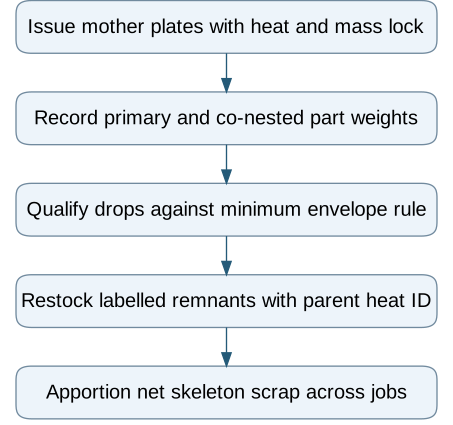
Make reusable remnants visible before buying more material — reporting workflow
Follow the workflow below, or open its complete text version.
Read the complete workflow as text
- Issue mother plates with heat and mass lock → Record primary and co-nested part weights
- Record primary and co-nested part weights → Qualify drops against minimum envelope rule
- Qualify drops against minimum envelope rule → Restock labelled remnants with parent heat ID
- Restock labelled remnants with parent heat ID → Apportion net skeleton scrap across jobs
Four rules for traceable remnant inventory control
To connect CAD/CAM nesting completion with ERP inventory and costing, plants enforce four operational rules at the cutting table:
1. Deterministic geometric qualification thresholds
Not every irregular skeleton strip belongs in warehouse inventory. Engineering defines a minimum reusable envelope—for example, any clean rectangular drop with usable dimensions of at least 300 mm × 300 mm for sheet/plate or 400 mm length for bar/tube. Smaller pieces route directly to skeleton scrap.
2. Automatic inheritance of parent genealogy
When the operator confirms a qualified drop at cutting completion, the system generates a child record (REM-316L-041) that inherits:
- Material master code, alloy specification and thickness (
SS316L — 6.0 mm) - Measured rectangular envelope (
600 mm × 1,250 mm) and calculated mass (36.00 kgat density8.00 g/cm³) - Parent Goods Receipt batch and Mill Heat Number (
HT-316L-908) - Parent inventory book rate (
₹320.00/kg)
3. Physical hard-marking and rack location binding
Before the drop leaves the unloading pallet, the operator applies a durable barcode label (or low-chloride stencil/etching for heavy plate) showing the REM ID, dimensions, alloy and heat number, and scans it into a dedicated vertical remnant rack slot (RACK-REM-B04).
4. Net-skeleton cost apportionment across co-nested jobs
When multiple work orders share the same mother plates, costing charges each job for its exact net part weight plus a proportional share of the net skeleton loss (gross skeleton cost minus recoverable metallic scrap credit), weighted by each job's net part mass.
Worked example: CNC fibre-laser nesting run (NEST-2026-412)
An illustrative process-equipment fabricator executes laser cutting run NEST-2026-412 using 4 mother plates of SS316L stainless steel (6.0 mm × 1,500 mm × 3,000 mm, Mill Heat HT-316L-908). Each plate weighs 216.00 kg, giving a total input mass of 864.00 kg valued at ₹320.00/kg (₹2,76,480 total issued value).
The nesting layout combines two production work orders on the four plates and leaves four clean rectangular drops (600 mm × 1,250 mm, 36.00 kg each) plus 72.00 kg of perforated skeleton webbing and laser kerf loss (recoverable from the stainless scrap processor at ₹110.00/kg).
Scroll horizontally to see all columns.
| Output disposition category | Mass (kg) | Mass share (%) | Gross material value @ ₹320/kg (₹) | Scrap recovery / net loss adjustment (₹) | Final ledger valuation (₹) | Traceability & ERP posting |
|---|---|---|---|---|---|---|
JOB-8810 primary parts (48 pump baseplates) |
540.00 | 62.50% | 1,72,800 | +12,600 (5/6 of net scrap loss) | 1,85,400 | Charged to JOB-8810 WIP (HT-316L-908) |
JOB-8814 co-nested parts (32 gusset brackets) |
108.00 | 12.50% | 34,560 | +2,520 (1/6 of net scrap loss) | 37,080 | Charged to JOB-8814 WIP (HT-316L-908) |
Certified reusable remnants (REM-316L-041 to 044) |
144.00 | 16.67% | 46,080 | 0 (retained at full book rate) | 46,080 | Returned to RACK-REM-B04 with heat ID |
Skeleton webbing & kerf scrap (SCRAP-SS316-OCT) |
72.00 | 8.33% | 23,040 | -15,120 (transferred to jobs) | 7,920 | Debited to stainless scrap bin @ ₹110/kg |
| Total reconciled nesting run | 864.00 | 100.00% | 2,76,480 | 0 | 2,76,480 | 100% mass, cost & heat reconciled |
Verifying the accounting and operational arithmetic
- Exact mass conservation:
540.00 kg + 108.00 kg + 144.00 kg + 72.00 kg = 864.00 kg(62.50% + 12.50% + 16.67% + 8.33% = 100.00%). - Exact net-scrap apportionment: The 72.00 kg skeleton has a gross material cost of
72.00 × ₹320 = ₹23,040and a recoverable stainless scrap value of72.00 × ₹110 = ₹7,920, leaving a net conversion waste of ₹15,120. Split across the two jobs in proportion to their net part weight (540 kg : 108 kg, or5 : 1),JOB-8810absorbs ₹12,600 andJOB-8814absorbs ₹2,520. - Protected working capital: Returning the four
600 mm × 1,250 mmdrops (144.00 kg) into ERP remnant stock preserves ₹46,080 of certifiedSS316Linventory that CAD/CAM nesting prioritizes before cutting a fresh mill plate on the next shift.
Implementation checklist for remnant governance
- CAD/CAM first-pick rule: Configure nesting software to query available
REM-*stock in the same alloy and thickness before allocating full mill sheets. - Cycle-count aging review: Flag any remnant that remains unconsumed after
90 daysso engineering can relax part-nesting orientation rules or reclassify aged odd-sized drops to scrap. - No unlabelled restocking: Block ERP remnant receipt transactions until the operator scans both the parent work order traveller and the printed
REMbarcode label.
Compare this workflow with your current setup
Share the step that takes the most manual work, the systems involved and the exceptions your team handles. That gives us a concrete starting point for comparing approaches.
Sources and further reading
Sources checked 15 October 2026. Worked examples and workflow diagrams are original illustrations, not reported client results.