Internal e-Kanban supermarkets & water-spider milk runs: size card loops, pitch intervals, and model-mix buffers
For production managers, planners and plant leaders · Compare approaches
TL;DR — what you’ll learn
- Decouple Production Kanbans (P-KANBAN, authorizing an upstream feeder cell to build a batch into the supermarket) from Withdrawal / Move Kanbans (W-KANBAN, authorizing the water-spider tow-train to move a tote from the supermarket to the final assembly line-side flow rack) ([Lean Kanban Principles](https://www.lean.org/lexicon-terms/kanban/)).
- Size every e-Kanban card loop using the Six-Parameter Littles Law Formula—incorporating hourly consumption rate ($D$), feeder setup/run lead time ($t_{\text{feeder}}$), supermarket dwell ($t_{\text{store}}$), water-spider pitch interval ($P_{\text{route}}$), safety volatility factor ($\alpha$), and fixed container pack quantity ($Q$)—and hard-block operators from printing ad-hoc duplicate cards.
- Synchronize Water-Spider (Mizusumashi) Tow-Train Milk Runs to a fixed rhythmic pitch ($P_{\text{route}} = 20,\; 30,\text{ or }60\text{ minutes}$) where every empty tote picked up at a line-side shooter rack triggers a 1-for-1 scanned Withdrawal Kanban for the next route cycle ([VDA 4905](https://www.vda.de/en/services/Publications)).
- Prevent both model-mix starvation and permanent WIP bloat by issuing Time-Bounded Spike Cards (TEMP_SPIKE_KANBAN) with an automatic expiry counter (TTL_CYCLES) whenever weekly Heijunka option penetration surges above the baseline sizing window.

Illustrative manufacturing inspection room and machine shop floor; not a client facility.
When a discrete manufacturer replaces push work orders with internal shop-floor Kanban between feeder sub-assembly cells (welding, stamping, harness braiding, sub-module pre-assembly) and final assembly lines, two failure modes commonly wreck material flow. First, supervisors size the loop by "gut feel" (putting 6 plastic cards in a rack), and whenever a line-side bin runs dry during a high-option shift, someone photocopies 3 extra cards—which remain in circulation forever and flood the aisle with unneeded WIP once demand returns to normal. Second, material handlers drive forklifts randomly across the plant in response to frantic radio calls ("expedite mode") rather than running a fixed-pitch Water-Spider (Mizusumashi) tow-train milk run. Forklifts arrive too late when three stations run out simultaneously, and return empty-handed instead of coupling full-tote delivery with empty-tote pickup.
The direct answer is to govern dual-loop e-Kanban state machines (EMPTY_SIGNAL - over SUPERMARKET_PICK - over IN_TRANSIT - over LINE_SIDE_FULL) and rhythmic water-spider route manifests inside the ERP and MES. Distinct from M010 (which covers external supplier Vendor-Managed Inventory and consignment settlement), this guide (M123) specifies internal sub-assembly supermarket sizing math, water-spider pitch-interval capacity balancing, missing-card audit controls, and auto-expiring model-mix spike cards.
Scope and operational boundary
This article defines the ERP, WMS, and MES workflow architecture for internal e-Kanban loops, supermarket replenishment, and water-spider tugger-train routing:
- What this workflow governs: Calculating optimal card counts ($K$), separating Production Kanban work instructions from Withdrawal Kanban transfer requests (ERPNext Material Request / Stock Entry), generating sequenced water-spider tugger pick lists per pitch window, reconciling lost/unscanned cards, and retiring temporary surge cards.
- What this workflow does not replace: Software card-loop formulas do not replace industrial ergonomics (maximum manual tote lift limits, typically $\le 12\text{–}15\text{ kg}$ for gravity flow racks), tow-tractor/AGV aisle safety standards (ISO 3691-4 / OSHA 1910.178), or upstream SMED (Single-Minute Exchange of Die) changeover reduction. Kanban sizing reflects the current physical replenishment lead time ($T_{\text{RL}}$); engineering must reduce physical changeover times before reducing card counts in the ERP.
Bounded kanban software for manufacturing verification and exception-routing workflow
Follow the workflow below, or open its complete text version.
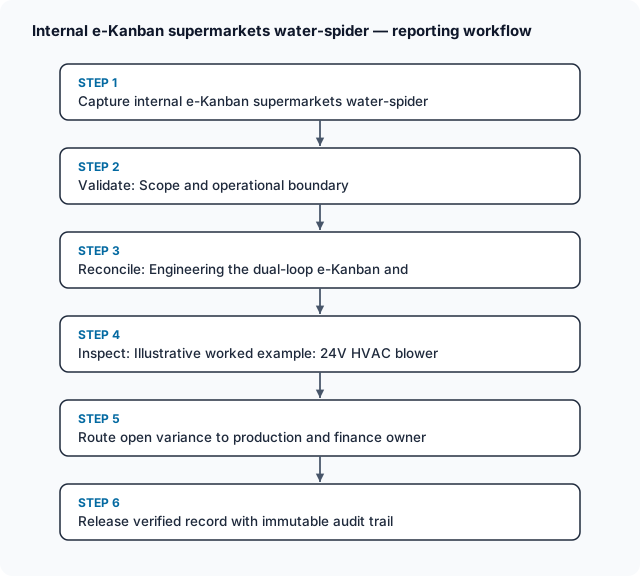
Read the complete workflow as text
- Capture kanban software for manufact baseline record → Verify revision, unit Basis and cutoff alignment
- Verify revision, unit Basis and cutoff alignment → Run deterministic reconciliation and tolerance check
- Run deterministic reconciliation and tolerance check → Quarantine mismatched or unapproved lines
- Quarantine mismatched or unapproved lines → Route exception to named domain and finance owner
- Route exception to named domain and finance owner → Release verified record with immutable audit trail
Engineering the dual-loop e-Kanban and water-spider routing model
1. Little's Law six-parameter e-Kanban card sizing formula. For any internal sub-assembly SKU stored in a decoupling supermarket between an upstream feeder cell and a downstream consumption line, the required number of active Kanban cards/containers ($K$) is governed by Little's Law:
$$K = \left\lceil \frac{D \times T_{\text{RL}} \times (1 + \alpha)}{Q} \right\rceil$$
where:
- $D$ ($\text{units/hour}$): Sustained consumption rate at the downstream assembly station during the active Heijunka scheduling period.
- $T_{\text{RL}}$ ($\text{hours}$): Total Replenishment Lead Time from the moment an empty card is scanned at the line until a full container is delivered back to the line-side rack: $$T_{\text{RL}} = t_{\text{wait_pitch}} + t_{\text{tugger_transit}} + t_{\text{supermarket_or_feeder_build}} + t_{\text{return_delivery}}$$
- $\alpha$ (dimensionless safety/volatility factor, typically $0.15\text{ to }0.30$): Buffers minor feeder micro-stops, quality check holds, or intra-shift sequence clustering.
- $Q$ ($\text{units/container}$): Standard pack quantity of the VDA KLT tote or wire basket (strictly fixed; partial totes are prohibited in a Kanban loop).
2. Rhythmic Water-Spider (Mizusumashi) pitch-interval capacity check. A water-spider tugger train operates like a bus schedule on a fixed Pitch Interval ($P_{\text{route}}$, e.g., $0.50\text{ hours} = 30\text{ minutes}$) across a defined zone of $M\text{ stations}$:
- Route Cycle Time Constraint: Total drive time ($t_{\text{drive}}$) + supermarket loading time ($t_{\text{load}}$) + line-side stop-and-swap time ($t_{\text{swap}}$) must not exceed $85%$ of the pitch interval: $$t_{\text{drive}} + \sum_{i=1}^{M} \left(t_{\text{load}, i} + t_{\text{swap}, i}\right) \le 0.85 \times P_{\text{route}}$$
- Trailer Slot Capacity Constraint: If the tugger train pulls $3\text{ trailers} \times 8\text{ tote slots} = 24\text{ totes maximum per trip}$, the sum of expected tote exchanges across all $M\text{ stations}$ in one pitch window ($\sum D_i \cdot P_{\text{route}} / Q_i$) plus a $20%$ surge margin must be $\le 24\text{ totes}$.
3. Dynamic Heijunka model-mix spike cards with automatic TTL expiry.
In mixed-model assembly (e.g., building standard 12V passenger variants alongside heavy-duty 24V commercial variants on the same line), sizing every option's Kanban loop for its theoretical $100%$ peak penetration wastes massive floor space. Conversely, sizing for the annual average ($40%$ penetration) causes immediate line starvation during a week when customer orders cluster at $60%$ penetration. Solve this in the ERP via Auto-Expiring Spike Cards (KANBAN_TYPE = SPIKE_TTL):
- When the weekly/daily Production Plan (ASCM Heijunka) shows option demand $D_{\text{surge}}$ exceeding baseline $D_{\text{base}}$ by $ over 20%$, the ERP computes $\Delta K = K_{\text{surge}} - K_{\text{base}}$ and activates $\Delta K$ digital Spike Cards printed on distinct orange-bordered e-Kanban labels carrying a hard cycle-count or date expiry (
TTL = 10 cyclesorEnd of Week). - The moment a Spike Card is scanned back into the supermarket after its
TTLexpires, the WMS retires the card (STATUS = RETIRED_SPIKE) without triggering a new feeder build—automatically draining the temporary buffer back to $K_{\text{base}}$.
under div over
under table over
under thead over
under tr over
under th over e-Kanban Card State under /th over
under th over Physical Location of Tote under /th over
under th over Scan Trigger Event under /th over
under th over ERP / WMS Transaction under /th over
under th over Exception Watchdog (SLA Breach) under /th over
under /tr over
under /thead over
under tbody over
under tr over
under td over under strong over 1. under code over LINE_FULL_AVAILABLE under /code over under /strong over under /td over
under td over Line-side gravity flow rack (Top lane) under /td over
under td over Water-spider scans station rack barcode on delivery under /td over
under td over Post under code over Stock Entry (Material Transfer) under /code over from Supermarket to Line-Side WIP under /td over
under td over Block duplicate scan if card is already in under code over LINE_FULL_AVAILABLE under /code over state under /td over
under /tr over
under tr over
under td over under strong over 2. under code over EMPTY_SIGNAL_QUEUED under /code over under /strong over under /td over
under td over Line-side return chute (Bottom lane) under /td over
under td over Operator empties tote & scans card (or presses e-Kanban button) under /td over
under td over Create prioritized replenishment line on next Water-Spider Pitch Manifest under /td over
under td over Alert Team Lead if $100%$ of cards for an item sit in under code over EMPTY_SIGNAL under /code over (Starvation Risk!) under /td over
under /tr over
under tr over
under td over under strong over 3. under code over SUPERMARKET_PICKED under /code over under /strong over under /td over
under td over Tugger train trailer slot under /td over
under td over Water-spider scans full replacement tote out of Supermarket under /td over
under td over Assign to active Tugger Trip ID; simultaneously fire under strong over under code over P-KANBAN under /code over under /strong over to Feeder Cell under /td over
under td over If Supermarket bin is empty at pick time, fire immediate under strong over Supermarket Stockout Andon under /strong over under /td over
under /tr over
under tr over
under td over under strong over 4. under code over FEEDER_IN_BUILD under /code over under /strong over under /td over
under td over Sub-assembly feeder cell queue under /td over
under td over Feeder cell operator accepts under code over P-KANBAN under /code over on MES terminal under /td over
under td over Execute lightweight backflush production receipt upon tote completion scan under /td over
under td over Flag overdue under code over P-KANBAN under /code over if feeder cell does not complete tote within $t_{\text{feeder}}$ SLA under /td over
under /tr over
under /tbody over
under /table over
under /div over
Illustrative worked example: 24V HVAC blower loop sizing, 30-min tugger pitch, and +50% surge spike cards
All figures below are illustrative and synthetic. Consider a mixed-model commercial vehicle cab line consuming a 24V brushless HVAC blower sub-assembly (SUB-BLOWER-24V, packed at $Q = 20\text{ blowers per KLT tote}$) fed from an internal sub-assembly cell via a decoupling supermarket and a Water-Spider tugger train running a $30\text{-minute}$ ($P_{\text{route}} = 0.50\text{ hour}$) pitch.
Step 1: Size the baseline e-Kanban loop ($D_{\text{base}} = 48.0\text{ units/hour}$).
Under the baseline model mix ($360\text{ units}$ per $7.5\text{-hour}$ net shift):
- Baseline Hourly Consumption ($D_{\text{base}}$): $\frac{360\text{ units}}{7.5\text{ hours}} = \mathbf{48.0\text{ units/hour}}$ ($0.80\text{ units/minute}$).
- Total Replenishment Lead Time ($T_{\text{RL}}$): $$T_{\text{RL}} = 1.50\text{ h (feeder cell build & queue)} + 0.50\text{ h (supermarket dwell)} + 0.50\text{ h (water-spider pitch cycle)} = \mathbf{2.50\text{ hours}}$$
- Pipeline Demand During Lead Time ($D_{\text{base}} \times T_{\text{RL}}$): $48.0\text{ units/h} \times 2.50\text{ h} = \mathbf{120.0\text{ units}}$.
- Baseline Active Kanban Cards ($K_{\text{base}}$) with $\alpha = 0.25$ ($25%$ safety factor): $$K_{\text{base}} = \left\lceil \frac{48.0 \times 2.50 \times (1 + 0.25)}{20\text{ units/tote}} \right\rceil = \left\lceil \frac{150.0\text{ units}}{20\text{ units/tote}} \right\rceil = \left\lceil 7.50 \right\rceil = \mathbf{8\text{ Kanban cards}}\quad (160\text{ units max WIP})$$
- Water-Spider $30\text{-Minute}$ Pitch Delivery Rate: $$\text{Totes per 30-Min Pitch} = \frac{48.0\text{ units/h} \times 0.50\text{ h}}{20\text{ units/tote}} = \frac{24.0\text{ units}}{20} = \mathbf{1.20\text{ totes/trip}}\quad (1\text{ tote on }80%\text{ of trips, }2\text{ totes on }20%)$$
Step 2: Handle a $+50%$ model-mix surge ($D_{\text{surge}} = 72.0\text{ units/hour}$) using temporary spike cards.
For a 5-shift fleet export build, heavy-duty 24V cab penetration jumps by $+50%$, raising hourly consumption of SUB-BLOWER-24V from $48.0\text{ units/h}$ to $D_{\text{surge}} = 72.0\text{ units/h}$ ($540\text{ units/shift}$):
- Why keeping $K_{\text{base}} = 8\text{ cards}$ ($160\text{ units}$) fails: During the $2.50\text{-hour}$ replenishment loop, the line now consumes $72.0 \times 2.50 = 180.0\text{ units}$—exceeding the entire $160\text{-unit}$ loop ceiling even before safety stock! The line will starve by $-20\text{ units}$ every cycle.
- Compute Surge Kanban Card Requirement ($K_{\text{surge}}$): $$K_{\text{surge}} = \left\lceil \frac{72.0 \times 2.50 \times (1 + 0.25)}{20\text{ units/tote}} \right\rceil = \left\lceil \frac{225.0\text{ units}}{20\text{ units/tote}} \right\rceil = \left\lceil 11.25 \right\rceil = \mathbf{12\text{ Kanban cards}}\quad (240\text{ units max WIP})$$
- Issue and Auto-Retire $\Delta K = 4$ Spike Cards: The ERP releases $12 - 8 = 4\text{ Temporary Spike Cards}$ (
SPIKE-24V-01..04) valid for5 shifts. At the end of Shift 5, as each of the $4\text{ spike cards}$ is emptied and scanned back, the system retires them automatically, returning the loop to $8\text{ cards}$ ($160\text{ units}$).
Scroll horizontally to see all columns.
Operating Regime (SUB-BLOWER-24V) |
Hourly Demand ($D$) | Replenishment Time ($T_{\text{RL}}$) | Pipeline Demand ($D \cdot T_{\text{RL}}$) | Safety Buffer ($+25%$) | Active Cards ($K$ @ $Q=20$) | Max Loop WIP ($\text{units}$) | Totes per $30\text{m}$ Tugger Trip |
|---|---|---|---|---|---|---|---|
| 1. Baseline Mix ($8\text{ Permanent Cards}$) | $48.0/\text{hr}$ | $2.50\text{ hrs}$ | $120.0\text{ pcs}$ | $+30.0\text{ pcs}$ | $8\text{ cards}$ | $160\text{ pcs}$ | $1.20\text{ totes/trip}$ |
| 2. $+50%$ Surge With Static $8$ Cards (Fail) | $72.0/\text{hr}$ | $2.50\text{ hrs}$ | $180.0\text{ pcs}$ | (Deficit $-20$) | $8\text{ cards}$ | $160\text{ pcs}$ | Line Starves ($180 over 160$) |
| 3. $+50%$ Surge With $+4$ TTL Spike Cards | $72.0/\text{hr}$ | $2.50\text{ hrs}$ | $180.0\text{ pcs}$ | $+45.0\text{ pcs}$ | $12\text{ cards}$ ($8+4$) | $240\text{ pcs}$ | $1.80\text{ totes/trip}$ |
Independent arithmetic verification.
- Baseline loop check: $(48.0 \times 2.50 \times 1.25) / 20 = 150.0 / 20 = 7.50 \implies \lceil 7.50 \rceil = 8\text{ cards}$ ($8 \times 20 = 160\text{ units}$, providing $160 / 48.0 = 3.33\text{ hours}$ of total coverage).
- Surge loop check: $(72.0 \times 2.50 \times 1.25) / 20 = 225.0 / 20 = 11.25 \implies \lceil 11.25 \rceil = 12\text{ cards}$ ($12 \times 20 = 240\text{ units}$, providing $240 / 72.0 = 3.33\text{ hours}$ of coverage); spike increment = $12 - 8 = 4\text{ cards}$ ($80\text{ units}$).
- Pitch delivery verification: At $72.0\text{ units/hour}$, a $0.50\text{-hour}$ tugger pitch delivers $72.0 \times 0.50 = 36.0\text{ units} = 1.80\text{ totes/trip}$ ($2\text{ totes}$ on $80%$ of trips, $1\text{ tote}$ on $20%$ of trips).
Workflow, owner roles, exception handling and recovery controls
Scroll horizontally to see all columns.
| Workflow stage | Accountable owner | Required system evidence | Exception condition | System hold & recovery control |
|---|---|---|---|---|
| 1. Quarterly & Mix-Change Loop Sizing | Lean / Industrial Engineer & Planner | Verified $D, T_{\text{RL}}, \alpha, Q$ parameters; active card register (CARD_ID $1..K$) |
Supervisor attempts to print a replacement card without auditing missing card ID | Block ad-hoc card reprints; require Lost Kanban Card Audit before re-issuing a replacement serial |
| 2. Line-Side Empty Trigger Scan | Assembly Operator | Barcode/RFID scan of emptied tote (EMPTY_SIGNAL_QUEUED) at gravity chute |
Operator forgets to scan empty tote until second bin is nearly exhausted | Water-spider physically scans every empty tote picked up on the 30-min route as a fail-safe catch |
| 3. Supermarket Pick & Tugger Manifest | Water-Spider (Tow-Train Driver) | Pitch Trip ID, scanned W-KANBAN picks, automatic P-KANBAN generation |
Supermarket rack has zero full totes when water-spider arrives (SUPERMARKET_SHORTFALL) |
Fire immediate Tier-1 Yellow Material Andon to Feeder Cell Lead; split route delivery once hot tote finishes |
4. Feeder Cell P-KANBAN Execution |
Sub-Assembly Cell Operator | FIFO/Heijunka P-KANBAN queue board + completed tote backflush scan |
Feeder cell builds non-requested part number "to keep busy" without an open P-KANBAN |
Hard-block MES production receipt (ERR_NO_OPEN_PKANBAN); enforce strict pull authorization |
| 5. Weekly Card Velocity & Dormancy Audit | Materials Supervisor | Card turn timestamp log (last_scan_age_hours per CARD_ID) |
Card KB-24V-06 shows zero scans for $ over 48\text{ operating hours}$ (lost under bench or in scrap area) |
Flag card SUSPECT_LOST_DORMANT; temporarily issue replacement serial and deactivate lost barcode |
Bounded pilot and implementation check
Pilot dual-loop e-Kanban and fixed-pitch water-spider routing across 1 feeder sub-assembly supermarket and 1 final assembly zone (8–12 part numbers) over 3 weeks:
- Pilot boundary: Size every pilot SKU using the 6-parameter Little's Law formula, label every tote with a serialized
W-KANBAN/P-KANBANbarcode, and transition the material handler from radio-expediting to a fixed $30\text{-minute}$ water-spider tow-train schedule. - Acceptance tests:
ACT-M123-01(Deterministic Card Sizing & Over-Print Block): Verify the ERP calculates $8\text{ baseline cards}$ ($160\text{ units}$) for the $48\text{ unit/hr}$ fixture and blocks printing a 9th permanent card without Industrial Engineering approval.ACT-M123-02(1-for-1 Supermarket Pick to FeederP-KANBANCoupling): Scan $2\text{ full totes}$ out of the supermarket onto the water-spider tugger manifest and confirm $2\text{ replenishment P-Kanbans}$ immediately appear on the feeder cell's build board.ACT-M123-03(Unauthorized Feeder Over-Build Interlock): Attempt to log a completed sub-assembly tote at the feeder cell when all $8\text{ cards}$ are already full (0openP-KANBANsignals); confirm the MES blocks the over-build.ACT-M123-04(Spike Card Auto-Retirement): Issue $4\text{ Spike Cards}$ withTTL = 3 cycles, cycle them 3 times, and confirm the system automatically transitions all 4 cards toRETIRED_SPIKEupon the 3rd empty return scan.
Next actions
- Separate Withdrawal Kanbans (
W-KANBAN) from Production Kanbans (P-KANBAN) wherever a supermarket exists: The tugger driver moves material usingW-KANBANsignals; the feeder cell builds solely againstP-KANBANsignals triggered when the supermarket is drawn down. - Put the water-spider tow-train on a strict 30- or 60-minute clock: Eliminate ad-hoc forklift calls by coupling every full-tote delivery with a mandatory empty-tote pickup along a fixed route.
- Run an automated 48-hour Dormant Card Audit every week: Any e-Kanban card serial that has not been scanned in $2\text{ operating days}$ is physically lost or stuck in quarantine—find or replace it before the reduced loop starves the line.
- Use
TTLAuto-Expiring Spike Cards for model-mix surges: Never increase permanent card counts to survive a temporary 1-week option spike without setting an automatic retirement date.
Frequently Asked Questions
How should discrete plants size internal e-Kanban supermarket loops, tow-train (water-spider) route intervals, and card-spike buffers during model-mix shifts?.
Teams should govern kanban software for manufacturing by linking every transaction to its source evidence, timestamp, and assigned owner before permitting downstream posting. Distinct from M010 (supplier VMI/consignment); M123 covers internal feeder-shop-to-final-assembly two-bin/e-Kanban loop calculation, pitch-interval tugger routing, and card freeze rules during engineering phase-outs. Rather than relying on informal spreadsheet overrides, the workflow enforces a documented verification gate and preserves the original observation whenever a correction is recorded.
How does electronic kanban system handle exceptions and mismatches?.
When a discrepancy occurs during electronic kanban system, the system routes the blocked record into an owned exception queue rather than silently dropping or auto-adjusting the balance. Assigned operational, quality, and finance owners must review and approve exceptions before posting. Each exception retains the original quantity, date, and counterparty reference until the designated reviewer resolves the variance with supporting evidence.
What should teams test before automating lean manufacturing software?.
Before scaling lean manufacturing software, run a bounded pilot using historical records that include partial receipts, late updates, duplicate messages, and rejected lines. Verify that the integration preserves idempotency, maintains a clear segregation of duties between operational entry and financial approval, and produces an auditable trail for every state transition.
Compare this workflow with your current setup
Share the step that takes the most manual work, the systems involved and the exceptions your team handles. That gives us a concrete starting point for comparing approaches.
Sources and further reading
Sources checked 15 October 2026. Worked examples and workflow diagrams are original illustrations, not reported client results.
