Pilot digital permits with explicit suspension, handover and closure
For EHS, operations and maintenance teams · Plan implementation
TL;DR — what you’ll learn
- Commercial permit to work software should be evaluated and piloted strictly as an administrative record-and-communication layer under a plant's existing EHS-approved permit procedure—never as a substitute for physical hazard verification, competent risk assessment or site safety authority.
- Before replacing paper registers, evaluate whether candidate software preserves a single authoritative permit state across mid-shift suspensions, multi-shift handovers, offline mobile sync delays and premature CMMS operational asset-release (Ready for Operations / Asset Released) attempts.
- In a hypothetical 30-day pre-pilot baseline audit template of 42 multi-shift maintenance permits at an illustrative Indian chemical utilities plant (BHAR-CHEM-03), 18 permits (42.86%) illustrate administrative record discrepancies across three failure modes: premature CMMS operational asset-release status transitions before permit closure (7 permits), unacknowledged shift-change handover gaps (6 permits) and stale field copies after a control-room suspension (5 permits).
- A proposed acceptance-test design traces synthetic permit PTW-2026-1042 (linked to CMMS work order WO-UTIL-8810 across a 480-minute window from 08:00 to 16:00 IST across seven immutable revisions v1–v7) through 345 minutes of version-locked active work, 135 minutes of explicit non-working states (85 minutes suspended hold, 25 minutes shift-handover hold and 25 minutes handback verification in HANDBACK_PENDING v6) and a point-in-time closure event (CLOSED_ARCHIVED v7 at 16:00 IST), using a 25 out of 25 negative exception test criterion for software state-locking before any live unit trial.

Illustrative permit-record review in a plant maintenance area; not a client facility.
Why evaluating permit to work software requires testing state transitions rather than form templates
When plant heads, maintenance managers and EHS leads in India evaluate permit to work software or plan a digital permit to work rollout, commercial product pages already cover the core lifecycle stages. For example, vendor overviews such as IAMTech's iPermit permit to work software page and Elisian's electronic permit to work software overview already describe configurable digital templates, isolation-certificate linking, simultaneous-operations (SIMOPS) conflict displays, mobile sign-offs, suspension, shift handover and permit closure. Those vendor descriptions state available software features; they do not by themselves prove that a specific plant's role hierarchy, vendor-specific offline mobile behaviour and ERP/CMMS integration will prevent conflicting status screens during an interrupted maintenance job.
Human-factors guidance from the UK Health and Safety Executive—specifically HSE's human factors briefing on permit-to-work systems and HSE HSG250: Guidance on permit-to-work systems—highlights why electronic permit workflows require deliberate human-factors and governance controls:
- A permit record does not make a job safe: As HSE's permit-to-work guidance emphasises, a permit-to-work is a formal recorded communication and control process, not a replacement for competent risk assessment or physical site preparation. (Note: UK HSE publications are non-statutory outside the UK and are cited here strictly as general process-safety and human-factors design guidance, not as Indian statutory law or a site operating procedure.)
- Electronic permit human-factors risks vs modern mobile offline caching: HSG250 (page 24, paragraph 51) cautions that electronic permit systems can lead to fewer physical site visits by issuers, alterations being made without informing the permit user, user-authentication weaknesses, absence of a paper copy displayed at the job site, and over-reliance on system backup during outages. Extending those human-factors principles to modern mobile pilot evaluations (a proposed pilot control rather than a literal topic in
HSG250), evaluation teams must also test vendor-specific offline tablet behaviour—specifically whether a field crew could view a stale cachedActivestatus on an offline tablet after the control room has suspended the permit. - Shift handover and CMMS operational release vs technical completion (
TECO): When a maintenance job spans multiple shifts or links to an ERP/CMMS maintenance order, system boundaries must distinguish between routine CMMS technical work completion (TECO) or craft time booking—which technicians may legitimately record once trade work finishes—and the operationalReady for Operations / Asset Released(return-to-service) decision. Under the proposed site workflow, recordingTECOis harmless administrative progress, whereas transitioning the asset or order toReady for Operations / Asset Releasedmust be gated until the permit has completed both Performing Authority handback (HANDBACK_PENDING v6) and Area Authority final closure (CLOSED_ARCHIVED v7).
Pilot digital permits with explicit suspension, handover and closure — reporting workflow
Follow the workflow below, or open its complete text version.
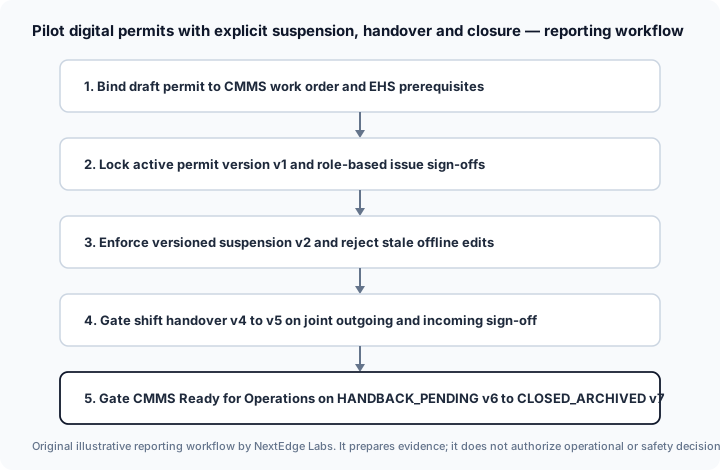
Read the complete workflow as text
- Bind draft permit to CMMS work order and EHS prerequisites → Lock active permit version and role-based issue sign-offs
- Lock active permit version and role-based issue sign-offs → Enforce versioned suspension and reject stale offline edits
- Enforce versioned suspension and reject stale offline edits → Gate shift handover on joint outgoing and incoming sign-off
- Gate shift handover on joint outgoing and incoming sign-off → Require permit handback closure before CMMS asset release
Define role ownership and system boundaries under the existing EHS-approved procedure
A software pilot must implement the facility's existing, EHS-approved permit-to-work procedure for a single bounded permit category. Software configuration teams and external consultants must never invent physical isolation points, gas-testing limits, personal protective equipment rules or safe-work methods inside a software template.
The table below proposes an administrative ownership and system-integration matrix (v1–v7) for evaluating a commercial electronic permit to work system alongside a plant CMMS/ERP:
Scroll horizontally to see all columns.
| Lifecycle event / system control | Authoritative role owner (per site EHS procedure) | Proposed record & version-control rule | System boundary (PTW software vs CMMS / mobile devices) | What the software status does not certify |
|---|---|---|---|---|
| 1. Draft request & prerequisite linking | Performing Authority / Maintenance Planner | Links permit draft to CMMS work order ID, functional location ID and reference numbers of site-approved isolation/risk certificates. | CMMS supplies asset ID and work order scope; PTW software blocks submission if required reference fields are blank. | Populated reference numbers do not verify that physical isolations or site preparations have been executed correctly. |
2. Authorised issue (ISSUED_ACTIVE v1) |
Area Authority / Permit Issuer (accepted by Performing Authority) | Distinct user accounts enforced by role-based access control (RBAC), validity start/end timestamps, and locked revision counter (v1). |
PTW software is the sole system of record for permit status; CMMS receives a read-only reference to v1. |
An ISSUED_ACTIVE badge records procedural sign-off; software RBAC alone cannot prove two people did not share a physical login without site credential governance. |
3. Mid-shift interruption (SUSPENDED_HOLD v2) |
Area Authority or EHS Authority (any role may trigger stop-work per site rule) | Increments permit revision (v1 -> v2), logs suspension timestamp and reason code, and invalidates prior active tokens. |
Offline tablets displaying v1 show a Last Verified Timestamp banner; any late mobile write carrying v1 is rejected (for example via an illustrative HTTP 409 conflict or equivalent server-side version block). |
Software suspension logs the administrative hold; physical work stoppage and safe site state depend on site personnel following the approved procedure. |
4. Reassessment & revalidation (REVALIDATED_ACTIVE v3) |
Area Authority & Competent Verifier (re-accepted by Performing Authority) | Requires explicit reassessment record under the site procedure before issuing a new revision (v3); never auto-resumes on a timer. |
Keeps CMMS Ready for Operations / Asset Released gated while permit remains in SUSPENDED_HOLD v2 (separate from routine post-facto craft time logging). |
Revalidation in software records that authorised personnel signed off their reassessment; software never evaluates physical conditions itself. |
5. Shift handover (HANDOVER_PENDING v4 -> HANDOVER_ACTIVE v5) |
Outgoing & Incoming Performing Authorities + Area Authority | Reaching shift cutoff or initiating transfer moves state to HANDOVER_PENDING (v4); joint outgoing sign-out and incoming sign-in advances to HANDOVER_ACTIVE (v5). |
Prevents automatic validity extension past shift boundary; flags unacknowledged handovers (v4) on the control-room board. |
A digital signature transfer does not replace the face-to-face site walkthrough required by the plant's EHS procedure (HSG250). |
6. Handback (HANDBACK_PENDING v6) & final closure (CLOSED_ARCHIVED v7) |
Performing Authority (v6 handback) & Area Authority (v7 final closure) |
Two-step closure: Performing Authority logs housekeeping/tool removal handback (HANDBACK_PENDING v6); Area Authority records final acceptance (CLOSED_ARCHIVED v7). |
Hard CMMS operational-release gate: Technicians may log trade completion (TECO), but CMMS cannot transition to Ready for Operations / Asset Released until permit reaches CLOSED_ARCHIVED (v7). |
Permit record closure (v7) does not by itself authorise removal of master physical locks or energisation outside the site's isolation procedure. |
Worked example: hypothetical baseline discrepancy audit and version-locked permit acceptance design (BHAR-CHEM-03)
Scope & safety boundary note: All facility codes (
BHAR-CHEM-03), permit identifiers (PTW-2026-1042), work orders (WO-UTIL-8810), role IDs, durations, exception responses and audit counts below represent a hypothetical pre-pilot audit template and proposed acceptance-test design created to illustrate software state-transition logic and record reconciliation. They do not report actual product testing, a client incident, a statutory compliance audit or a safe-work instruction. All physical hazard controls, isolation methods and emergency procedures remain governed exclusively by the facility's qualified EHS and engineering authorities.
Step 1: Hypothetical pre-pilot baseline record audit template (42 multi-shift maintenance permits)
To establish a quantitative baseline before evaluating commercial permit to work software on utility cooling-water and compressed-air headers at hypothetical plant BHAR-CHEM-03, this audit template compares 42 completed multi-shift maintenance permits across paper permit folders, control-room logbooks and CMMS operational-release timestamps:
Scroll horizontally to see all columns.
Hypothetical baseline audit classification (30-day sample, BHAR-CHEM-03) |
Permit count | Share of sample (%) |
Illustrative timing / record drift | Administrative record risk modelled |
|---|---|---|---|---|
| 1. Complete, reconciled permit & CMMS record set | 24 | 57.14% | 0 min unresolved drift |
Issue, shift transfer, suspension (where applicable), handback and final closure timestamps aligned across permit and CMMS logs. |
2a. Premature CMMS Ready for Operations release before permit closure |
7 | 16.67% | 44.0 min early asset release (range 18–95 min) |
Beyond harmless trade TECO, the CMMS order/asset was marked Ready for Operations / Asset Released while the permit remained open (ISSUED_ACTIVE or HANDBACK_PENDING). |
| 2b. Unreconciled shift-change handover signature gap | 6 | 14.29% | 62.5 min unacknowledged window (range 45–85 min) |
Work spanned the 14:00 IST shift change with outgoing signature missing or incoming Performing Authority signing more than 45 minutes late. |
| 2c. Stale field copy after mid-shift control-room suspension | 5 | 11.90% | 38.0 min lag before paper retrieval |
Control-room register logged a temporary suspension, but the physical field copy retained the original 08:00–16:00 IST active header with no version change. |
Subtotal: Permits with administrative record discrepancies (2a + 2b + 2c) |
18 | 42.86% | — | Target for proposed software state-lock and CMMS operational-release gate. |
Total baseline multi-shift permits in template (1 + 2a + 2b + 2c) |
42 | 100.00% | — | Reconciled 100.00% (24 + 7 + 6 + 5 = 42 permits). |
Step 2: Proposed 480-minute acceptance-test lifecycle trace (PTW-2026-1042, revisions v1–v7)
To verify how a candidate permit to work software configuration would address all three administrative record defects (2a, 2b and 2c), the hypothetical acceptance-test script below traces synthetic maintenance permit PTW-2026-1042 (linked to utility pump overhaul work order WO-UTIL-8810) across an 8-hour (480-minute) planned window (08:00–16:00 IST) through seven sequential immutable revisions (v1–v7):
Scroll horizontally to see all columns.
Permit revision & state (PTW-2026-1042) |
Clock window (IST) |
Elapsed minutes | Active work minutes | Non-working hold / handback minutes | Authoritative sign-offs & prerequisite refs | Proposed acceptance / integration check during window |
|---|---|---|---|---|---|---|
v1: ISSUED_ACTIVE |
08:00–10:15 |
135 | 135 | 0 | Issued by Area Authority AA-104; accepted by Day Shift PA-208 (refs ISO-REF-441, PRE-CHK-882). |
Verify that v1 cannot be issued when prerequisite reference ISO-REF-441 is unapproved. |
v2: SUSPENDED_HOLD |
10:15–11:40 |
85 | 0 | 85 | Suspended by AA-104 at 10:15 IST due to adjacent unit process alert EVT-901. |
At 10:22 IST, simulate an offline field tablet syncing a stale v1 progress note; verify server rejects the write (e.g., illustrative HTTP 409: Revision v1 superseded by v2 or equivalent version lock). |
v3: REVALIDATED_ACTIVE |
11:40–13:45 |
125 | 125 | 0 | Reassessed per site SOP by AA-104 & EHS-019; re-accepted by PA-208 at 11:40 IST. |
Verify that v2 cannot auto-resume on a timer; require fresh v3 sign-offs from all three role holders. |
v4: HANDOVER_PENDING |
13:45–14:10 |
25 | 0 | 25 | Outgoing PA-208 initiates shift transfer at 13:45 IST; work pauses pending incoming shift. |
Keep permit in non-working HANDOVER_PENDING (25 min) until incoming PA-312 and Afternoon Area Authority AA-109 both sign off at 14:10 IST. |
v5: HANDOVER_ACTIVE |
14:10–15:35 |
85 | 85 | 0 | Active under Afternoon Shift PA-312 and AA-109 (v5). |
Confirm shift-change audit trail preserves outgoing PA-208 scope notes alongside incoming PA-312 acceptance. |
v6: HANDBACK_PENDING |
15:35–16:00 |
25 | 0 | 25 | PA-312 logs trade completion (TECO allowed) and initiates permit handback at 15:35 IST (v6). |
At 15:42 IST, simulate an attempt to set WO-UTIL-8810 to Ready for Operations / Asset Released in CMMS; verify integration blocks operational release (ERR_PTW_OPEN_1042) for the remaining 18 min (15:42–16:00 IST) while permit is still in HANDBACK_PENDING (v6). |
v7: CLOSED_ARCHIVED |
16:00 (point-in-time closure) |
0 | 0 | 0 | Area Authority AA-109 records final workplace acceptance and closes permit at 16:00 IST (v7). |
Point-in-time transition from HANDBACK_PENDING (v6) to CLOSED_ARCHIVED (v7) at 16:00 IST unlocks the CMMS Ready for Operations / Asset Released gate. |
| Reconciled 8-hour lifecycle total | 08:00–16:00 |
480 | 345 | 135 | 7 sequential immutable versions (v1–v7) |
345 min active (135 + 125 + 85) + 135 min hold/handback (85 + 25 + 25) + 0 min closure event (v7) = 480 min. |
Proposed pre-trial acceptance criteria, negative exception tests and rollback protocol
Before moving a permit to work software evaluation from conference-room testing to a live unit pilot, define formal acceptance criteria requiring joint sign-off from the EHS Manager, Operations Area Manager, Maintenance Head and IT/OT Application Owner. Note that passing a software exception suite (25 / 25) is a proposed pilot acceptance criterion for administrative record locking, not proof of physical plant safety:
- Require all 25 proposed negative/exception test cases (
25 / 25 = 100%target block rate) to pass in staging:- 5 stale offline revision writes: Simulate an offline mobile tablet attempting to post a progress check, attachment or handback against
v1after the server has transitioned the permit toSUSPENDED_HOLD (v2). All 5 attempts must be rejected by the server's version-conflict control (such as an illustrativeHTTP 409conflict response or equivalent vendor lock) without overwritingv2(following the same versioned write-lock principle described in our ERP, MES, QMS and PLM system boundary architecture). - 5 unacknowledged shift handovers: Cross the configured shift cutoff timestamp without incoming Performing Authority and Area Authority sign-offs; all 5 permits must transition automatically to
HANDOVER_PENDING (v4)(non-working state) rather than remaining active. - 5 premature CMMS operational asset-release transitions: While allowing legitimate trade
TECOor craft hour logging per site rules, attempt to transition the linked CMMS maintenance order or asset toReady for Operations / Asset Releasedwhile the permit is inISSUED_ACTIVE (v1),SUSPENDED_HOLD (v2),REVALIDATED_ACTIVE (v3),HANDOVER_PENDING (v4),HANDOVER_ACTIVE (v5)orHANDBACK_PENDING (v6); all 5 operational-release attempts must be blocked untilCLOSED_ARCHIVED (v7). - 5 expired validity window extension attempts on unfinished/open permits: Allow an unfinished/open permit (not yet in
CLOSED_ARCHIVED v7) to reach its planned end timestamp (16:00 IST), or attempt a one-click extension beyond the maximum duration allowed by the site's EHS procedure; all 5 unfinished permits must transition toEXPIRED_HOLDand require the procedure's full revalidation or replacement workflow (whereas a permit that completes handback and reachesCLOSED_ARCHIVED v7at or before16:00 ISTremains validly closed). - 5 RBAC role-separation checks (paired with procedural credential-sharing governance): Attempt to have the same user ID sign as both Permit Issuer (
Area Authority) and Permit Acceptor (Performing Authority), or attempt to issue a permit using an IT administrator account; all 5 must be rejected by role-based access control (RBAC). Because softwareRBAConly validates user account IDs and cannot prove that two individuals did not share a physical terminal login or password, pair this test with site authentication governance and shift audit rules.
- 5 stale offline revision writes: Simulate an offline mobile tablet attempting to post a progress check, attachment or handback against
- Enforce single-ledger fallback and rollback during connectivity or system outages:
- Never run split authority: If plant Wi-Fi, identity services or the PTW application becomes unavailable, the Area Authority invokes the site's approved existing paper permit fallback for the affected unit.
- Outage reconciliation gate before resuming digital control: Before re-enabling electronic permit issuance after an outage, EHS and the Area Authority must reconcile 100% of paper fallback permits issued, suspended or closed during the outage into the software audit register so operators never face two competing lists of active permits.
Scope this automation around your operation
Tell us your current systems, transaction volume and the exception you need to resolve. We can discuss a focused first release, its review controls and how to measure the result.
Sources and further reading
Sources checked 15 October 2026. Worked examples and workflow diagrams are original illustrations, not reported client results.

