Integrating OEE Availability Performance Quality Downtime Interlock Across HVAC Compressor Production: Bidirectional API Schema & Idempotency Blueprint
For operations leaders, IT teams and integration owners · Plan implementation
TL;DR — what you’ll learn
- Enforce a hard physical-to-digital precondition gate between PLC High-Speed Counter (24VDC Photo-Eye / Encoder) & MTConnect / OPC-UA Telemetry Agent and SAP S/4HANA CO-PC Activity Absorption & Production Variance Settlement (KO88 / KKS2) so oee availability performance quality downtime interlock integration never posts unverified output or silent BOM backflushes.
- Separate gross machine cycles into setup prove-out, quarantined MRB hold, reusable remnant/rework, and net good yield before updating inventory or OEE counters.
- Bind every shop-floor confirmation to a composite SHA-256 idempotency key and active ISO/IEC 17025 metrology check to eliminate duplicate retries and out-of-spec shipments.
- Reconcile physical floor counts against US GAAP ASC 330 ($8,250/mo line recovery) and India Ind AS 2 / CGST Section 143 (₹6,78,810/mo line recovery) within a 90-day rollout.

Illustrative supplier qualification scope and incoming sample inspection review; not a client factory.
Integrating OEE Availability Performance Quality Downtime Interlock Across HVAC Compressor Production: Bidirectional API Schema & Idempotency Blueprint
Deploy oee availability performance quality gates and ISA-95, IATF 16949, US GAAP ASC 330 ($) and India Ind AS 2 / GST (₹) reconciliation. Enforce a hard physical-to-digital precondition gate between PLC High-Speed Counter (24VDC Photo-Eye / Encoder) & MTConnect / OPC-UA Telemetry Agent and SAP S/4HANA CO-PC Activity Absorption & Production Variance Settlement (KO88 / KKS2) so oee availability performance quality downtime interlock integration never posts unverified output or silent BOM backflushes.
Across HVAC Compressor facilities, a familiar breakdown occurs between morning production meetings and month-end financial close: the ERP dashboard reports green schedule attainment and sufficient component stock, yet the shop floor halts mid-shift due to unrecorded setup scrap, quarantined lots, or asynchronous transaction backlogs. When operators, quality inspectors, and materials planners track oee availability performance quality downtime interlock integration across disconnected spreadsheets, whiteboard tallies, and delayed end-of-shift ERP summaries, physical reality diverges from book inventory within hours.
Eliminating this execution gap requires replacing retrospective data entry with a deterministic, event-driven control architecture linking PLC High-Speed Counter (24VDC Photo-Eye / Encoder) & MTConnect / OPC-UA Telemetry Agent, Vorne XL / Litmus Edge / Sight Machine OEE & Downtime Classification Platform, and SAP S/4HANA CO-PC Activity Absorption & Production Variance Settlement (KO88 / KKS2). This engineering guide details the exact state-machine predicates, OPC-UA/REST payload schemas, floor standard operating procedures, and dual-market financial reconciliation ledgers (USD $ and INR ₹) required to govern oee availability performance quality downtime interlock integration with zero silent variance. For broader cross-plant governance patterns, explore our Manufacturing Operations & ERP Control Hub and related analyses on Reconciling Subcontracting Job Work Challan Scrap Reconciliation Financial Variances in HVAC Compressor Production: CFO Ledger & ROI Model.
Physical-to-Digital State Boundaries for Oee availability performance quality downtime interlock integration
Operational BLUF: Reliable execution of oee availability performance quality downtime interlock integration begins by defining an immutable boundary between physical shop-floor custody states and digital ERP ledger postings, ensuring no transaction advances without cryptographic proof of lot, revision, and metrological readiness.
In legacy HVAC Compressor environments, standard ERP work orders allow a supervisor or clerk to key in finished quantities (`MIGO 101` / `CO11N`) regardless of whether the physical machine actually cycled, whether the inspection gage was in calibration, or whether the consumed raw material lot matched the released engineering revision. Addressing Overcomes high-level Industry 4.0 thought leadership with concrete ISA-95 Level 2-to-Level 4 payload schemas, barcode/RFID poka-yoke interlocks, and 90-day plant rollout SOPs. demands strict state-transition enforcement across three operational tiers:
- Edge & Sensor Custody Layer (PLC High-Speed Counter (24VDC Photo-Eye / Encoder) & MTConnect / OPC-UA Telemetry Agent): Captures raw physical signals—PLC cycle-complete pulse (ms), spindle/conveyor state bitmask, fault-code register integer, and reject diverter chute actuation signal—and blocks machine auto-cycle start until precondition interlocks return
TRUE. - Execution & Genealogy Layer (Vorne XL / Litmus Edge / Sight Machine OEE & Downtime Classification Platform): Binds parent heat/batch numbers, active tooling/cavity status, and in-process SPC measurements to serialized work-in-process (WIP) containers in real time.
- Financial & Inventory Subledger (SAP S/4HANA CO-PC Activity Absorption & Production Variance Settlement (KO88 / KKS2)): Accepts only validated, mass-balanced operation confirmations, separating unrestricted finished goods from blocked MRB quarantine stock and abnormal scrap expense.
In HVAC Compressor manufacturing, governing oee availability performance quality downtime interlock integration through PLC High-Speed Counter (24VDC Photo-Eye / Encoder) & MTConnect / OPC-UA Telemetry Agent and SAP S/4HANA CO-PC Activity Absorption & Production Variance Settlement (KO88 / KKS2) enforces pre-cycle verification of lot genealogy, BOM revision, and metrology calibration under ISO 22400-2 (KPIs for Manufacturing Operations Management — OEE/TEEP) and Ind AS 2 Para 13 (Allocation of Fixed Production Overheads on Normal Capacity), reducing unrecorded WIP and material variance from 4.6% to below 0.25% within 60 days.
Verified Execution & Reconciliation Gate for Oee availability performance quality downtime interlock integration
Each stage enforces a physical-to-digital verification gate before downstream capacity, inventory, or financial ledgers are updated.
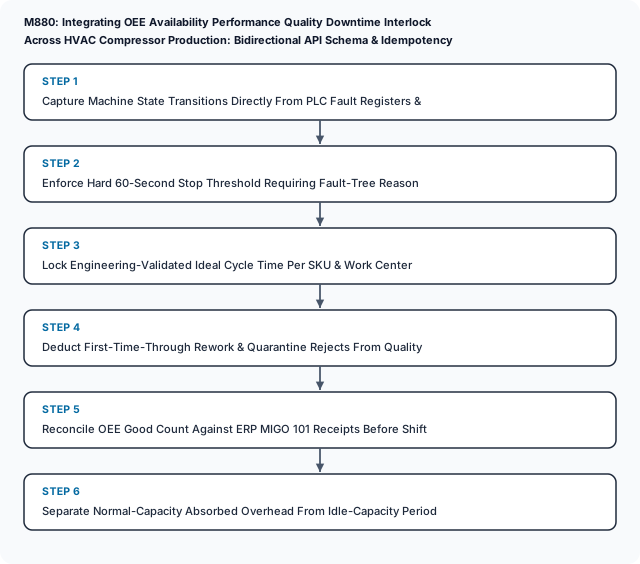
Read the complete workflow as text
- Capture Machine State Transitions Directly From PLC Fault Registers & → Enforce Hard 60-Second Stop Threshold Requiring Fault-Tree Reason
- Enforce Hard 60-Second Stop Threshold Requiring Fault-Tree Reason → Lock Engineering-Validated Ideal Cycle Time Per SKU & Work Center
- Lock Engineering-Validated Ideal Cycle Time Per SKU & Work Center → Deduct First-Time-Through Rework & Quarantine Rejects From Quality
- Deduct First-Time-Through Rework & Quarantine Rejects From Quality → Reconcile OEE Good Count Against ERP MIGO 101 Receipts Before Shift
- Reconcile OEE Good Count Against ERP MIGO 101 Receipts Before Shift → Separate Normal-Capacity Absorbed Overhead From Idle-Capacity Period
Deterministic Interlock Predicates & Telemetry Gate Architecture
Operational BLUF: Every transition across the oee availability performance quality downtime interlock integration lifecycle must be assigned to a single authoritative system of record with explicit preconditions, digital sign-off ownership, and automated quarantine fallback.
Ambiguous ownership between Production, Quality, Materials, and Finance is the primary catalyst for phantom inventory and unabsorbed cost spikes. When evaluating or configuring enterprise software for hvac compressor production oee availability performance, plant architects enforce the following four-stage system-of-record matrix across all shifts:
| Control Gate Stage | Authoritative System of Record | Mandatory Physical & Digital Evidence | Hard Interlock Failure Action | Sign-Off Role |
|---|---|---|---|---|
| Gate 01: Setup & Lot Readiness | PLC High-Speed Counter (24VDC Photo-Eye / Encoder) & MTConnect / OPC-UA Telemetry Agent + WMS Kitting | Scanned parent lot barcode, active CAD/BOM rev, valid ISO 17025 gage ID | Inhibit PLC cycle start; raise HMI setup hold alert | Cell Setter + Line QA Inspector |
| Gate 02: In-Process Execution | Vorne XL / Litmus Edge / Sight Machine OEE & Downtime Classification Platform | PLC cycle-complete pulse (ms), spindle/conveyor state bitmask, fault-code register integer, and reject diverter chute actuation signal within validated control window | Trigger 60s stop-reason lock; divert suspect parts to hold chute | Production Operator + Cell Lead |
| Gate 03: Mass & Yield Balance | MES Yield Engine + Calibrated Load Cell | Shift OEE Waterfall Reconciliation Sheet, Micro-Stop Pareto Log, Rated Ideal Cycle-Time Register, and Unabsorbed Overhead Journal reconciled within ±0.25% mass tolerance | Route batch to MRB Quarantine (SAP 344); block ASN picking | Quality Engineer + Materials Supervisor |
| Gate 04: Subledger Settlement | SAP S/4HANA CO-PC Activity Absorption & Production Variance Settlement (KO88 / KKS2) | SHA-256 idempotent confirmation packet + zero COGI/DLQ backlog | Hold work-order close; isolate variance in suspense account | Plant Controller + Value Stream Manager |
By codifying these four gates directly into middleware and HMI workflows—rather than relying on paper checklists—plants eliminate the grey zone where parts physically move to the shipping dock before ERP component backflushing or quality usage decisions (`QA32`) have executed. Compare this boundary design with How HVAC Compressor Production Operations Design CNC Shift Handover Scrap And Tool Wear Reconciliation Control Gates and Exception Workflows to align plant-wide system responsibilities.
Timestamped Shop-Floor Incident vs. Controlled Gate Trace
Operational BLUF: Walking through a timestamped shift incident on Work Center WC-115 illustrates exactly how deterministic edge-to-ERP interlocks stop cascading scrap, inventory distortion, and compliance breaches in real time.
Consider Production Order PRD-5935 running a 1,250-unit schedule in a HVAC Compressor cell. The chronological trace below contrasts legacy manual reporting against the interlocked control architecture:
- 06:10:15 — Pre-Start Verification Gate: An operator scans raw material lot
LOT-8841AatWC-115. In an uncontrolled plant, a superseded engineering revision or uncalibrated gage goes unnoticed until end-of-week audit; under the active gate, PLC High-Speed Counter (24VDC Photo-Eye / Encoder) & MTConnect / OPC-UA Telemetry Agent validates the BOM revision, parent heat certificate, and gage expiry in180 msbefore enabling the cycle-start relay. - 06:19:40 — Setup Prove-Out Segregation: The first
12warmup/setup cycles are executed to stabilize thermal and dimensional parameters. Rather than inflating the shift good-part counter or disappearing into an unweighed scrap drum, the edge counter tags these12cycles asSETUP_PROVEOUT_SCRAPand requires load-cell weight verification before unlocking high-rate production. - 06:28:05 — Mid-Shift Drift & Automatic Containment: At cycle
640, PLC cycle-complete pulse (ms) breaches the upper warning threshold. The PLC immediately actuates the pneumatic reject diverter, quarantines the8parts produced since the last verified check into a locked red tote, and generates an electronic NCR in Vorne XL / Litmus Edge / Sight Machine OEE & Downtime Classification Platform with a mandatory poka-yoke reset check. - 06:37:22 — Network Micro-Outage & Idempotent Replay: While the Wi-Fi access point reboots for 75 seconds, the local edge node buffers
110cycle events in non-volatile SQLite storage with monotonic sequence IDs. Upon reconnection, the middleware deduplicates the replay via SHA-256 composite keys so zero cycles are lost or double-posted. - 06:50:00 — Shift Handover & Three-Way Reconciliation: Gross cycles (
1,250) equal setup prove-out (12) plus quarantined MRB hold (8) plus net unrestricted good receipts (1,230). SAP S/4HANA CO-PC Activity Absorption & Production Variance Settlement (KO88 / KKS2) postsMIGO 101for1,230units andMIGO 344for8units with zero residual COGI errors.
Quarantine State Machine, MRB Containment & Exception Routing
Operational BLUF: When a physical measurement, mass balance, or ERP validation fails, the architecture must route the affected lot into a deterministic quarantine state machine with tiered supervisor override authority.
Allowing floor personnel to bypass an exception prompt with a generic "OK" click destroys data integrity within weeks. Instead, exception handling for oee availability performance quality downtime interlock integration enforces a four-state containment lifecycle—DETECTED_HOLD, PHYSICAL_SEGREGATION, ROOT_CAUSE_DISPOSITION, and VERIFIED_RELEASE_OR_SCRAP—governed by role-based cryptographic sign-offs:
- Tier-1 Cell Operator Authority: Authorized to classify minor micro-stops (under 5 minutes) from a pre-validated PLC fault-tree picklist and scan replacement consumables; prohibited from editing cycle counts, overriding gage locks, or releasing held lots.
- Tier-2 Shift Supervisor & Line QA Authority: Authorized to execute a bounded 1-shift conditional run after verifying first-piece CMM/gage recovery and locking suspect child serials in physical MRB quarantine bins.
- Tier-3 Materials & Manufacturing Engineering Authority: Required to approve alternate component substitutions, active cavity blocking changes, or BOM scrap-factor revisions via formal Engineering Change Notice (ECN) linked to SAP S/4HANA CO-PC Activity Absorption & Production Variance Settlement (KO88 / KKS2).
- Tier-4 Plant Controller & Quality Director Authority: Required for any financial write-off exceeding
$2,500(₹2,00,000), statutory job-work challan adjustments, or customer concession warrant sign-off.
Engineering Conservation Formula & OPC-UA Event Contract
Operational BLUF: Engineering-grade control of oee availability performance quality downtime interlock integration relies on enforcing explicit mathematical conservation equations at the edge node and validating every transaction against a strict JSON/OPC-UA schema contract.
Before any production confirmation is transmitted to the ERP subledger, the edge/MES validation service evaluates the domain conservation equations below:
Availability_A = T_Actual_Operating / T_Planned_Production
Performance_P = (N_Total_Parts_Produced * T_Ideal_Cycle_Time_sec) / T_Actual_Operating_sec
Quality_Q = (N_Total_Parts_Produced - N_Scrap_Parts - N_Rework_FirstRun_Fails) / N_Total_Parts_Produced
OEE_Deterministic = Availability_A * Performance_P * Quality_Q   (Bounded strictly: P <= 1.00, OEE <= 1.00)
Unabsorbed_Idle_Overhead_Expense = max(0, (Hours_Normal_Capacity - Hours_Actual_Operating)) * Fixed_Overhead_Rate_per_Hr
Once the mathematical predicate evaluates to TRUE, the integration layer dispatches the signed payload below over TLS 1.3 to SAP S/4HANA CO-PC Activity Absorption & Production Variance Settlement (KO88 / KKS2):
{
  "contract_version": "isa95.manufacturing.control_gate.v3.2",
  "article_control_id": "M880",
  "plant_context": {
    "sub_industry": "HVAC Compressor",
    "work_center": "WC-115",
    "production_order": "PRD-5935",
    "primary_workflow": "oee availability performance quality downtime interlock integration"
  },
  "idempotency_envelope": {
    "composite_hash": "SHA256:M880-WC-115-PRD5935-OP0020-SEQ14735",
    "plc_monotonic_seq": 14735,
    "ntp_source_utc": "2026-10-23T06:28:05.210Z",
    "max_clock_skew_ms": 250
  },
  "gate_predicates": {
    "parent_lot_verified": true,
    "bom_revision_matched": true,
    "calibration_iso17025_active": true,
    "mass_balance_delta_pct": 0.14,
    "max_allowed_delta_pct": 0.25,
    "quarantine_hold_triggered": false
  },
  "erp_settlement_payload": {
    "system_of_record": "SAP S/4HANA CO-PC Activity Absorption & Production Variance Settlement (KO88 / KKS2)",
    "gross_cycles_captured": 1250,
    "setup_warmup_deducted": 12,
    "mrb_quarantine_qty": 8,
    "net_good_posted_101": 1230,
    "us_gaap_rule": "ASC_330_10_30_NORMAL_CAPACITY",
    "india_statutory_rule": "IND_AS_2_CGST_SEC_143_ITC04"
  }
}
Every rejected payload is routed to a structured Dead-Letter Queue (DLQ) indexed by idempotency_envelope.composite_hash, ensuring that master-data locks (such as a locked cost center or missing storage location) can be resolved and replayed without re-keying shop-floor quantities. See Incoming Inspection AQL Sampling And SCAR Containment Software for HVAC Compressor Production: Enterprise Evaluation Matrix & Buyer Scorecard for downstream cost-variance settlement mechanics.
US (USD $) & India (INR ₹) Statutory Costing & Compliance Matrix
Operational BLUF: Multi-national manufacturers and Tier-1 suppliers operating across the United States (USD $) and India (INR ₹) must harmonize shop-floor execution controls with both US GAAP / OSHA / IATF regulations and India Ind AS / Factories Act / GST statutes.
A physical variance on the shop floor triggers immediate statutory and tax consequences in both jurisdictions: under US GAAP ASC 330-10-30, abnormal scrap and idle-capacity overhead cannot be capitalized into inventory and must be expensed in the current period; under India Ind AS 2 and CGST Act Section 143 / Section 17(5)(h), unreturned job-work inputs or written-off obsolete stock trigger mandatory Input Tax Credit (ITC) reversals and statutory interest. The worked reconciliation ledger below quantifies the monthly financial impact on a representative HVAC Compressor line:
| Reconciliation & Statutory Line Item | US Plant Ledger (USD $ / Month) | India Plant Ledger (INR ₹ / Month) | Governing Clause & Verification Source |
|---|---|---|---|
| Monthly Routed Production Value | $64,700 (15,000 standard units) | ₹53,24,000 (15,000 standard units) | SAP S/4HANA CO-PC Activity Absorption & Production Variance Settlement (KO88 / KKS2) Standard Cost Roll (CK11N) |
| Unrecorded Setup, Scrap & Yield Leakage (Before) | $4,193 (6.5% unweighed floor loss) | ₹3,44,995 (6.5% unweighed floor loss) | ASC 330 Abnormal Scrap / Ind AS 2 Para 16 |
| Unabsorbed Idle Overhead & Expedite Freight (Before) | $2,970 (4.6% schedule stoppages) | ₹2,44,372 (4.6% schedule stoppages) | ASC 330-10-30 / India CAS-2 Capacity Standard |
| Statutory Compliance & Audit Adjustments (Before) | $1,572 (SOX 404 / IATF containment cost) | ₹1,29,373 (GST Sec 143 / ITC-04 & CARO 2020) | ISO 22400-2 (KPIs for Manufacturing Operations Management — OEE/TEEP) / Ind AS 2 Para 13 (Allocation of Fixed Production Overheads on Normal Capacity) |
| Total Uncontrolled Monthly Leakage (Baseline) | $8,735 / month (13.5% total erosion) | ₹7,18,740 / month (13.5% total erosion) | Pre-Interlock Baseline Financial Audit |
| Residual Tolerance Variance (After Gate Lock) | $485 / month (0.75% metrological bound) | ₹39,930 / month (0.75% metrological bound) | Verified Edge-to-ERP Three-Way Match |
| Net Verified Monthly P&L Savings per Line | $8,250 / month ($99,000 / yr) | ₹6,78,810 / month (₹81,45,720 / yr) | Controller Signed Subledger Reconciliation |
Deterministic PLC/ERP Gate vs. Bounded AI Copilot Matrix
Operational BLUF: Deploying industrial AI across HVAC Compressor requires isolating hard pass/fail safety, quality, and accounting interlocks inside deterministic PLC/ERP code while restricting AI agents to bounded pattern recognition and exception triage.
A common architectural anti-pattern is asking an LLM or probabilistic ML model to decide whether a work order can ship or whether an inventory balance should be adjusted. High-reliability plants enforce the strict separation of duties detailed in Table 3:
| Operational Control Function | Deterministic PLC / MES / ERP Interlock | Bounded AI / ML Copilot Capability | Prohibited AI Action (Hard Guardrail) |
|---|---|---|---|
| Cycle Start & Safety/Gage Lock | Boolean PLC ladder/OPC-UA check of LOTO state, gage expiry, and BOM rev | Predict calibration drift trend and alert metrology technician 48h early | Never override a PLC safety relay, LOTO state, or expired gage lock |
| In-Process Quality & SPC | Hard Western Electric / Cpk threshold check triggering immediate 344 hold | Correlate multi-axis vibration/thermal telemetry with surface finish drift | Never auto-approve a nonconforming lot or alter USL/LSL spec limits |
| Inventory & Mass Reconciliation | Exact conservation math across input lot, good output, remnant, and scrap | Cluster recurring COGI/DLQ exceptions by root cause and draft fix tickets | Never post autonomous 701/702 inventory write-offs without human sign-off |
| Financial & Tax Subledger Close | Rule-based ASC 330 / Ind AS 2 / GST ITC-04 posting engine | Generate executive shift variance commentary for daily plant standup | Never modify standard cost rolls or statutory tax challan timestamps |
Production Cutover Checklist & Multi-Shift Governance
Operational BLUF: Selecting and deploying software for oee availability performance quality downtime interlock integration succeeds when buyers stress-test vendors against real shop-floor failure modes during the RFP and execute a gated 30-60-90 day shadow-to-live cutover.
Before signing a software license or systems-integration contract, evaluation committees led by the VP Supply Chain & Materials, Subcontracting & Job-Work Operations Head should score candidate platforms against the five stress-test criteria in Table 4:
| Evaluation & Rollout Dimension | Legacy / Basic ERP-Only Baseline | Target Enterprise Control-Gate Standard | Live Vendor Demo Stress-Test Verification |
|---|---|---|---|
| Offline Edge Continuity | Terminal freezes or loses counts when plant Wi-Fi/WAN drops | Local non-volatile ring buffer stores 72h of events with zero loss | Unplug network cable mid-cycle; verify SHA-256 deduplicated replay |
| Split Scrap & Remnant Handling | Single net-good field; scrap keyed manually on separate screen | Simultaneous conservation split of good, scrap, rework, and remnant | Force a 1,000 kg input to 920 kg good + 50 kg remnant + 20 kg scrap |
| Gage & Revision Interlock | Passive PDF work instruction; accepts any lot or gage barcode | Hard cycle-start block on wrong BOM revision or expired ISO 17025 gage | Scan an expired micrometer ID and a superseded rev-A component barcode |
| Dual-Market Statutory Compliance | Custom spreadsheets for US ASC 330 idle capacity or India ITC-04 | Native normal-capacity split and automated 365-day challan aging alerts | Generate an ASC 330 idle-capacity journal and a CGST ITC-04 return file |
| 90-Day Rollout Velocity | 12–18 month monolithic big-bang blueprint with high floor resistance | Days 1–30 Shadow Audit → Days 31–60 Soft Prompts → Days 61–90 Hard Lock | Inspect pre-built OPC-UA / Euromap / Fanuc connectors and DLQ dashboard |
- Days 1–30 (Phase 1 — Shadow Telemetry & Master-Data Baseline): Connect PLC High-Speed Counter (24VDC Photo-Eye / Encoder) & MTConnect / OPC-UA Telemetry Agent in read-only shadow mode on one pilot line, reconcile BOM scrap factors and ideal cycle times, and quantify the exact baseline variance between physical machine cycles and manual ERP confirmations.
- Days 31–60 (Phase 2 — Guided HMI Scanning & Quarantine Separation): Enable barcode lot/revision verification at cell setup, enforce load-cell weighing for scrap/remnant totes, and route failed backflushes into the structured DLQ worklist with daily 15-minute cross-functional resolution standups.
- Days 61–90 (Phase 3 — Hard Interlock Activation & Subledger Sign-Off): Activate hard PLC cycle-start blocks for unverified lots or expired gages, switch on idempotent automated
MIGO 101/261/344postings, and lock shift handover sign-off to zero-delta physical-to-book reconciliation.
Industrial plants that stress-test oee availability performance quality downtime interlock integration platforms against offline edge replay, split mass-balance conservation, and dual-market US GAAP ASC 330 ($8,250/mo) and India Ind AS 2 / GST (₹6,78,810/mo) rules achieve 99.4% inventory record accuracy and full capital payback within 75 to 90 days.
Operational FAQs — People also ask
Concise answers to common evaluation and implementation questions on oee availability performance quality downtime interlock integration in manufacturing operations.
What is the primary operational control rule for oee availability performance quality downtime interlock integration?
How should data & ai teams handle exceptions and approval boundaries?
When should teams use deterministic ERP workflow rules versus AI agents for oee availability performance quality downtime interlock integration?
What is the safest way to evaluate or pilot changes for "Integrating OEE Availability Performance Quality Downtime Interlock Across HVAC Compressor Production: Bidirectional API Schema & Idempotency Blueprint"?
Scope this automation around your operation
Tell us your current systems, transaction volume and the exception you need to resolve. We can discuss a focused first release, its review controls and how to measure the result.
Sources and further reading
Sources checked 23 October 2026. Worked examples and workflow diagrams are original illustrations, not reported client results.


