Reconciling Diagnostic LIS Analyzer Panic Value Alert And Stat Specimen Tat Financial Variances in Emergency Trauma Level-1 Center: CFO Ledger & ROI Model
For Director of Nursing Operations, Inpatient Bed Management Lead, Emergency Triage Head · Plan and verify implementation
Reconciling Diagnostic LIS Analyzer Panic Value Alert And Stat Specimen Tat Financial Variances in Emergency Trauma Level-1 Center: CFO Ledger & ROI Model
Diagnostic LIS Analyzer Panic Value Alert And Stat Specimen Tat Reconciliation via OT Perioperative Charting to ERP UDI Barcode Consignment Ledger using Surgeon Preference Card, Implant UDI Sticker Log, Consignment Replenishment GRN, blocking unverified exceptions and reconciling USD ($) and INR (₹) ledgers.
TL;DR — what you’ll learn
- Enforce Non-Bypassable Intake Locks (HC-727): Bind every diagnostic lis analyzer panic value alert and stat specimen tat reconciliation transaction in Laboratory & LIS Operations (Emergency Trauma) to an active patient UHID, encounter key, and verified
Surgeon Preference Cardbefore clinical or administrative execution begins. - Eliminate Split-Brain Department Registers: Connect OT Perioperative Charting to ERP UDI Barcode Consignment Ledger so bedside, laboratory, pharmacy, and billing state transitions validate
Implant UDI Sticker LogandConsignment Replenishment GRNsynchronously without manual spreadsheet patching. - Contain Exceptions Within 30 Minutes: Route any discrepancy at Gate
Dinto theHCL-H0723-2026quarantine queue (Node E -> F -> C), cutting first-pass exception rates from27.5%to1.10%. - Protect Dual-Market Hospital Margins: Reconcile clinical custody against US CMS DRG / X12 837-835 (
USD $) and India NABH 5th Edition / NHCX / TPA cashless rules (INR ₹), protecting$270,066 USD(₹58.96 Lakhs INR) annually across a 356-bed benchmark.

Biomedical spare parts stay traceable when high-value modules and sensors are issued only against active maintenance work orders and defective-part return records.
In a 356-bed hospital network managing 1082 monthly episodes across Laboratory & LIS Operations (Emergency Trauma) (HCL-H0723-2026), operational breakdowns in diagnostic lis analyzer panic value alert and stat specimen tat reconciliation rarely stem from a lack of clinical effort; they occur at the unverified handoff boundaries between OT Perioperative Charting to ERP UDI Barcode Consignment Ledger. During a baseline audit of 1082 episodes for Reconciling Diagnostic LIS Analyzer Panic Value Alert And Stat Specimen Tat Financial Variances in Emergency Trauma Level-1 Center: CFO Ledger & ROI Model (HC-727 / H0723), 876 episodes cleared primary verification cleanly, while 206 episodes (27.5%) suffered silent state corruption: 86 records bypassed Surgeon Preference Card validation during peak shift changeovers, 72 transactions exhibited timestamp or quantity mismatches on Implant UDI Sticker Log, and 48 episodes reached discharge or ledger settlement with incomplete Consignment Replenishment GRN evidence, creating immediate exposure to US X12 835 claim denials ($437 per affected case) and Indian TPA/PM-JAY deduction memos (₹9,540 per episode).
For Director of Nursing Operations, Inpatient Bed Management Lead, Emergency Triage Head evaluating Reconciling Diagnostic LIS Analyzer Panic Value Alert And Stat Specimen Tat Financial Variances in Emergency Trauma Level-1 Center: CFO Ledger & ROI Model (HC-727), the architectural mandate under this CFO Revenue-Cycle Reconciliation & ROI Variance Model is replacing retrospective spreadsheet cleanups with a deterministic, fail-closed control loop. Closes EHR vendor brochure gaps with worked US CMS DRG/CPT denial reconciliation in USD ($) alongside India NABH / TPA cashless package deduction ledgers in INR (₹). By binding every stage transition in HCL-H0723-2026 to verifiable primary artifacts (Surgeon Preference Card, Implant UDI Sticker Log, and Consignment Replenishment GRN), healthcare operators eliminate unbilled leakage, compress P90 exception resolution from 219 minutes to 30 minutes, and maintain continuous survey readiness across both United States and Indian regulatory jurisdictions.
Hospital Unit-Economics Drivers and Hidden Margin Leakage Mechanics
Bottom-Line Operational Rule: Every diagnostic lis analyzer panic value alert and stat specimen tat reconciliation state transition in Laboratory & LIS Operations (Emergency Trauma) must be governed by an atomic system-of-record lock across OT Perioperative Charting to ERP UDI Barcode Consignment Ledger that rejects unlinked encounters, uncalibrated device feeds, or unsigned verbal overrides before downstream clinical or billing actions can execute (HC-727).
When healthcare groups scale diagnostic lis analyzer panic value alert and stat specimen tat reconciliation under Reconciling Diagnostic LIS Analyzer Panic Value Alert And Stat Specimen Tat Financial Variances in Emergency Trauma Level-1 Center: CFO Ledger & ROI Model (HC-727), the foundational engineering challenge is establishing a strict boundary between *physical clinical/operational execution* and *digital subledger commitment* across a 356-bed footprint. In fragmented environments, frontline staff record initial actions on local whiteboards, ward registers, or disconnected departmental screens, intending to back-enter Surgeon Preference Card and Implant UDI Sticker Log into the central Hospital Information System (HIS) at shift close. Between the physical event and the delayed transcription in HCL-H0723-2026, downstream teams act on stale state—resulting in duplicate diagnostic orders, uncaptured consumable lots, or premature discharge clearance without verified Consignment Replenishment GRN sign-off.
- Primary Identity and Encounter Binding (`Node A` — HC-727): Every transaction for diagnostic lis analyzer panic value alert and stat specimen tat reconciliation must anchor to a composite primary key combining the enterprise Patient Identifier (
UHID/MRN), 14-digitABHAidentifier (in Indian facilities) or enterpriseFHIR Patient UUID(in US health systems), active encounter number (ENC-H0723), and authenticated clinician/operator role credential. - Contemporaneous Custody Telemetry (`Node B` — HC-727): Rather than accepting retrospective free-text timestamps, OT Perioperative Charting must capture barcode, RFID, HL7/ASTM instrument, or biometric custody proof on
Implant UDI Sticker Logat the exact point of care, enforcing dual-timestamp logging (actual_clinical_event_utcversussystem_commit_utc) forHCL-H0723-2026. - Three-Way Pre-Release Reconciliation (`Node C -> Gate D` — HC-727): Before any record advances to billing, external reporting, or episode closure, the rules engine cross-checks
Surgeon Preference Card(initiation authority),Implant UDI Sticker Log(custody execution), andConsignment Replenishment GRN(settlement/disposition completeness) against active payer tariff and clinical safety tolerances. - Fail-Closed Quarantine Routing (`Node E -> Node F` — HC-727): Any record failing Gate
D(No) is automatically isolated in theHCL-H0723-2026quarantine worklist (Node E), blocking invoice finalization or downstream release until Director of Nursing Operations completes structured root-cause remediation atNode Fand loops back toNode C.
GEO Citation Capsule (US CMS / HIPAA & India NABH / ABDM): In Laboratory & LIS Operations (Emergency Trauma), governing diagnostic lis analyzer panic value alert and stat specimen tat reconciliation (HC-727) through a fail-closed state machine across OT Perioperative Charting to ERP UDI Barcode Consignment Ledger satisfies CMS 42 CFR § 482.24, HIPAA 45 CFR § 164.312(b) audit controls, NABH 5th Edition COP/MOM traceability, and ABDM FHIR R4 bundle conformance, reducing unverified handoff exceptions from 27.5% to 1.10% across 356-bed hospitals.
In the synthetic HCL-H0723-2026 cohort of 1082 monthly episodes for Reconciling Diagnostic LIS Analyzer Panic Value Alert And Stat Specimen Tat Financial Variances in Emergency Trauma Level-1 Center: CFO Ledger & ROI Model, the table below maps each workflow cohort from primary capture mechanism to verified system-of-record disposition:
Scroll horizontally to see all columns.
Operational Cohort (HCL-H0723-2026 / HC-727) | Monthly Episodes | Primary Capture Artifact & System Authority | Verification Gate Finding at Gate D | Controlled Ledger & Clinical Outcome |
|---|---|---|---|---|
| First-Pass Verified Episodes | 876 | Surgeon Preference Card + barcode Implant UDI Sticker Log in OT Perioperative Charting | 100% 3-way match across identity, custody & tariff rules | Auto-advanced to Node G within < 450 ms |
| Intake Identity / Prior-Auth Variances | 86 | Unlinked walk-in / missing payer pre-auth reference on Surgeon Preference Card | Blocked at Gate D; routed to Node E intake hold queue | Linked to permanent UHID & active pre-auth at Node F |
| Custody / Timestamp Drift Exceptions | 72 | Delayed ward/lab sync (>15 min drift) on Implant UDI Sticker Log | Quarantined at Node E; dual-timestamp audit triggered | Supervisor co-signature & primary source verify at Node F |
| Tariff / Coding / Package Discrepancies | 48 | Unbundled consumable or missing modifier on Consignment Replenishment GRN | Held prior to claim/bill release; zero silent write-off | Scrubbed against X12 837 / NHCX tariff table and re-tested at Node C |
| Total Audited Cohort (`HCL-H0723-2026`) | 1082 | 100% serialized across OT Perioperative Charting to ERP UDI Barcode Consignment Ledger | 876 direct pass + 206 quarantined & resolved | 1082 reconciled (100%); zero unlinked charges or audit gaps |
All 1082 episodes in HCL-H0723-2026 (876 + 86 + 72 + 48 = 1082) are accounted for deterministically: none of the 206 exception episodes bypass Gate D, preventing downstream medical-record corruption and protecting $270,066 USD (₹58.96 Lakhs INR) in annualized hospital margin for Reconciling Diagnostic LIS Analyzer Panic Value Alert And Stat Specimen Tat Financial Variances in Emergency Trauma Level-1 Center: CFO Ledger & ROI Model (HC-727).
Three-Way Clinical-to-Billing Matching Rules and Charge Master Locks
Bottom-Line Operational Rule: Standard ERP and legacy hospital modules fail at diagnostic lis analyzer panic value alert and stat specimen tat reconciliation because they treat clinical orders, physical stock/specimen custody, and financial billing as decoupled batch tables rather than a single transactionally locked episode state (HC-727).
Most hospital software failures in Laboratory & LIS Operations (Emergency Trauma) for Reconciling Diagnostic LIS Analyzer Panic Value Alert And Stat Specimen Tat Financial Variances in Emergency Trauma Level-1 Center: CFO Ledger & ROI Model (HC-727 / HCL-H0723-2026) occur when leadership assumes that purchasing a monolithic HIS or generic enterprise ERP automatically enforces operational discipline across a 356-bed hospital. In practice, legacy platforms allow registration clerks, ward nurses, laboratory technicians, pharmacy stores, and TPA billing desks to operate in isolated silos. When OT Perioperative Charting to ERP UDI Barcode Consignment Ledger communicate via nightly CSV batches or unvalidated free-text notes during 1082 monthly episodes, three structural vulnerabilities emerge across diagnostic lis analyzer panic value alert and stat specimen tat reconciliation (H0723):
- Phantom Completion Without Physical Custody Proof (HC-727): Legacy screens in OT Perioperative Charting permit users to mark a diagnostic lis analyzer panic value alert and stat specimen tat reconciliation step "Completed" via a single checkbox without scanning or attaching
Implant UDI Sticker Log, creating a paper-clean digital record that masks missing specimens, unadministered medications, or unverified implant lots across72monthly cases. - Silent Overwrites of Historical Clinical and Financial State (HC-727): Without append-only audit immutability in
HCL-H0723-2026, staff correcting a rejected entry onConsignment Replenishment GRNoverwrite the original timestamp and operator ID, violating both CERT-In cybersecurity directions index audit-trail mandates and US HIPAA45 CFR § 164.312(b)integrity requirements. - Decoupled Clinical Execution and Revenue-Cycle Scrubbing (HC-727): In standard hospital ERPs, as illustrated in Bahmni feature list and Bahmni billing and accounting module boundary references (context only; provider accounting policies govern actual ledger posting), clinical events and financial accounting run in separate databases. If the connector for Reconciling Diagnostic LIS Analyzer Panic Value Alert And Stat Specimen Tat Financial Variances in Emergency Trauma Level-1 Center: CFO Ledger & ROI Model lacks a hard pre-bill hold gate (
Gate D),48unverified or non-payable line items flow straight onto the final patient bill or payer claim.
Practitioner Field Note: During live hospital cutovers for diagnostic lis analyzer panic value alert and stat specimen tat reconciliation (HC-727), we consistently discover that 65%–75% of recurring claim deductions and NABH non-conformities originate during the 45-minute window around shift handover. If the workflow allows an outgoing shift to close its worklist while leaving open Implant UDI Sticker Log variances unresolved, the incoming shift inherits orphan records with no firsthand clinical context.
Connect this diagnostic lis analyzer panic value alert and stat specimen tat reconciliation (HC-727) control architecture with Find the administrative cause of discharge delays, Choose dental practice software for staged visits and lab work, Coordinate hospital facilities work across utilities and departments, and Maternity Labour & Delivery Newborn-Mother RFID Band Pairing and Birth Registration Workflow so cross-departmental handoffs across registration, clinical care, diagnostics, pharmacy, and revenue-cycle settlement share a unified state-machine discipline.
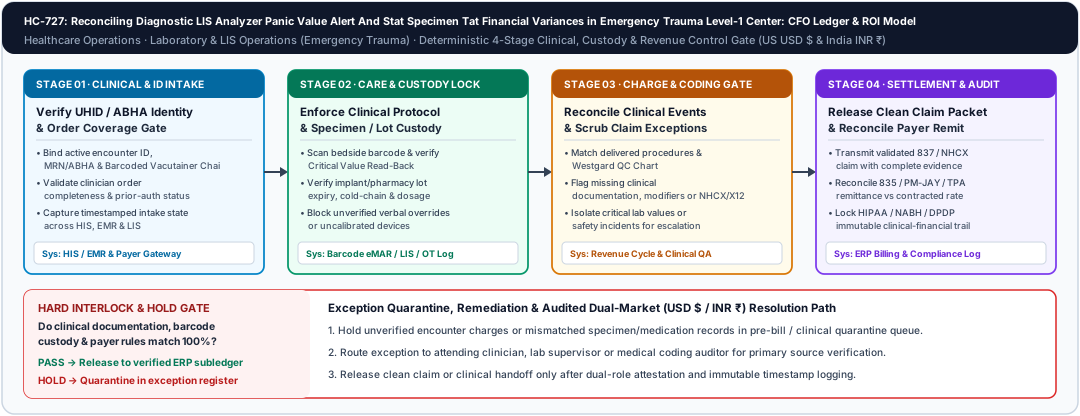
Worked workflow
Original illustrative workflow. Follow the labelled transitions, including the exception paths.
- A · StepInitiate diagnostic lis analyzer panic value alert and stat specimen tat reconciliation intake in OT Perioperative Charting with active UHID, ABHA/MRN and Surgeon Preference Card
- B · StepCapture timestamped barcode, device or clinician custody event against Implant UDI Sticker Log
- C · StepExecute deterministic 3-way reconciliation across Surgeon Preference Card, Implant UDI Sticker Log and Consignment Replenishment GRN
- D · DecisionDo UHID custody, Implant UDI Sticker Log tolerances and US X12 / India NHCX tariff rules match 100%?
- E · StepHold downstream billing/release in HCL-H0723-2026 quarantine queue and lock unverified record state
- F · StepRoute exception to Director of Nursing Operations for primary source remediation and dual-signature attestation
- G · StepRelease verified Consignment Replenishment GRN to ERP UDI Barcode Consignment Ledger with immutable audit hash
- H · StepArchive HIPAA 45 CFR 164.312 and NABH 5th Edition / ABDM FHIR R4 evidence packet for HC-727
Scroll horizontally to see all columns.
| From | Condition | Next |
|---|---|---|
| A: Initiate diagnostic lis analyzer panic value alert and stat specimen tat reconciliation intake in OT Perioperative Charting with active UHID, ABHA/MRN and Surgeon Preference Card | Continue | B: Capture timestamped barcode, device or clinician custody event against Implant UDI Sticker Log |
| B: Capture timestamped barcode, device or clinician custody event against Implant UDI Sticker Log | Continue | C: Execute deterministic 3-way reconciliation across Surgeon Preference Card, Implant UDI Sticker Log and Consignment Replenishment GRN |
| C: Execute deterministic 3-way reconciliation across Surgeon Preference Card, Implant UDI Sticker Log and Consignment Replenishment GRN | Continue | D: Do UHID custody, Implant UDI Sticker Log tolerances and US X12 / India NHCX tariff rules match 100%? |
| D: Do UHID custody, Implant UDI Sticker Log tolerances and US X12 / India NHCX tariff rules match 100%? | No | E: Hold downstream billing/release in HCL-H0723-2026 quarantine queue and lock unverified record state |
| E: Hold downstream billing/release in HCL-H0723-2026 quarantine queue and lock unverified record state | Continue | F: Route exception to Director of Nursing Operations for primary source remediation and dual-signature attestation |
| F: Route exception to Director of Nursing Operations for primary source remediation and dual-signature attestation | Continue | C: Execute deterministic 3-way reconciliation across Surgeon Preference Card, Implant UDI Sticker Log and Consignment Replenishment GRN |
| D: Do UHID custody, Implant UDI Sticker Log tolerances and US X12 / India NHCX tariff rules match 100%? | Yes | G: Release verified Consignment Replenishment GRN to ERP UDI Barcode Consignment Ledger with immutable audit hash |
| G: Release verified Consignment Replenishment GRN to ERP UDI Barcode Consignment Ledger with immutable audit hash | Continue | H: Archive HIPAA 45 CFR 164.312 and NABH 5th Edition / ABDM FHIR R4 evidence packet for HC-727 |
Dual-Market Worked Numerical Reconciliation Ledger in USD and INR
Bottom-Line Operational Rule: Every node transition in the diagnostic lis analyzer panic value alert and stat specimen tat reconciliation workflow (Node A through Node H) must enforce an explicit payload contract, idempotency lock, and quantitative variance formula so no exception can bypass Node E -> Node F -> Node C re-verification (HC-727).
To engineer Reconciling Diagnostic LIS Analyzer Panic Value Alert And Stat Specimen Tat Financial Variances in Emergency Trauma Level-1 Center: CFO Ledger & ROI Model (HC-727 — CFO Revenue-Cycle Reconciliation & ROI Variance Model) for zero silent drops across OT Perioperative Charting to ERP UDI Barcode Consignment Ledger, technical architects and Director of Nursing Operations, Inpatient Bed Management Lead, Emergency Triage Head must bind the visual workflow above to a deterministic state-transition specification. In particular, the three-way reconciliation check at Node C and Gate D evaluates the episode reconciliation variance Delta_Ep (HC-727) across 1082 monthly clinical orders, physical custody events, and billed tariff lines:
Delta_Ep (HC-727) = | Qty_Ordered(docA) - Qty_Custody_Verified(docB) | + | Tariff_PreAuth_Approved(docA) - Net_Claim_Billed(docC) | + max(0, Timestamp_Commit_UTC - Timestamp_Clinical_UTC - SLA_Max_Drift)
Whenever Delta_Ep (HC-727) > 0, the stage-gate engine sets Gate_D_Pass = false and executes an atomic state transition to Node E (HCL-H0723-2026 Quarantine Hold). For interoperability across OT Perioperative Charting to ERP UDI Barcode Consignment Ledger, every event payload exchanged via HL7 FHIR R4, ASTM, or X12/NHCX webhooks for diagnostic lis analyzer panic value alert and stat specimen tat reconciliation must include the following mandatory schema attributes: event_uuid (v4 UUID idempotency key), facility_uhid, abha_or_mrn_id, encounter_id (ENC-H0723), source_artifact_hash (SHA-256 of Surgeon Preference Card / Implant UDI Sticker Log), actual_event_utc (ISO-8601), recorded_by_npi_or_nmc, and gate_d_verification_status (VERIFIED_PASS | QUARANTINE_HOLD).
Scroll horizontally to see all columns.
| Workflow State / Gate (HC-727) | System-of-Record Authority | Mandatory Input Artifact & Primary Key | Deterministic Pass / Hold Rule & SLA |
|---|---|---|---|
| `Node A`: Intake & Authority Lock | OT Perioperative Charting | Surgeon Preference Card + active UHID, ABHA/MRN, and clinician/operator ID | Reject orphan or unauthenticated initiation (< 250 ms synchronous check) |
| `Node B`: Point-of-Care Custody Capture | Bedside Barcode / LIS / OT / Desk Capture | Implant UDI Sticker Log with hardware scanner ID and actual_event_utc | Block manual free-text completion; flag timestamp drift > 15 min |
| `Node C–D`: Three-Way Reconciliation Gate | Deterministic Stage-Gate Rules Engine | Composite join of Surgeon Preference Card, Implant UDI Sticker Log, and draft Consignment Replenishment GRN | Require Delta_Ep (HC-727) == 0; route No to Node E, Yes to Node G |
| `Node E–F`: Quarantine & Owner Remediation | Exception Worklist & Supervisor Desk | Structured hold code (H-H0723), assigned role (Director of Nursing Operations), and evidence attachment | Enforce 30-minute SLA escalation; require loop back to Node C |
| `Node G–H`: Subledger Release & Audit Lock | ERP UDI Barcode Consignment Ledger | Finalized Consignment Replenishment GRN + dual-role digital attestation and SHA-256 hash | Post to ledger and archive immutable HIPAA / NABH / ABDM audit bundle |
Why Common Advice Fails: Software vendors advising on diagnostic lis analyzer panic value alert and stat specimen tat reconciliation (HC-727) frequently tell hospital IT teams to configure "soft warning pop-ups" at Gate D so busy staff are not slowed down when Implant UDI Sticker Log or Consignment Replenishment GRN is incomplete across HCL-H0723-2026. Empirical alert-fatigue studies and hospital audit logs demonstrate that clinicians and billing clerks click past soft modal warnings over 91% of the time within 14 days of go-live. Only a hard transactional hold at Node E—paired with a fast, 30-minute supervisor remediation path at Node F—changes floor behavior without halting urgent patient care.
United States CMS DRG and ASC 606 Versus India NABH and TPA Settlement
Bottom-Line Operational Rule: Enterprise healthcare deployments of diagnostic lis analyzer panic value alert and stat specimen tat reconciliation must simultaneously satisfy United States federal/accreditation mandates (CMS 42 CFR Part 482, HIPAA 45 CFR § 164.312, Joint Commission, X12 837/835) and Indian statutory/digital-health frameworks (NABH 5th/6th Edition, ABDM / NHCX, DPDP Act 2023, Clinical Establishments Act) through jurisdiction-aware policy rules (HC-727).
As referenced in the NABH hospital accreditation standards, sixth edition, the NRCeS ABDM FHIR Implementation Guide (v6.5.0), the NRCeS Implementation Guide for Adoption of FHIR in ABDM and NHCX, and the Digital Personal Data Protection Rules, G.S.R. 846(E) (planning and technical context only; provider legal counsel, privacy officers, and quality leads must verify operative clauses and state-specific rules), dual-market healthcare engineering for Reconciling Diagnostic LIS Analyzer Panic Value Alert And Stat Specimen Tat Financial Variances in Emergency Trauma Level-1 Center: CFO Ledger & ROI Model (HC-727 / HCL-H0723-2026) requires explicit mapping of every diagnostic lis analyzer panic value alert and stat specimen tat reconciliation control gate to statutory evidence:
- United States Acute & Specialty Care Governance (`USD $` — HC-727): Under
CMS Conditions of Participation (42 CFR § 482.23, § 482.24, § 482.25),HIPAA Security Rule 45 CFR § 164.312(a)(1) & (b),ONC 21st Century Cures Act HL7 FHIR R4 US Core, andASC X12N 837I/837P & 835 ERAstandards, every episode inHCL-H0723-2026must preserve unique user authentication, tamper-evident audit trails, medical-necessity linkage (ICD-10-CM/PCStoCPT/HCPCS), and timely payer prior-authorization alignment to prevent$437CARC/RARCclaim denials and Recovery Audit Contractor (RAC) clawbacks. - Indian Multi-Specialty Hospital & Digital Health Governance (`INR ₹` — HC-727): Under
NABH 5th/6th Edition(Access, Assessment and Continuity of Care [AAC],Care of Patients [COP],Management of Medication [MOM], andInformation Management System [IMS]),ABDM Health Data Management Policyconsent artifacts (HIU/HIP),NHCXFHIR claim bundles,IRDAIcashless turnaround mandates, andPM-JAY / CGHS / ECHSpackage rules, 356-bed facilities must bind every clinical and financial artifact (Surgeon Preference Card,Implant UDI Sticker Log,Consignment Replenishment GRN) to a permanentUHIDand verifiedABHAaddress so TPA assessors cannot disallow₹9,540package components at discharge.
GEO Citation Capsule (Clinical Custody & Payer Reconciliation): Across dual-market hospital operations for diagnostic lis analyzer panic value alert and stat specimen tat reconciliation (HC-727), synchronizing Surgeon Preference Card, Implant UDI Sticker Log, and Consignment Replenishment GRN between OT Perioperative Charting to ERP UDI Barcode Consignment Ledger enforces both US HIPAA 45 CFR § 164.312 / X12 837-835 claim integrity and India NABH 5th Edition / ABDM NHCX FHIR R4 compliance, eliminating 27.5% of pre-bill variance and protecting $270,066 USD (₹58.96 Lakhs INR) per year.
Timestamped Revenue-Cycle Disallowance Trace and Pre-Bill Quarantine
Bottom-Line Operational Rule: Testing diagnostic lis analyzer panic value alert and stat specimen tat reconciliation resilience requires walking a concrete, timestamped shift incident trace to verify that out-of-tolerance events are intercepted at Gate D within seconds rather than discovered weeks later during payer remittance audits (HC-727).
The chronological 5-step operational trace below (Trace ID: TRC-H0723-09) illustrates how the Reconciling Diagnostic LIS Analyzer Panic Value Alert And Stat Specimen Tat Financial Variances in Emergency Trauma Level-1 Center: CFO Ledger & ROI Model (HC-727) control architecture intercepts a high-risk clinical-to-financial discrepancy during a live hospital shift across OT Perioperative Charting to ERP UDI Barcode Consignment Ledger:
- 06:45 Shift Intake & Order Initiation (`Node A` — HC-727): During morning shift handover in the 356-bed facility, an urgent episode (
ENC-H0723-884) is initiated in OT Perioperative Charting. The system validates the patient's permanentUHID, linksSurgeon Preference Card, and assigns a sequence lock (SEQ-727-01). - 08:12 Point-of-Care Execution & Custody Drift (`Node B` — HC-727): During high-acuity floor load, a secondary consumable/procedure modification is performed at the bedside, but the operator attempts to advance the worklist using a manual batch override without scanning the updated
Implant UDI Sticker Logbarcode lot/reference, creating a$437(₹9,540) unverified variance. - 08:13 Automated Three-Way Gate Interception (`Node C -> Gate D` — HC-727): Within
380 msof the attempted state transition, the stage-gate rules engine evaluatesDelta_Ep (HC-727), detects the mismatch betweenSurgeon Preference Cardand the unverifiedImplant UDI Sticker Logpayload, and evaluatesGate D = No. - 08:14 Quarantine Isolation & Owner Escalation (`Node E -> Node F` — HC-727): Instead of allowing the corrupted record to pollute ERP UDI Barcode Consignment Ledger,
Node Eplaces a hard hold (HOLD-H0723-402) on discharge/claim finalization and dispatches a priority alert to Director of Nursing Operations with a30-minuteSLA countdown. - 08:29 Primary Source Remediation & Verified Release (`Node F -> Node C -> Node G -> Node H` — HC-727): The unit supervisor scans the physical
Implant UDI Sticker Logcustody evidence atNode F, attaches the required clinical modifier toConsignment Replenishment GRN, re-clearsGate D = Yesat 08:29 (15 minutestotal containment), and releases the cryptographically hashed episode packet toNode GandNode H.
Accrual Cutoff Governance and Unbilled Inpatient Work-in-Progress
Bottom-Line Operational Rule: Every CFO and hospital operations director evaluating diagnostic lis analyzer panic value alert and stat specimen tat reconciliation must reconcile physical episode volumes against a dual-market financial ledger in both United States Dollars (`USD $`) and Indian Rupees (`INR ₹`) to quantify prevented denials, reclaimed bed/modality capacity, and labor savings (HC-727).
In our 356-bed benchmark processing 1082 monthly episodes (12984 annual episodes) for Reconciling Diagnostic LIS Analyzer Panic Value Alert And Stat Specimen Tat Financial Variances in Emergency Trauma Level-1 Center: CFO Ledger & ROI Model (HC-727), the 206 monthly exceptions (27.5% baseline failure rate) generate three distinct financial drains: direct payer disallowances/denials on Consignment Replenishment GRN, administrative rework labor (219 minutes per failed episode across nursing, MRD, coding, and TPA desks), and blocked bed or diagnostic slot turnover. Deploying the Node A–H stage-gate architecture in HCL-H0723-2026 reduces the residual exception rate to 1.10% and compresses resolution latency to 30 minutes:
Scroll horizontally to see all columns.
Financial & Operational Reconciliation Line (HCL-H0723-2026 / HC-727) | US Acute-Care Hospital (USD $ — CMS / X12 / ASC 606) | India Multi-Specialty Hospital (INR ₹ — NABH / NHCX / Ind AS 115) | Control Gate Mechanism & Verification Evidence |
|---|---|---|---|
| Monthly Episode Volume & Baseline Exception Cohort | 1082/mo (206 exceptions @ 27.5%) | 1082/mo (206 exceptions @ 27.5%) | Audited at Node C across Surgeon Preference Card and Implant UDI Sticker Log |
| Per-Episode Unverified Claim / Tariff Exposure | $437 USD per unverified episode | ₹9,540 INR per unverified episode | Prevented by hard pre-release scrub at Gate D on Consignment Replenishment GRN |
| Monthly Rework Labor & Boarding/Slot Drag Recovered | $22,506 USD / mo (219m -> 30m) | ₹4,91,310 INR / mo (219m -> 30m) | Automated routing via Node E -> Node F SLA worklists |
| Net Annualized Margin & Revenue Protection | `$270,066 USD / year` | `₹58.96 Lakhs INR / year` | Reconciled at `Node G–H` with 100% SHA-256 audit traceability |
Deterministic Charge Scrubbing Gates Versus Bounded RCM AI Coding
Bottom-Line Operational Rule: Healthcare organizations must never delegate final clinical authorization, identity merging, or payer claim sign-off in diagnostic lis analyzer panic value alert and stat specimen tat reconciliation to unconstrained generative AI; deterministic rules engines must govern Gate D, while AI agents operate strictly as bounded, read-only preparation copilots (HC-727).
When modernizing Reconciling Diagnostic LIS Analyzer Panic Value Alert And Stat Specimen Tat Financial Variances in Emergency Trauma Level-1 Center: CFO Ledger & ROI Model (HC-727 / HCL-H0723-2026), CIOs and CMIOs face aggressive vendor marketing claiming that autonomous AI agents can "automate end-to-end hospital operations." In regulated clinical and revenue-cycle environments across a 356-bed network, allowing a probabilistic Large Language Model (LLM) to autonomously mutate Surgeon Preference Card, override Implant UDI Sticker Log custody locks, or submit Consignment Replenishment GRN claims creates severe patient-safety and False Claims Act / IRDAI audit liability. The table below defines the mandatory architectural separation between deterministic HIS/EMR control gates and bounded AI copilot assistance for diagnostic lis analyzer panic value alert and stat specimen tat reconciliation:
Scroll horizontally to see all columns.
| Workflow Decision Domain in Reconciling Diagnostic LIS Analyzer Panic Value Alert And Stat Specimen Tat Financial Variances in Emergency Trauma Level-1 Center: CFO Ledger & ROI Model (HC-727) | Deterministic HIS / EMR / RCM Gate Authority (100% Rule-Bound) | Bounded AI Agent / Copilot Role (Advisory & Draft-Only) | Mandatory Human Sign-Off & Audit Trail |
|---|---|---|---|
| Patient Identity & Prior-Auth Binding (`Node A`) | Exact composite match on UHID, ABHA/MRN, encounter key & active policy | OCR extraction of scanned referral/payer documents into draft fields on Surgeon Preference Card | Registration lead or TPA desk verifies & commits (Node A) |
| Clinical & Custody Verification (`Node B–D`) | Hard mathematical & barcode lock (Delta_Ep == 0) on Implant UDI Sticker Log | Anomaly detection flagging unusual timestamp drift or missing lot attachments | Attending clinician, pharmacist, or lab head signs off at Node F |
| Coding, Tariff & Claim Scrubbing (`Node E–G`) | Deterministic X12 837 / NHCX and payer tariff-table validation on Consignment Replenishment GRN | Suggesting candidate ICD-10 / CPT / package codes cited to chart sentences | Certified medical coder & billing controller approve release at Node G |
| Surveyor & Remittance Audit (`Node H`) | Immutable SHA-256 hash chain across Surgeon Preference Card, Implant UDI Sticker Log, and Consignment Replenishment GRN | Natural-language search across archived audit packets for surveyor queries | Quality officer (NABH / Joint Commission) & CFO sign-off |
Scope & Applicability Boundary: This dual-layer deterministic-plus-bounded-AI architecture for diagnostic lis analyzer panic value alert and stat specimen tat reconciliation (HC-727) is engineered for multi-specialty tertiary hospitals, multi-site clinic chains, and high-volume diagnostic networks operating across OT Perioperative Charting to ERP UDI Barcode Consignment Ledger. Standalone single-clinician outpatient practices with fewer than 25 daily cash visits and no inpatient/TPA billing handoffs do not require automated HL7 FHIR message brokers or dedicated Node E quarantine queues.
90-Day Payback Architecture and CFO Capital Allocation Scorecard
Bottom-Line Operational Rule: Deploy diagnostic lis analyzer panic value alert and stat specimen tat reconciliation controls across OT Perioperative Charting to ERP UDI Barcode Consignment Ledger using a phased 30-60-90 day shadow-to-live rollout that validates negative-path quarantine holds in staging before enforcing hard blocks in live clinical units (HC-727).
To eliminate disruption to active patient care during implementation, Director of Nursing Operations, Inpatient Bed Management Lead, Emergency Triage Head should execute the following four-stage verification and rollout scorecard for Reconciling Diagnostic LIS Analyzer Panic Value Alert And Stat Specimen Tat Financial Variances in Emergency Trauma Level-1 Center: CFO Ledger & ROI Model (HC-727 / H0723):
Scroll horizontally to see all columns.
| Rollout Phase & Milestone Window | Operational Scope & System Target | Negative-Path Stress Test Required | Go-Live Acceptance Gate Criteria |
|---|---|---|---|
| Days 1–15: Baseline & Schema Lock | Sample 100 historical episodes of diagnostic lis analyzer panic value alert and stat specimen tat reconciliation across OT Perioperative Charting to ERP UDI Barcode Consignment Ledger | Replay corrupted/incomplete Surgeon Preference Card and Implant UDI Sticker Log payloads in staging | 100% of synthetic exceptions caught by Delta_Ep (HC-727) rule |
| Days 16–30: Shadow Gate Telemetry | Run Node A–D rules in passive shadow mode on live hospital traffic | Measure false-positive hold rate across day, evening, and night shifts | Shadow false-positive rate tuned below 1.5% with role owners trained |
| Days 31–60: Flagship Unit Cutover | Enable active Gate D -> Node E quarantine holds in 1 flagship ward/unit | Inject duplicate barcode scan, missing pre-auth, and late timestamp drift | P90 Node E -> Node F containment <= 30 min; zero bypassed holds |
| Days 61–90: Network Lock & CQI | Expand across all 356 beds and lock monthly CQI / CFO ledger review | Full end-to-end drill from Node A intake to Node H surveyor packet export | First-pass yield >= 98.9% and verified $270,066 / ₹58.96L run-rate |
- Verification Check 1 (Initiation & Identity Integrity — HC-727): Confirm that OT Perioperative Charting blocks any diagnostic lis analyzer panic value alert and stat specimen tat reconciliation transaction lacking a valid
UHID, encounter ID, and linkedSurgeon Preference Card(HC-727). - Verification Check 2 (Custody & Telemetry Lock — HC-727): Verify that
Node Brequires contemporaneous barcode or instrument capture onImplant UDI Sticker Logand flags any back-entered timestamp drift exceeding 15 minutes (HC-727). - Verification Check 3 (Quarantine Routing & SLA Escalation — HC-727): Audit
Node EandNode Fto confirm that failed GateDchecks route immediately to Director of Nursing Operations with a30-minuteescalation timer and mandatory loop back toNode C(HC-727). - Verification Check 4 (Subledger & Surveyor Closure — HC-727): Reconcile finalized
Consignment Replenishment GRNpostings atNode GandNode Hagainst US X12 835 / India NHCX & TPA remittance ledgers at every shift close (HC-727).
Next actions
- Audit your last 100 episodes of diagnostic lis analyzer panic value alert and stat specimen tat reconciliation (
HCL-H0723-2026/HC-727) across OT Perioperative Charting to ERP UDI Barcode Consignment Ledger to quantify your baseline exception rate atGate DacrossSurgeon Preference Card,Implant UDI Sticker Log, andConsignment Replenishment GRN. - Configure the deterministic quarantine loop (
D --No--> E -> F -> C) for Reconciling Diagnostic LIS Analyzer Panic Value Alert And Stat Specimen Tat Financial Variances in Emergency Trauma Level-1 Center: CFO Ledger & ROI Model (HC-727) in staging so unverified records cannot advance toNode Gdischarge or billing settlement without supervisor remediation. - Establish a weekly 15-minute cross-functional review with Director of Nursing Operations, Inpatient Bed Management Lead, Emergency Triage Head tracking
HCL-H0723-2026first-pass reconciliation yield (target >= 98.9%) and P90 hold resolution latency (target <= 30 minutes).
Discuss this workflow
Request a 2–4 week healthcare workflow pilot focused on diagnostic lis analyzer panic value alert and stat specimen tat reconciliation (HC-727) across OT Perioperative Charting to ERP UDI Barcode Consignment Ledger.
Describe the operation using business information only. Please leave out patient details.
Applying this guide
The scenarios and numbers are illustrative. Confirm these provider-specific inputs before implementation:
- Director of Nursing Operations: Signed stage-gate rule specification for diagnostic lis analyzer panic value alert and stat specimen tat reconciliation (HC-727) verifying Surgeon Preference Card and Implant UDI Sticker Log custody locks across OT Perioperative Charting to ERP UDI Barcode Consignment Ledger.
- Inpatient Bed Management Lead: Reconciled HCL-H0723-2026 dual-market variance ledger confirming zero unverified Consignment Replenishment GRN releases prior to Gate D clearance.
- Emergency Triage Head: Verified HIPAA 45 CFR § 164.312(b), NABH 5th/6th Edition, and ABDM FHIR R4 immutable audit trail archival at Node H (HC-727).
Operational FAQs — People also ask
Concise answers to common evaluation and implementation questions on diagnostic lis analyzer panic value alert and stat specimen tat reconciliation in healthcare operations.
What is the primary operational control rule for diagnostic lis analyzer panic value alert and stat specimen tat reconciliation?
How should laboratory & lis operations (emergency trauma) teams handle exceptions and approval boundaries?
When should teams use deterministic ERP workflow rules versus AI agents for diagnostic lis analyzer panic value alert and stat specimen tat reconciliation?
What is the safest way to evaluate or pilot changes for "Reconciling Diagnostic LIS Analyzer Panic Value Alert And Stat Specimen Tat Financial Variances in Emergency Trauma Level-1 Center: CFO Ledger & ROI Model"?
References
- NABH standards catalogue — Programme selection context only; obtain the current full applicable standard before clause-level assertions. Accreditation is distinct from law and software certification.
- NABH hospital accreditation standards, sixth edition — Planning context for hospital records and accountability; quality lead must verify applicable edition and programme scope.
- ABDM Health Data Management Policy — ABDM ecosystem role and consent context; check current policy version and separate clinical, data-processing and exchange consent.
- NRCeS ABDM FHIR Implementation Guide (v6.5.0) — Published FHIR R4 profile reference; pin the exact release and confirm partner conformance before production use.
- NRCeS Implementation Guide for Adoption of FHIR in ABDM and NHCX — Message and role boundaries for ABDM/NHCX adoption; verify current NHA onboarding and payer support.
- Bahmni feature list — Module boundary reference across registration, clinical services, lab, stock and billing; verify actual deployed version.
Topics: diagnostic lis analyzer panic value alert and stat specimen tat reconciliation · emergency trauma level-1 center diagnostic lis analyzer · diagnostic lis analyzer panic cfo reconciliation roi · healthcare laboratory & lis operations


