Sauce and dressing batch records: link equilibrium pH, viscosity holds, and density-adjusted fill weights
For Food safety leads, compliance managers and quality heads · Compare approaches
TL;DR — what you’ll learn
- Enforce hard ERP quality locks between mixing kettles and bottle fillers so no emulsified dressing or acidified sauce batch transfers to packaging until equilibrium pH, Brookfield viscosity, and specific gravity clear their specification windows.
- Adjust volumetric piston-filler stroke settings using the batch's actual measured specific gravity at filling temperature ($85^\circ\text{C}$ hot-fill vs $22^\circ\text{C}$ ambient emulsion), preventing systematic underfills or excessive giveaway when density shifts.
- Separate cold-emulsified mayonnaise shear-stability holds (droplet size and post-homogenizer viscosity recovery) from hot-filled tomato/chili sauce thermal pasteurization and cap-inversion sterilization logs.
- Reconcile kettle batch mass against checkweigher average fill weights, line-purge waste, and rejected underfill bottles before closing the work order.
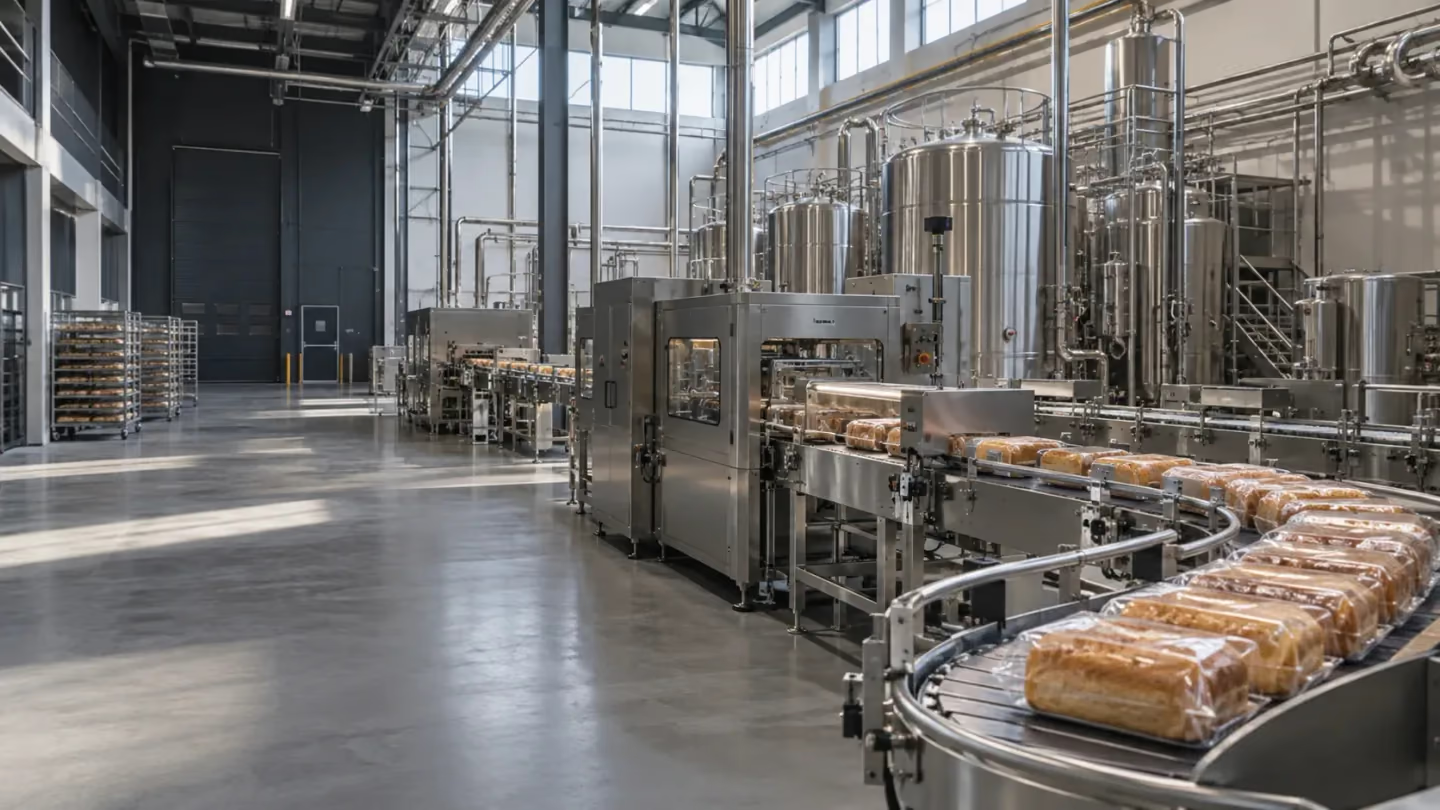
In mayonnaise, ketchup, salad dressing, and emulsified condiment plants, quality and yield losses happen at the handoff between the batching kettle and the volumetric filling machine. If a batch with an out-of-range equilibrium pH or low shear viscosity is pumped to the filler, the entire packaged lot faces quarantine or oil-separation recalls; conversely, if filler operators adjust piston strokes by guesswork when switching between hot-filled sauces ($82^\circ\text{C}\text{–}88^\circ\text{C}$) and cold-emulsified dressings ($20^\circ\text{C}\text{–}25^\circ\text{C}$), the line either violates legal minimum net-weight rules or gives away 2% to 3% of every kettle in unbilled overfills. Distinct from FB-019 (general catch-weight giveaway in solid packs), this guide (FB-131) governs acidified-food equilibrium pH critical limits, shear-emulsion viscosity holds, and density-compensated volumetric fill-weight control.
How should mayonnaise, ketchup, and dressing manufacturers link equilibrium pH (<4.1–4.6), Brookfield viscosity checks, and hot/cold fill-weight giveaway controls?
Enforce hard ERP quality locks between mixing kettles and bottle fillers so no emulsified dressing or acidified sauce batch transfers to packaging until equilibrium pH, Brookfield viscosity, and specific gravity clear their specification windows. Adjust volumetric piston-filler stroke settings using the batch's actual measured specific gravity at filling temperature ($85^\circ\text{C}$ hot-fill vs $22^\circ\text{C}$ ambient emulsion), preventing systematic underfills or excessive giveaway when density shifts.
- 01Capture batch contextLot, unit, timestamp and source reference
- 02Verify against rulesActive specification, tolerance and cut-off
- 03Reconcile variancesSeparate physical events from timing gapsDo the batch records and tolerances agree?YesApprove ledger postingNoKeep the disputed quantity in a visible hold status and route to the designated owner.
- 04Approve ledger postingRetain signed-off evidence and history
Illustrative information flow. The article explains the evidence, exceptions and responsible decisions. Diagram: NextEdge Labs.
Scope and regulatory boundary
This article defines the ERP/MES batch-release and filler-control record architecture for liquid and emulsified condiments:
What this workflow governs: Linking kettle titration and equilibrium pH logs, viscometer readings, pycnometer/Coriolis specific-gravity measurements at filling temperature, volumetric piston stroke calculations, checkweigher feedback loops, and closed-batch mass balance. What this workflow does not replace: It does not prescribe scheduled thermal process filings, preservative formulations, or microbiological challenge studies. Acidified and shelf-stable condiment processors must comply with statutory food-safety and metrology frameworks such as U.S. FDA 21 CFR Part 114 (Acidified Foods), NIST Handbook 133 (Checking the Net Contents of Packaged Goods), and Codex Alimentarius condiment and hygiene standards. Qualified Process Authorities and QA managers own thermal and pH critical limits.
Scroll horizontally to see all columns.
| Parameter | Analytical Instrument & Basis | Consequence if Out of Spec | ERP / MES Interlock Action |
|---|---|---|---|
| **Equilibrium pH** | Two-point calibrated pH electrode at $25^\circ\text{C}$ ($\text{pH} \le 4.10$ operating limit) | Microbiological survival risk; statutory recall exposure | Hard-lock kettle transfer (`PH_CRITICAL_HOLD`); require Process Authority / QA disposition |
| **Titratable Acidity** | $\text{NaOH}$ titration to pH $8.1$ ($\%\text{ w/w}$ acetic/citric acid) | Flavour imbalance; insufficient buffering capacity | Hold kettle for documented vinegar/acid trim addition and re-homogenization |
| **Brookfield Viscosity** | Spindle #4 / #6 at $20\text{ RPM}$, specified $T^\circ\text{C}$ ($\text{cP}$) | Emulsion breakdown or filler nozzle stringing/foaming | Divert to rework/starch-shear hold; block high-speed filling |
| **Specific Gravity ($\rho_{T}$)** | Pycnometer or inline Coriolis meter at filler manifold $T^\circ\text{C}$ ($\text{g/mL}$) | Systematic underfill (MAV failure) or excessive product giveaway | Recalculate piston stroke volume $V_{\text{stroke}}$ before releasing filler run |
Source: GS1 · Lot identification and movement event records. Reference details
Three interdependent parameters that govern kettle-to-filler release
Configuring an ERP quality gate (such as ERPNext Quality Inspection attached to the intermediate kettle transfer) requires verifying three linked physical parameters before opening the filler supply valve:
Equilibrium pH and Titratable Acidity (Food-Safety Gate): Under acidified-food regulations (21 CFR Part 114), finished equilibrium pH must remain at or below the statutory ceiling of $4.6$ (with commercial condiment specifications typically enforcing an operating target band of $3.60\text{–}4.15$ alongside acetic/citric acid titration checks) to prevent spore outgrowth. If vinegar dosing or particulate equilibration drifts, the batch must remain locked in the holding tank for documented acid adjustment and re-test. Apparent Viscosity and Shear Recovery (Emulsion & Flow Gate): Measured via rotational viscometer (e.g., Brookfield spindle/RPM at a specified temperature, expressed in $\text{cP}$ or $\text{mPa}\cdot\text{s}$) or Bostwick consistometer ($\text{cm}$ flow in $30\text{ seconds}$). In oil-in-water emulsions like mayonnaise, over-shearing in the colloid mill or high oil temperatures breaks the lecithin/egg-yolk interfacial film, causing oil separation in the jar; in hot-filled sauces, viscosity drift changes nozzle drip and piston cavitation at the filler. Specific Gravity at Filling Temperature (Volumetric-to-Gravimetric Conversion Gate): Most condiment lines fill by volume (piston displacement in $\text{mL}$ or flowmeter pulses) while selling by net weight ($\text{g}$ on the label) or vice versa. Because thermal expansion and entrained air alter specific gravity ($\rho_{T}$, in $\text{g/mL}$), the required piston stroke volume ($V_{\text{stroke}}$) to achieve a target checkweigher net mass ($M_{\text{target}}$) is: $$V_{\text{stroke}} = \frac{M_{\text{label}} + k \cdot \sigma_{\text{filler}}}{\rho_{T}}$$ where $M_{\text{label}}$ is the declared net weight, $\sigma_{\text{filler}}$ is the filler's standard deviation across heads, $k$ is the statistical confidence multiplier (e.g., $k = 2.0$ so $\ge 97.7\%$ of bottles exceed $M_{\text{label}}$ and zero bottles fall below the NIST Handbook 133 Maximum Allowable Variation), and $\rho_{T}$ is the batch's measured specific gravity at actual filling temperature $T$.
Source: Frappe / ERPNext · Material movement and reconciliation controls. Reference details
Illustrative worked example: hot-fill sauce density compensation and giveaway reduction
Illustrative production scenario using synthetic batch figures to demonstrate density-to-fill-weight arithmetic; not a client case study.
A condiment plant produces a $6,200\text{ kg}$ kettle batch of tomato-chili culinary sauce (BATCH-KET-409) packed into $500.0\text{ g}$ net-weight glass bottles (nominal target run: $12,000\text{ bottles}$ $= 6,000.0\text{ kg}$ declared net contents, with $200.0\text{ kg}$ budgeted for kettle cling, CIP line purge, and startup sampling).
Step 1: Verify kettle quality release gates (`BATCH-KET-409`)
Before opening the pasteurizer-to-filler transfer valve, QA records: Equilibrium pH ($25^\circ\text{C}$): $3.88$ (clears internal critical limit $\le 4.10$ and statutory ceiling $\le 4.60$). Titratable acidity: $1.42\%\text{ w/w}$ as acetic acid (within $1.35\%\text{–}1.50\%$ spec). Brookfield viscosity ($25^\circ\text{C}$, Spindle #4, 20 RPM): $14,200\text{ cP}$ (within $13,000\text{–}15,500\text{ cP}$ window). Specific gravity at ambient $20^\circ\text{C}$ ($\rho_{20}$): $1.135\text{ g/mL}$. Specific gravity at hot-fill manifold temperature $85^\circ\text{C}$ ($\rho_{85}$): $1.095\text{ g/mL}$ (thermal expansion reduces density by $3.52\%$).
Step 2: Calculate why ambient density settings cause hot-fill underweights
If an operator sets the 12-head volumetric piston filler using the ambient $20^\circ\text{C}$ specific gravity ($1.135\text{ g/mL}$) to target $500.0\text{ g}$:
$$V_{\text{wrong}} = \frac{500.0\text{ g}}{1.135\text{ g/mL}} = 440.53\text{ mL per stroke}$$
Because the sauce actually passes through the piston cylinder at $85^\circ\text{C}$ ($\rho_{85} = 1.095\text{ g/mL}$), each $440.53\text{ mL}$ stroke dispenses a true net mass of:
Step 3: Compute temperature-corrected piston volume and giveaway savings
The 12-head piston filler exhibits a verified head-to-head standard deviation of $\sigma_{\text{filler}} = 1.50\text{ g}$. Using a $2\sigma$ safety buffer ($+3.0\text{ g}$) above the $500.0\text{ g}$ label weight:
Target checkweigher mean net weight ($M_{\text{target}}$): $$M_{\text{target}} = 500.0\text{ g} + (2.0 \times 1.50\text{ g}) = 503.0\text{ g per bottle}$$ Required piston stroke volume at $85^\circ\text{C}$ ($V_{\text{stroke\_85}}$): $$V_{\text{stroke\_85}} = \frac{503.0\text{ g}}{1.095\text{ g/mL}} = 459.36\text{ mL per stroke}$$ Overfill giveaway comparison against manual operator over-adjustment: Previously, to avoid checkweigher rejects without computing hot density, operators manually cranked the filler stroke to $467.12\text{ mL}$, averaging $511.5\text{ g/bottle}$ ($11.5\text{ g/bottle}$ giveaway). Under the density-compensated $459.36\text{ mL}$ setting ($503.0\text{ g/bottle}$, or $3.0\text{ g/bottle}$ giveaway), the sauce saved across a $12,000\text{-bottle}$ run is: $$\text{Giveaway Saved} = (511.5\text{ g} - 503.0\text{ g}) \times 12,000\text{ bottles} = 8.5\text{ g} \times 12,000 = 102,000\text{ g} = 102.0\text{ kg}$$ At $503.0\text{ g/bottle}$, that $102.0\text{ kg}$ of recovered sauce yields $\lfloor 102,000 / 503.0 \rfloor = 202\text{ additional saleable bottles}$ from the exact same kettle batch.
Summary
Reliable sauce emulsion viscosity ph pasteurization fill weight control depends on consistent lot identity, shared cut-off times, and explicit exception ownership across production, quality, and finance. When teams verify physical evidence before posting adjustments, both traceability and margin reporting remain defensible.
What to do next
- Audit one recent week of sauce emulsion viscosity ph pasteurization fill weight control transactions to identify unrecorded movements, unit mismatches, or late entries.
- Define the mandatory lot, unit, and approval fields required before an operator or integration can post a status change.
- Pilot the exception queue on one product line and review unresolved variances at a fixed daily cut-off.
Compare this workflow with your current setup
Share the step that takes the most manual work, the systems involved and the exceptions your team handles. That gives us a concrete starting point for comparing approaches.
Sources and further reading
Sources checked 15 October 2026. The worked examples and software evaluation suggestions are NextEdge Labs’ editorial analysis.
- GS1 Global Traceability StandardGS1 · Release 2.0, August 2017
Reference framework for identification and traceability data. Citing it does not imply that a proposed system is GS1 certified.
- Stock EntryFrappe / ERPNext · Online product documentation, accessed October 2026
Examples of distinct material receipt, issue, transfer and manufacturing transactions, including transit handling.
Visual credits
AI-generated illustration created for NextEdge Labs; it does not depict a client facility. Workflow diagram by NextEdge Labs. Icons from Lucide (ISC licence).