Pasta and noodle extrusion records: control hydration, drying humidity curves, and 12.5% moisture gates
For Logistics heads, warehouse leads and distribution managers · Compare approaches
TL;DR — what you’ll learn
- Reconcile pasta and dry-noodle production yields on a dry-solids mass balance rather than gross flour weight: link incoming semolina moisture ($14.0\%\text{–}14.5\%$), extruder dough hydration ($\sim 30\%\text{–}32\%$), and finished post-cooler moisture ($\le 12.5\%\text{–}13.0\%$) on every work order.
- Enforce multi-zone drying temperature and relative-humidity ($\Delta\text{RH}$) differential curves alongside post-dryer stabilization logs; rapid surface evaporation creates crust hardening and internal stress fractures ("checking") that only crack open 24 to 48 hours after packaging.
- Cap dry regrind addition (ground clean cutter trim and startup scrap) at the recipe's validated ceiling (typically $\le 5\%\text{–}8\%$ of total dry charge) and block cross-allergen (egg vs non-egg) or dark-speck floor sweepings from re-entering the mixer.
- Hold finished silo discharge to packaging until cooled pasta clears both the statutory moisture ceiling ($\le 12.5\%$ or $\le 13.0\%$ by jurisdiction) and a 24-hour stress-checking inspection.

In industrial pasta and dried-noodle manufacturing, two invisible defects destroy batch profitability after the product leaves the dryer: stress checking (microscopic hairline fractures caused by excessive moisture gradients between the pasta core and surface during drying, causing strands to shatter inside retail bags days later) and over-drying giveaway (running dryers at $10.5\%\text{–}11.0\%$ final moisture instead of targeting $12.0\%\text{–}12.3\%$ below the statutory $12.5\%\text{–}13.0\%$ limit, evaporating hundreds of kilograms of saleable weight per shift). Distinct from FB-111 (wheat milling and tempering extraction) and FB-002 (yeast-leavened bakery fermentation), this guide (FB-132) governs extrusion vacuum pressure, hygrometric multi-zone drying curves, regrind addition ceilings, and dry-matter moisture yield reconciliation.
How should pasta and instant-noodle plants control semolina hydration, multi-zone drying humidity curves (preventing stress checking), and legal 12.5%–13.0% final moisture limits?
Reconcile pasta and dry-noodle production yields on a dry-solids mass balance rather than gross flour weight: link incoming semolina moisture ($14.0\%\text{–}14.5\%$), extruder dough hydration ($\sim 30\%\text{–}32\%$), and finished post-cooler moisture ($\le 12.5\%\text{–}13.0\%$) on every work order. Enforce multi-zone drying temperature and relative-humidity ($\Delta\text{RH}$) differential curves alongside post-dryer stabilization logs; rapid surface evaporation creates crust hardening and internal stress fractures ("checking") that only crack open 24 to 48 hours after packaging.
- 01Capture batch contextLot, unit, timestamp and source reference
- 02Verify against rulesActive specification, tolerance and cut-off
- 03Reconcile variancesSeparate physical events from timing gapsDo the batch records and tolerances agree?YesApprove ledger postingNoKeep the disputed quantity in a visible hold status and route to the designated owner.
- 04Approve ledger postingRetain signed-off evidence and history
Illustrative information flow. The article explains the evidence, exceptions and responsible decisions. Diagram: NextEdge Labs.
Scope and regulatory boundary
This article defines the ERP/MES batch record, dryer-zone telemetry, and dry-matter yield accounting architecture for extruded pasta and dry noodles:
What this workflow governs: Calculating dry-solids mass balance from semolina and regrind inputs to packaged pasta, enforcing extruder vacuum and die-pressure locks, monitoring pre-drying/main-drying/stabilization relative-humidity differentials, capping clean regrind ratios, and gating silo release on final moisture and checking inspections. What this workflow does not replace: It does not replace OEM dryer PLC control loops, thermal pasteurization validation for fresh/filled pasta, or statutory food-composition testing. Finished moisture and composition limits must comply with applicable food standards such as U.S. FDA 21 CFR 139.110 (Macaroni and Noodle Products — maximum 13.0% moisture), Codex Alimentarius Standard CXS 178-1991 and Italian DPR 187/2001 (maximum 12.5% moisture for durum wheat pasta), and reference moisture methods such as Cereals & Grains Association Method 44-15.02.
Scroll horizontally to see all columns.
| Stage | Target Control Parameter | Physical / Regulatory Risk | Mandatory ERP / MES Action |
|---|---|---|---|
| **1. Pre-Mixer Dosing** | Semolina moisture $14.0\%\text{–}14.5\%$; clean regrind $\le 6.0\%$; allergen match | Excess regrind degrades bite texture; egg regrind contaminates vegan pasta | Barcode-lock regrind tote to matching allergen family and cap feeder ratio at $6.0\%$ |
| **2. Vacuum Extrusion** | Vacuum $\le -0.85\text{ bar}$ absolute gauge; die pressure $90\text{–}120\text{ bar}$; dough $31.0\%$ moisture | Air inclusions cause chalky white spots and drying fracture initiation | Trigger alarm if vacuum drops above $-0.78\text{ bar}$ for $>90\text{ seconds}$; divert wet strand to wet-rework chopper |
| **3. Multi-Zone Dryer** | Zone $T^\circ\text{C}$ and $\text{RH}\%$ within $\pm 1.5\%$ of SKU curve; stabilization dwell met | Low $\text{RH}\%$ crusting causes 24-hr post-pack stress checking ("crazing") | Log zone $\Delta\text{RH}$ excursion on batch record; place silo lot on 24-hour checking observation hold |
| **4. Cooler & Silo Release** | Final moisture $12.0\%\text{–}12.4\%$ (max $12.5\%$); checking defects $\le 1.0\%$ | $>12.5\%$ violates legal limit; $<11.2\%$ loses saleable weight and shatters in VFFS | Block VFFS packaging order release until NIR/air-oven moisture and checking count pass |
Source: GS1 · Lot identification and movement event records. Reference details
Four process control gates from semolina dosing to cooling silo release
Because 100 kilograms of semolina arriving at $14.2\%$ moisture contains $85.8\text{ kg}$ of dry solids, its theoretical finished weight at $12.2\%$ moisture is $85.8 / (1 - 0.122) = 97.72\text{ kg}$ before any physical scrap loss occurs. Managing this conversion in ERP production orders (such as ERPNext Bill of Materials and Process Loss records) requires four linked control gates:
Hydration Dosing and Clean Regrind Ceiling Gate: Gravimetric loss-in-weight feeders meter durum semolina, water, and milled dry regrind into the high-speed hydration trough. Because regrind has already undergone mechanical shear and starch gelatinization/protein cross-linking, exceeding the validated regrind ceiling (e.g., $\le 6.0\%$ of total dry charge) weakens the gluten network, increases cooking loss, and shifts dough hydration demand. Additionally, egg-pasta regrind must be strictly segregated from semolina-only SKUs to prevent undeclared allergen cross-contact. Extruder Vacuum and Die-Head Pressure Gate: Before the dough screw forces hydrated semolina ($\sim 30\%\text{–}32\%$ moisture) through bronze or Teflon-insert dies, the vacuum chamber must hold at least $-0.80\text{ to }-0.90\text{ bar}$ ($80\text{–}90\text{ kPa}$ vacuum). If a vacuum seal leaks, entrapped air bubbles oxidize carotenoid pigments (bleaching the yellow amber colour) and form micro-voids that nucleate stress cracks during drying. Multi-Zone Drying Curve ($\Delta T / \Delta\text{RH}$) and Stabilization Gate: Pasta drying progresses through three hygrometric phases: case-hardening / pre-drying (reducing moisture from $\sim 31\%$ to $\sim 23\%$ while keeping relative humidity high enough that surface pores remain elastic), main diffusion drying ($\sim 23\%$ down to $\sim 14\%$), and high-humidity thermal stabilization plus cooling ($\sim 14\%$ to $12.0\%\text{–}12.5\%$, relaxing internal tensile stress between the drier outer shell and moister core). If dryer exhaust dampers open too far and relative humidity drops more than $4\text{ percentage points}$ below the recipe curve, the surface shrinks faster than core moisture can diffuse outward—causing delayed "checking" fractures after cooling. Final Moisture Ceiling vs Over-Drying Yield Gate: Finished pasta above $12.5\%$ (EU/Italy export standard) or $13.0\%$ (US 21 CFR 139.110 ceiling) is illegal to sell and risks mould growth in sealed film packs. Conversely, pasta dried below $11.5\%$ suffers both direct evaporative weight loss and severe brittleness in vertical form-fill-seal (VFFS) drop tubes.
Source: Frappe / ERPNext · Material movement and reconciliation controls. Reference details
Illustrative worked example: dry-matter mass balance and over-drying yield loss
Illustrative production scenario with synthetic batch figures to demonstrate dry-matter and moisture arithmetic; not a client case study.
An industrial pasta line runs a continuous shift lot (LOT-PENNE-308) charging $10,000.0\text{ kg}$ of durum wheat semolina and $500.0\text{ kg}$ of clean milled semolina-pasta regrind to produce dry penne rigate under a strict $\le 12.5\%$ maximum legal moisture specification (with an internal plant target window of $12.0\%\text{–}12.3\%$).
Step 1: Compute dry-solids charge and extruder hydration water
Incoming semolina dry solids ($M_{\text{sem}}$ at $14.2\%$ moisture): $$\text{Semolina Dry Matter} = 10,000.0\text{ kg} \times (1 - 0.142) = 8,580.0\text{ kg dry solids}$$ Incoming clean regrind dry solids ($M_{\text{reg}}$ at $12.0\%$ moisture): Regrind blend share check: $$\text{Regrind Ratio} = \frac{500.0\text{ kg}}{10,000.0 + 500.0\text{ kg}} = 4.76\% \le 6.0\%\text{ ceiling (PASS)}$$ Regrind dry matter: $$\text{Regrind Dry Matter} = 500.0\text{ kg} \times (1 - 0.120) = 440.0\text{ kg dry solids}$$ Total dry solids entering extruder ($D_{\text{total}}$): $$D_{\text{total}} = 8,580.0 + 440.0 = 9,020.0\text{ kg dry solids}$$ Extruder dough mass and water addition to reach $31.0\%$ wet dough moisture: $$M_{\text{wet\_dough}} = \frac{9,020.0\text{ kg}}{1 - 0.310} = \frac{9,020.0}{0.690} = 13,072.46\text{ kg wet dough}$$ $$\text{Required Hydration Water} = 13,072.46\text{ kg} - 10,500.0\text{ kg} = 2,572.46\text{ kg water}$$
Step 2: Account for wet die/cutter trim and compare final drying moisture regimes
Suppose die purge, startup wet trim, and floor sweepings remove $1.20\%$ of total dry solids ($9,020.0 \times 0.012 = 108.24\text{ kg}$ dry solids), leaving $D_{\text{net}} = 8,911.76\text{ kg}$ of net dry solids entering the multi-zone dryer. Compare the finished saleable pasta weight across two dryer control outcomes:
Regime A — Controlled Hygrometric Curve hitting Target $12.2\%$ Final Moisture: $$M_{\text{finished\_12.2}} = \frac{8,911.76\text{ kg dry solids}}{1 - 0.122} = \frac{8,911.76}{0.878} = 10,150.07\text{ kg finished pasta}$$ Regime B — Uncontrolled Low-Humidity Over-Drying to $10.8\%$ Final Moisture: $$M_{\text{finished\_10.8}} = \frac{8,911.76\text{ kg dry solids}}{1 - 0.108} = \frac{8,911.76}{0.892} = 9,990.76\text{ kg finished pasta}$$
Step 3: Quantify evaporative giveaway and checking scrap impact
$$\text{Direct Over-Drying Weight Loss} = 10,150.07\text{ kg} - 9,990.76\text{ kg} = 159.31\text{ kg per batch}\;(-1.57\%\text{ yield loss})$$
In addition, because Regime B's low humidity in Drying Zone 2 created a steep surface-to-core moisture gradient, post-cooler light-box inspection finds $6.4\%$ stress-checked pieces (exceeding the $\le 1.0\%$ release limit), forcing the lot to be diverted from retail packaging to industrial milling/regrind stock.
Summary
Reliable pasta noodle extrusion drying curve moisture checking control depends on consistent lot identity, shared cut-off times, and explicit exception ownership across production, quality, and finance. When teams verify physical evidence before posting adjustments, both traceability and margin reporting remain defensible.
What to do next
- Audit one recent week of pasta noodle extrusion drying curve moisture checking control transactions to identify unrecorded movements, unit mismatches, or late entries.
- Define the mandatory lot, unit, and approval fields required before an operator or integration can post a status change.
- Pilot the exception queue on one product line and review unresolved variances at a fixed daily cut-off.
Compare this workflow with your current setup
Share the step that takes the most manual work, the systems involved and the exceptions your team handles. That gives us a concrete starting point for comparing approaches.
Sources and further reading
Sources checked 15 October 2026. The worked examples and software evaluation suggestions are NextEdge Labs’ editorial analysis.
- GS1 Global Traceability StandardGS1 · Release 2.0, August 2017
Reference framework for identification and traceability data. Citing it does not imply that a proposed system is GS1 certified.
- Stock EntryFrappe / ERPNext · Online product documentation, accessed October 2026
Examples of distinct material receipt, issue, transfer and manufacturing transactions, including transit handling.
Visual credits
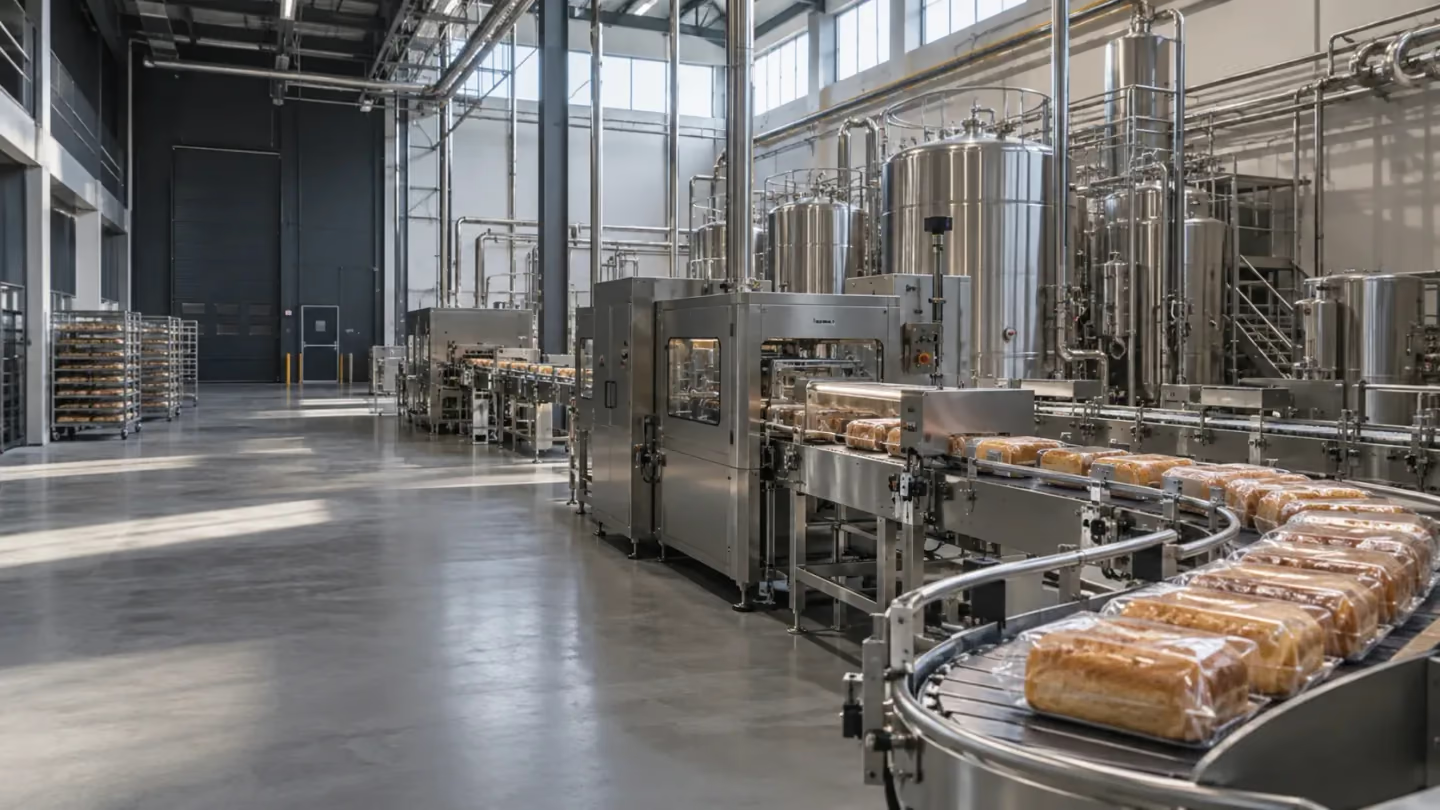
AI-generated illustration created for NextEdge Labs; it does not depict a client facility. Workflow diagram by NextEdge Labs. Icons from Lucide (ISC licence).