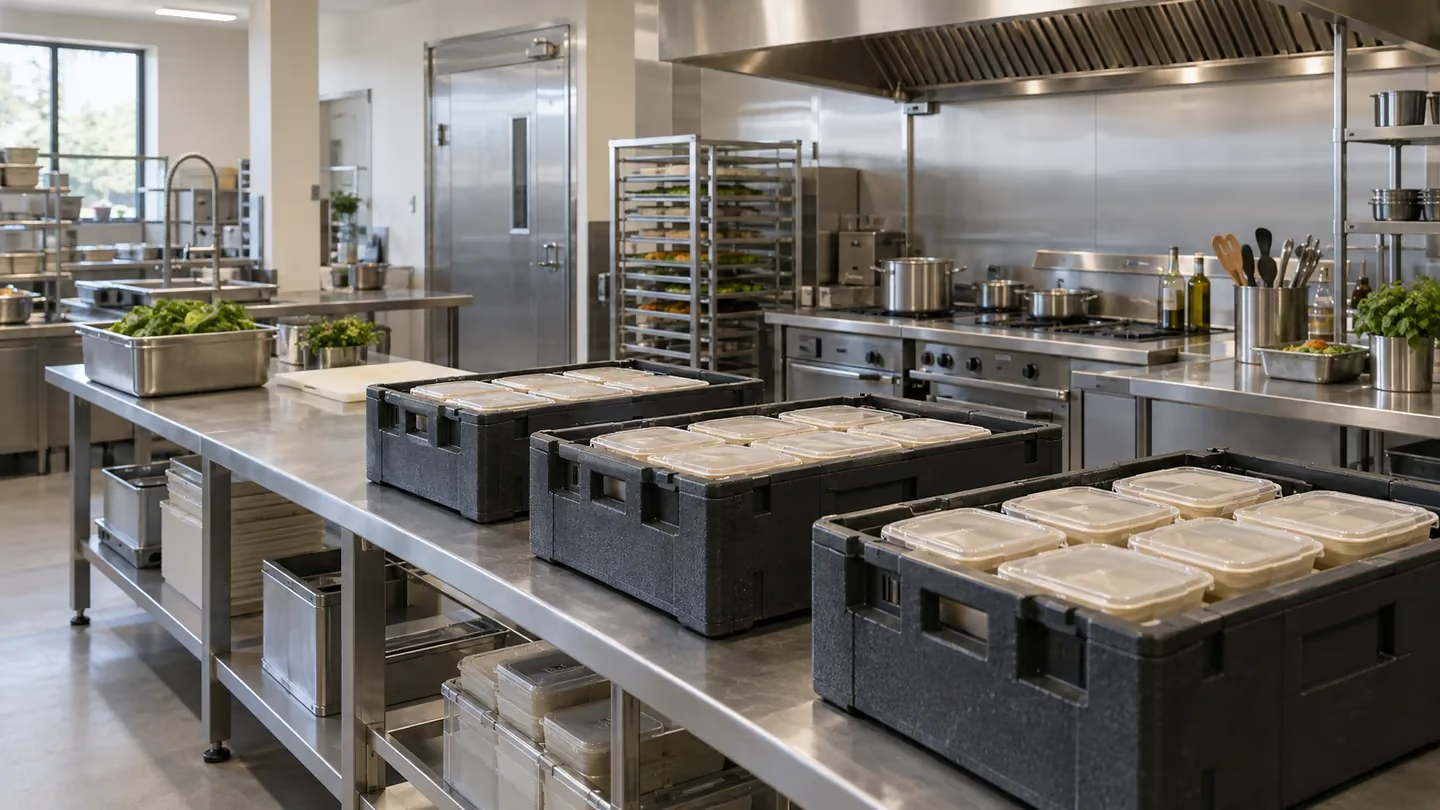
Commercial warewashing sanitation records: verify thermal strips, chemical ppm titrations, and drum interlocks
For IT heads, operations directors and digital project owners · Compare approaches
TL;DR — what you’ll learn
- Distinguish manifold gauge temperatures from utensil-surface sanitization: require irreversible $71^\circ\text{C}$ ($160^\circ\text{F}$) thermal test strips or thermolabel data loggers at the dish rack alongside $82^\circ\text{C}\text{–}90^\circ\text{C}$ ($180^\circ\text{F}\text{–}194^\circ\text{F}$) final-rinse manifold verification on high-temperature warewashers.
- For low-temperature chemical sanitizing machines, verify active sanitizer concentration ($\text{ppm}$ free chlorine or quaternary ammonium), wash-water temperature minimum, and pH window via shift test-strip/dropper titrations rather than relying solely on pump indicator lights.
- Reconcile peristaltic dispenser rack counts against weighed chemical drum depletion each week; a collapsed peristaltic squeeze tube or air-locked pickup lance allows hundreds of racks to run with zero sanitizer even when the drum is still half full.
- Hold and re-wash any rack batch of catering pans, cutting boards, or insulated meal trays whenever thermal strips fail to turn black, chemical titration drops below the statutory floor, or ATP bioluminescence swabs exceed surface cleanliness thresholds.
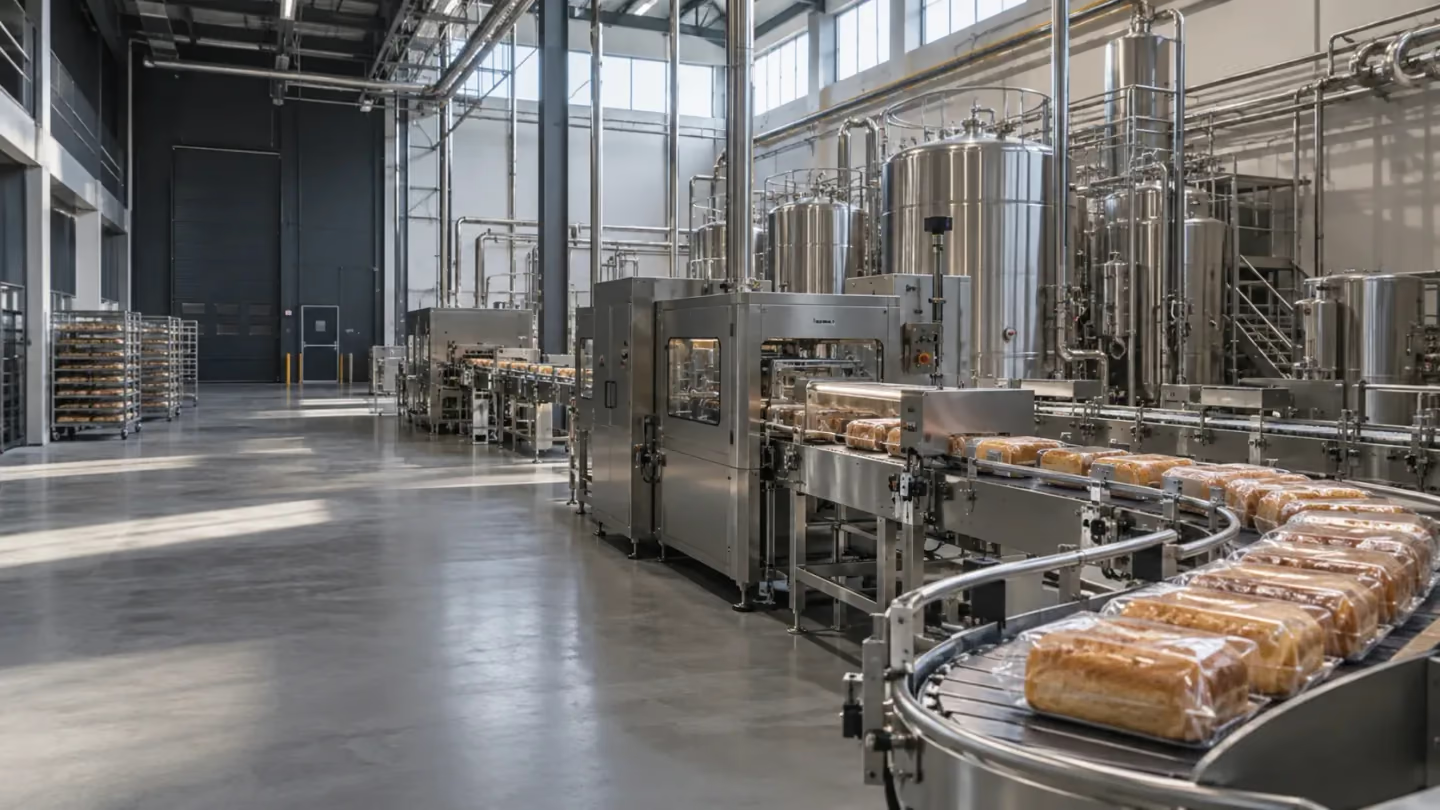
In institutional catering commissaries, hospital kitchens, airline flight kitchens, and multi-site restaurants, a single warewashing failure can cross-contaminate thousands of ready-to-eat meals. Unlike FB-081 (which governs closed-pipe industrial Clean-in-Place [CIP] circuits and plant master sanitation schedules), this guide (FB-133) covers commercial conveyor and rack dishmachine sanitation verification: utensil-surface thermal strips, chemical sanitizer $\text{ppm}$ titrations, empty-drum and peristaltic-tube mass-balance checks, and ATP swab re-wash holds.
How should multi-site kitchens and caterers verify conveyor-dishwasher final-rinse thermal strips (82°C) or chemical sanitizer ppm titrations before releasing sanitized ware?
Distinguish manifold gauge temperatures from utensil-surface sanitization: require irreversible $71^\circ\text{C}$ ($160^\circ\text{F}$) thermal test strips or thermolabel data loggers at the dish rack alongside $82^\circ\text{C}\text{–}90^\circ\text{C}$ ($180^\circ\text{F}\text{–}194^\circ\text{F}$) final-rinse manifold verification on high-temperature warewashers. For low-temperature chemical sanitizing machines, verify active sanitizer concentration ($\text{ppm}$ free chlorine or quaternary ammonium), wash-water temperature minimum, and pH window via shift test-strip/dropper titrations rather than relying solely on pump indicator lights.
- 01Capture batch contextLot, unit, timestamp and source reference
- 02Verify against rulesActive specification, tolerance and cut-off
- 03Reconcile variancesSeparate physical events from timing gapsDo the batch records and tolerances agree?YesApprove ledger postingNoKeep the disputed quantity in a visible hold status and route to the designated owner.
- 04Approve ledger postingRetain signed-off evidence and history
Illustrative information flow. The article explains the evidence, exceptions and responsible decisions. Diagram: NextEdge Labs.
Scope and regulatory boundary
This article specifies the foodservice quality-audit, chemical-inventory, and shift-verification record architecture for commercial warewashing:
What this workflow governs: Recording pre-shift and mid-shift dishmachine thermal-strip and chemical-titration checks, reconciling rack counter totals against sanitizer/detergent drum depletion, interlocking empty-drum alarms, and enforcing re-wash holds on unsanitized ware batches. What this workflow does not replace: It does not replace health-department inspection standards, chemical safety data sheet (SDS) handling procedures, or OEM dishmachine service manuals. Operators must comply with applicable food-safety codes such as the U.S. FDA Food Code 2022 (Sections 4-501.112 and 4-501.114), equipment certification criteria in NSF/ANSI 3 (Commercial Warewashing Equipment), and Codex Alimentarius General Principles of Food Hygiene (CXC 1-1969).
Scroll horizontally to see all columns.
| Sanitization Method | Manifold / Tank Parameter | Utensil-Surface Verification Gate | Weekly Mass-Balance Audit | Mandatory Hold & Recovery Action |
|---|---|---|---|---|
| **High-Temperature Thermal** | Booster manifold $82^\circ\text{C}\text{–}90^\circ\text{C}$; flow pressure $15\text{–}25\text{ psi}$ | Irreversible $71^\circ\text{C}$ ($160^\circ\text{F}$) thermal strip attached to test pan turns black | Booster gas/kWh log + descaling maintenance check | Halt dishmachine; descale spray jets/check pressure regulator; re-wash all ware since last passed strip |
| **Low-Temperature Chlorine** | Wash tank $\ge 49^\circ\text{C}$; rinse water pH $\le 8.0\text{–}10.0$ per temp band | Colorimetric test strip / drop titration reads **$50\text{–}100\text{ ppm}$** free chlorine on rack run-off | Rack count $\times$ $\text{mL/rack}$ vs weighed $20\text{ L}$ sanitizer drum depletion | Lock machine; replace peristaltic squeeze tube or empty drum; re-wash held racks |
| **Low-Temperature Quat (QAC)** | Water temp $\ge 24^\circ\text{C}$; water hardness $\le 500\text{ ppm}$ (or label limit) | Quat test strip matches manufacturer concentration (typically $200\text{ ppm}$) | Rack count $\times$ $\text{mL/rack}$ vs weighed QAC container | Adjust proportioner metering tip; re-wash ware batch and verify with fresh strip |
Source: GS1 · Lot identification and movement event records. Reference details
Why wall-mounted manifold gauges and pump lights miss warewashing failures?
Many commissary kitchens log a single number on a clipboard—"Final Rinse: $83^\circ\text{C}$" or "Sanitizer Pump: ON", without testing what actually reaches the dish surface. Three physical failure modes make gauge-only logging unreliable:
Manifold-to-Rack Heat Loss and Clogged Rinse Nozzles (High-Temp Machines): Under FDA Food Code Section 4-501.112 and NSF/ANSI 3, stationary rack and conveyor machines using hot-water sanitization must maintain a final-rinse manifold temperature between $82^\circ\text{C}$ ($180^\circ\text{F}$) and $90^\circ\text{C}$ ($194^\circ\text{F}$) (above $90^\circ\text{C}$, water flashes to steam before contacting the ware) and deliver at least $71^\circ\text{C}$ ($160^\circ\text{F}$) at the utensil surface (or accumulate $\ge 3,600$ Heat Unit Equivalents). If scale clogs two spray-arm jets or water pressure drops below $15\text{ psi}$ ($100\text{ kPa}$), the booster-heater gauge still reads $84^\circ\text{C}$ while pans passing through the centre of the rack never reach $71^\circ\text{C}$. Peristaltic Tube Fatigue and Air-Locked Chemical Lines (Low-Temp Machines): Low-temperature chemical machines sanitize at lower water temperatures ($49^\circ\text{C}\text{–}55^\circ\text{C}$) by injecting sodium hypochlorite ($50\text{–}100\text{ ppm}$ free chlorine at requisite pH/temp) or quaternary ammonium compounds per FDA Food Code Section 4-501.114. When the rubber squeeze tube inside a peristaltic dosing pump flattens after weeks of compression, the pump motor spins normally—lighting the "Dosing OK" LED, while delivering less than half the required sanitizer volume. Protein Soil Carryover Quenching Free Chlorine: When wash-tank water is not drained between heavy batch runs or scrap trays are bypassed, dissolved protein and food soil carried into the final rinse immediately consume active free chlorine, dropping residual sanitizer on the utensil surface below $50\text{ ppm}$.
Source: Frappe / ERPNext · Material movement and reconciliation controls. Reference details
Illustrative worked example: peristaltic sanitizer under-dosing caught by rack-to-drum reconciliation
Illustrative institutional-commissary scenario using synthetic figures to demonstrate titration and chemical mass-balance arithmetic; not a client case study.
An institutional catering commissary operates a commercial rack dishmachine (DW-COMM-02) running low-temperature sodium hypochlorite sanitization across 3 shifts per day ($18\text{ shifts}$ per 6-day operating week). Each shift washes an average of $280\text{ racks}$, and each rack cycle uses $1.85\text{ L}$ of final-rinse water.
Step 1: Compute expected chemical consumption per shift and per week
Final-rinse water volume per shift ($V_{\text{rinse\_shift}}$): $$V_{\text{rinse\_shift}} = 280\text{ racks/shift} \times 1.85\text{ L/rack} = 518.0\text{ L/shift}$$ Required stock sanitizer injection for a $75\text{ ppm}$ target: To maintain an operating target of $75\text{ ppm}$ active chlorine (centred inside the $50\text{–}100\text{ ppm}$ statutory band) using a commercial $12.5\%$ ($125,000\text{ ppm}$) sodium hypochlorite stock drum: $$V_{\text{chem\_shift}} = 518.0\text{ L} \times \frac{75\text{ ppm}}{125,000\text{ ppm}} = 0.3108\text{ L/shift} = 310.8\text{ mL/shift}\;\left(1.11\text{ mL/rack}\right)$$ Expected 18-shift weekly drum depletion ($V_{\text{expected\_week}}$, across $5,040\text{ racks}$): $$V_{\text{expected\_week}} = 18\text{ shifts} \times 0.3108\text{ L/shift} = 5.5944\text{ L}\;(\approx 5.59\text{ L})$$
Step 2: Reconcile physical drum weigh-back against rack counter logs
At the end of the 18-shift week, the sanitation supervisor weighs the $20\text{ L}$ sodium hypochlorite pail (LOT-HYPO-118, specific gravity $1.20\text{ kg/L}$) on the chemical storage scale and compares actual consumption against the dishmachine's digital rack counter ($5,040\text{ racks}$):
Actual liquid sanitizer consumed ($V_{\text{actual\_week}}$): $3.4500\text{ L}$ ($4.14\text{ kg}$ net mass loss). Cumulative dosing deficit: $$\text{Volume Deficit} = 3.4500\text{ L} - 5.5944\text{ L} = -2.1444\text{ L}\;(-38.33\%\text{ under-delivery})$$ Implied chlorine concentration during the final 6 shifts: Because the first 12 shifts consumed the normal $12 \times 0.3108\text{ L} = 3.7296\text{ L}$ before the peristaltic squeeze tube fatigued (or across the last 6 shifts delivered only $0.120\text{ L/shift}$ instead of $0.3108\text{ L/shift}$), the effective chlorine concentration delivered during the degraded shifts dropped to: $$C_{\text{degraded}} = 75\text{ ppm} \times \frac{0.120\text{ L}}{0.3108\text{ L}} = 28.96\text{ ppm} \approx 29\text{ ppm} < 50\text{ ppm statutory minimum}$$
This weekly drum-to-rack mass balance catches both the mechanical peristaltic tube failure and the fact that the afternoon steward had recorded "75 ppm" on the paper log without actually dipping a test strip during Shifts 14–18.
Workflow, owner roles, exceptions, and recovery controls
Using digital quality checklists (such as ERPNext Quality Inspection linked to equipment maintenance and chemical lot registers), enforce four operational gates:
Summary
Reliable commercial dishwashing chemical titration sanitation verification depends on consistent lot identity, shared cut-off times, and explicit exception ownership across production, quality, and finance. When teams verify physical evidence before posting adjustments, both traceability and margin reporting remain defensible.
What to do next
- Audit one recent week of commercial dishwashing chemical titration sanitation verification transactions to identify unrecorded movements, unit mismatches, or late entries.
- Define the mandatory lot, unit, and approval fields required before an operator or integration can post a status change.
- Pilot the exception queue on one product line and review unresolved variances at a fixed daily cut-off.
Compare this workflow with your current setup
Share the step that takes the most manual work, the systems involved and the exceptions your team handles. That gives us a concrete starting point for comparing approaches.
Sources and further reading
Sources checked 15 October 2026. The worked examples and software evaluation suggestions are NextEdge Labs’ editorial analysis.
- GS1 Global Traceability StandardGS1 · Release 2.0, August 2017
Reference framework for identification and traceability data. Citing it does not imply that a proposed system is GS1 certified.
- Stock EntryFrappe / ERPNext · Online product documentation, accessed October 2026
Examples of distinct material receipt, issue, transfer and manufacturing transactions, including transit handling.
Visual credits
AI-generated illustration created for NextEdge Labs; it does not depict a client facility. Workflow diagram by NextEdge Labs. Icons from Lucide (ISC licence).