Keeping lot identity through meat and seafood processing
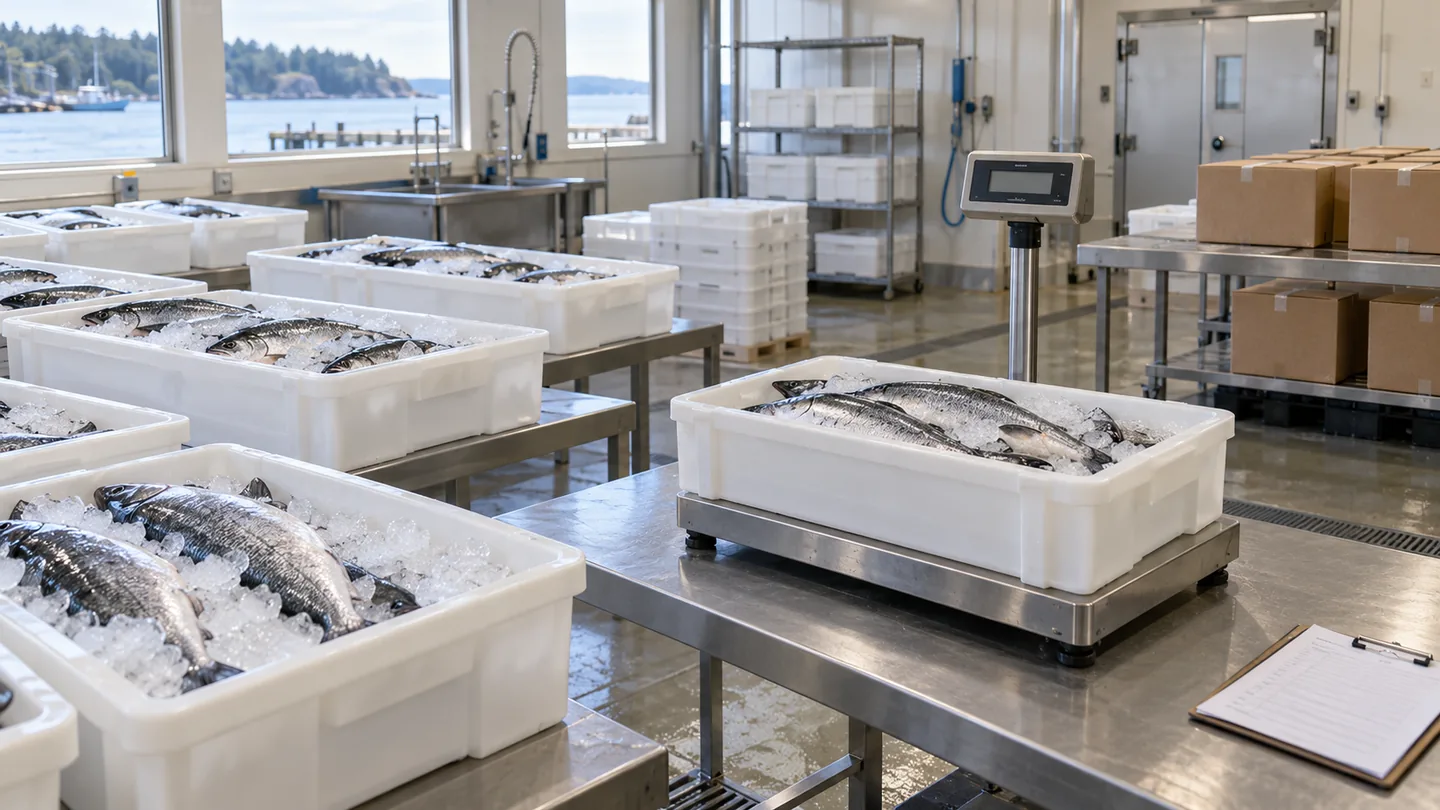
A processor may receive whole product and sell several cuts, portions or pack sizes. The stock changes identity and quantity along the way. Meat and seafood traceability software has to retain that history while giving operators a workable way to capture it on the production floor.
A finished label is only useful if the system recorded the inputs behind it. Inspect the relationships at each split, combination and repack.
- 01Receive and weighLot, container, count and actual weight
- 02Process the inputsRecord splits, combinations and outputs
- 03Reconcile the runMain product, other outputs and lossesCan the quantities be explained?YesContinue the trace exerciseNoInvestigate the measurement or missing event; preserve the original record when correcting it.
- 04Trace the shipmentRetrieve source relationships in both directions
Quantity reconciliation is a record check. It does not replace quality release or handling procedures. Diagram: NextEdge Labs.
Count and weight need their own records
Ten boxes do not necessarily represent a fixed weight. If purchasing, handling and invoicing use different quantities, store each explicitly and agree which one governs each transaction. Replacing an actual weight with a nominal value can conceal a discrepancy before the processing run starts.
Connect a scale reading to the correct lot, container and unit. Plan for a corrected measurement, a disconnected scale and a partially used container. An operator should be able to use an approved fallback and record where the value came from.
Avoid deriving weight from a count merely to make two applications agree. If one system cannot carry the required quantity, the limitation belongs in the integration design and acceptance criteria.
Account for every output from a processing run
Here is a simplified reconciliation exercise: a 100 kg input produces 62 kg of the main cut, 23 kg of secondary cuts, 10 kg of trim and 5 kg recorded as loss. Those figures are invented for the exercise; they are not yield benchmarks. Their purpose is to show that the main saleable output is only one part of the material account.
Give each relevant output its own identity and status. If trim is used in a later approved process, preserve the source relationship. If two incoming lots feed one run, retain both rather than choosing whichever reference is easier to print.
GS1’s Global Traceability Standard calls for input-to-output relationships at transformation events. The system design should make those relationships retrievable after cutting, portioning, combining and repacking.
Source: GS1 · Section 5: data recording requirements, R24. Reference details
Test the label and the workstation together
Watch how an operator identifies a container, confirms a weight and applies a label. Screen design, scanner placement and readable identifiers all affect whether the record is captured at the right time. A correct database model cannot recover a relationship that was never entered.
Include damaged labels, duplicate scans and reprints in the demonstration. A reprint should identify the same physical item unless the approved process explicitly creates a new one. Keep a visible confirmation that a scan or weight was accepted, so staff do not repeat the action to be sure.
Meat and seafood workflows should be evaluated with their own products and attributes. Ask the team to show the actual identification fields used by the business and confirm that they survive a split or repack. A category label in a product brochure is not enough to establish that fit.
Restricted stock stays restricted when it moves
A hold needs to affect the interfaces that allocate and dispatch stock, as well as the screen where quality staff enter it. Moving the product to another location should not reset its status. A partial release requires an explicit relationship to the quantity and containers covered by that decision.
Handling records should remain connected to the lot and time period. FAO’s cold-chain discussion provides context for temperature control across food distribution. It does not provide a universal rule for releasing a particular batch. Assessment and disposition belong to the qualified team using the applicable product-specific procedures.
Source: Food and Agriculture Organization of the United Nations (FAO) · Discussion of temperature control from production through distribution. Reference details
Try the trace from a shipped pack, then from a receipt
From a shipped pack, retrieve the processing runs and source lots. From one receipt, identify all outputs, remaining stock and destinations. Include a multi-input run, a partial consumption and a corrected weight.
Write down the relationships the system cannot explain. Then ask whether the missing evidence can be captured at the workstation without slowing the operator into bypassing the process. That is the implementation problem to solve before adding another reporting screen.
For procurement, require a usable export of the relationships and corrections. The business should be able to inspect its own history without commissioning a custom report every time a customer asks a question.
Sources and further reading
Sources checked 15 October 2026. The worked examples and software evaluation suggestions are NextEdge Labs’ editorial analysis.
- GS1 Global Traceability StandardGS1 · Release 2.0, August 2017
Reference framework for identification and traceability data. Citing it does not imply that a proposed system is GS1 certified.
- From farm to fork: how to keep food fresh and healthy, sustainablyFood and Agriculture Organization of the United Nations (FAO) · 12 June 2026
Background on temperature control and food loss. No savings forecast or product-specific safety threshold is inferred from this article.
Visual credits
AI-generated illustration created for NextEdge Labs; it does not depict a client facility. Workflow diagram by NextEdge Labs. Icons from Lucide (ISC licence).