Halal, Kosher, and Organic Segregated Production: Certificate Expiry Gates, Ritual Purge Runs, and Audit Mass-Balance Ledgers
For Inventory managers and supply-chain heads · Compare approaches
TL;DR — what you’ll learn
- Standardize halal kosher organic segregated batch certificate mass balance around explicit lot, revision, and unit-of-measure checkpoints before automating ERP postings.
- Separate physical floor observations from commercial or quality release decisions so discrepancies remain visible.
- Route out-of-tolerance variances to a named owner with mandatory supporting evidence and timestamped sign-off.
- Reconcile physical counts, laboratory or inspection records, and financial ledgers at a shared cut-off.
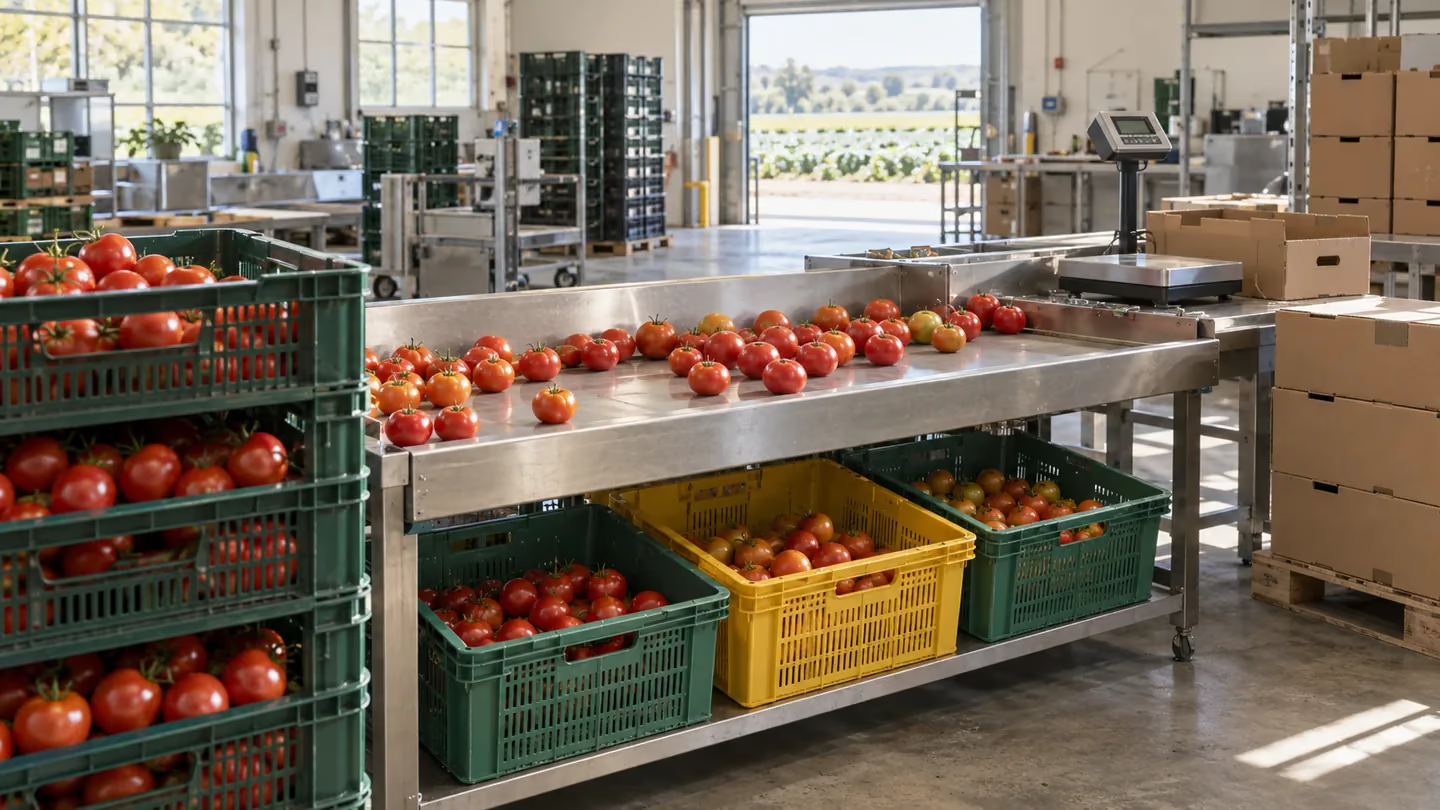
In food and beverage operations, halal kosher organic segregated batch certificate mass balance often fails when floor sheets, laboratory checks, and ERP entries record the same batch at different times or in different units. Separating physical observation from commercial or quality release keeps the stock ledger accurate and gives supervisors a clear exception queue.
How should food businesses govern halal kosher organic segregated batch certificate mass balance?
Standardize halal kosher organic segregated batch certificate mass balance around explicit lot, revision, and unit-of-measure checkpoints before automating ERP postings. Separate physical floor observations from commercial or quality release decisions so discrepancies remain visible.
- 01Capture batch contextLot, unit, timestamp and source reference
- 02Verify against rulesActive specification, tolerance and cut-off
- 03Reconcile variancesSeparate physical events from timing gapsDo the batch records and tolerances agree?YesApprove ledger postingNoKeep the disputed quantity in a visible hold status and route to the designated owner.
- 04Approve ledger postingRetain signed-off evidence and history
Illustrative information flow. The article explains the evidence, exceptions and responsible decisions. Diagram: NextEdge Labs.
1. Why Religious and Organic Certifications Fail on Shared Multi-Purpose Processing Lines
Global ingredient processors, dairy plants, confectioners, and contract manufacturers rarely enjoy the luxury of building separate factories for Certified Organic (USDA NOP / EU 2018/848 / India NPOP), Halal (JAKIM, BPJPH/MUI, IFANCA, GSO 2055-1), Kosher Pareve / Dairy / Passover (OU, OK, Star-K, Kof-K), and conventional product lines. Instead, they must run certified and non-certified formulations on shared spray dryers, extruders, chocolate conches, and bottling lines while storing raw materials in shared distribution warehouses.
Unlike standard food safety (HACCP/FSMA), where a validated chemical/thermal limits check proves the absence of biological pathogens, religious and organic claims are process-integrity and provenance statuses. A batch of organic oat milk or Kosher Pareve dark chocolate can be 100% microbiologically sterile and chemically indistinguishable from a conventional batch in a laboratory test—yet still trigger a catastrophic Certificate Revocation, Import Customs Seizure, or Fraud Prosecution if any of four operational breakdowns occur:
Expired or Agency-Incompatible Supplier Certificates at Goods Receipt: An emulsifier (E471 mono- and diglycerides) arrives from an approved supplier, but the supplier switched their Halal certifier to a local body not recognized by Malaysia's JAKIM or Indonesia's BPJPH, or their annual Organic Transaction Certificate (TC) lapsed 4 days before the purchase order shipped. Silent Downgrade Contamination on Shared Equipment: A heat exchanger runs a Kosher Dairy batch at $85^\circ\text{C}$, followed the next morning by a Kosher Pareve (non-dairy/non-meat) batch without a Mashgiach-witnessed boiling-water Kosherization (Hag'alah) cycle, instantly rendering the Pareve batch Dairy and violating every downstream vegan/Pareve customer label. Unaccounted Organic Flush / Purge Loss: To clear conventional soy lecithin residue from a chocolate pipeline before an Organic run, the plant flushes $350\text{ kg}$ of certified Organic cocoa butter through the pipes. Instead of downgrading that $350\text{ kg}$ purge lot to conventional stock, the operator leaves it in the Organic surge tank—resulting in an Organic Mass-Balance Audit Failure where finished Organic sales exceed certified Organic raw material inputs (adjusted for real process shrink). Prohibited Cleaning Chemicals or Processing Aids: Using porcine-derived defoamers, bone-char filtered sugar, ethanol-based flavor carriers above permissible residual thresholds ($>0.01\%\text{–}0.1\%$ depending on fatwa standard), or conventional synthetic sanitizers without a validated potable water rinse prior to an Organic run.
Scroll horizontally to see all columns.
| Certification Regime | Sub-Classification / Tier | Strict Incompatibility & Downgrade Triggers | Mandatory Line Transition Protocol |
|---|---|---|---|
| **Halal** (`MS 1500` / `HAS 23000` / `GSO 2055-1`) | - Halal Meat/Poultry (Slaughtered) <br> - Halal Dairy/Plant <br> - Ethanol Threshold ($<0.01\%$ or $<0.5\%$ by market) | **Absolute Prohibition**: Porcine (*Mughallazah* / severe *Najis*), carrion, blood, non-Halal animal enzymes/gelatin/L-cysteine, intoxicants. (Many authorities prohibit running *any* porcine product in the same building/line; mild *Mutawassitah* requires validated wash). | Dedicated non-porcine facility; if transitioning from non-certified botanical/chemical line: full caustic/acid CIP + $7\times$ potable water rinse (with clay/*Sertu* ritual cleansing if severe *Najis* ever occurred). |
| **Kosher** (`OU` / `OK` / `Star-K`) | - **Pareve** (Neutral) <br> - **Dairy** (*Milchig*) <br> - **Meat** (*Fleishig*) <br> - **Passover** (*Pesach* - No *Chametz* grain/corn syrup) | Mixing Meat + Dairy; processing non-Kosher animal/grape derivatives on hot equipment ($>43^\circ\text{C}\text{–}49^\circ\text{C}$ *Yad Soledet Bo* threshold). | Cold transition: standard validated CIP. Hot transition ($>43^\circ\text{C}$) from Dairy to Pareve or Non-Kosher to Kosher: **24-hour equipment idle rest (*Ben Yomo* wait)** + Mashgiach-supervised $100^\circ\text{C}$ overflowing boiling water purge (*Hag'alah*) or torch/kiln burnout (*Libun*). |
| **Organic** (`USDA NOP` / `EU 2018/848` / `NPOP`) | - **100% Organic** <br> - **Organic** ($\ge 95\%$ certified organic ag ingredients) <br> - **Made with Organic** ($\ge 70\%$) | GMO ingredients, ionizing radiation, synthetic solvents (hexane), sewage sludge, non-allowed synthetic processing aids, prohibited quaternary ammonium sanitizers without verified zero-residue rinse. | Documented wet CIP + ATP/conductivity zero-sanitizer rinse check **OR** physical purge using a sacrificial quantity of Certified Organic material (which must be downgraded and sold as Conventional). |
Source: GS1 · Lot identification and movement event records. Reference details
2. Tri-Dimensional Certification Matrix: Halal, Kosher, and Organic Rules in ERP
A durable food compliance software architecture cannot model certification as a simple boolean checkbox (is_halal = true). Each certification regime carries hierarchical compatibility rules that must be evaluated across Ingredients + Processing Aids + CIP Chemicals + Equipment State + Packaging Materials:
Source: Frappe / ERPNext · Material movement and reconciliation controls. Reference details
3. Supplier & Lot Certificate Governance: Preventing Expired or Scope-Mismatched Receipts
In the ERP procurement and receiving module, certification validation operates at three hierarchical levels:
Annual Facility Certificate (CERT_FACILITY): Stored against the Manufacturer_Site_ID (never just the broker or trader!). Includes certifying_body (e.g., JAKIM, MUI, OU, ECOCERT), certificate_number, issue_date, expiry_date, and approved_sku_annex_list. Shipment-Specific Transaction Certificate (CERT_BATCH_TC): Required for bulk Organic grain/oil imports (COI / NOP Import Certificate) and Halal meat/gelatin consignments. A shipment cannot be converted from DOCK_QUARANTINE to CERTIFIED_UNRESTRICTED until the lot-specific Transaction Certificate number and net certified weight ($\text{kg}$) are matched to the physical bill of lading. Cross-Border Certifier Mutual Recognition Matrix: A flavor house in Europe may hold a Halal certificate from a regional European certifier (CERT-BODY-X). If that flavor is used in a beverage SKU destined for Indonesia (requiring BPJPH / MUI mutual recognition) or Malaysia (requiring JAKIM foreign recognized body status), the ERP evaluates:
$$\text{Market\_Compliance}(SKU, \text{Country}) = \bigwedge_{i=1}^{n} \left( \text{Cert\_Body}(L_i) \in \text{Recognized\_Bodies}(\text{Country}) \land \text{Manufacture\_Date}(L_i) \le \text{Expiry\_Date}(L_i) \right)$$
4. Spatial Segregation in WMS: Preventing Overhead Drip, Vapor Cross-Contact, and Forbidden Racks
Organic, Halal, and Kosher auditors immediately issue major non-conformities when warehouse racks mix certified and non-certified pallets carelessly. The Warehouse Management System (WMS) putaway engine enforces three spatial rules:
Vertical Gravity Putaway Rule ("Certified Above Conventional"): In multi-tier pallet racking storing liquid IBC totes, drums, or breathable woven sacks, an Organic, Halal, or Kosher pallet may never be stored in a rack bay underneath a conventional, non-Halal, or non-Kosher liquid tote where a leaky valve or punctured bag could drip downward onto certified stock. WMS putaway algorithms restrict certified liquid/powder storage either to dedicated zone aisles (ZONE-ORG-01, ZONE-HALAL-01) or to top rack tiers above non-certified materials. Closed-Container & Dedicated Scoop/Scale Rule: Once a $25\text{ kg}$ bag of Organic spice or Kosher Pareve vitamin premix is opened in the weigh-dispense booth, it must be transferred into a color-coded rigid bin (Green = Organic, Blue = Kosher Pareve, Red = Kosher Dairy) and weighed exclusively on dedicated or sanitised scales using colour-coded scoops. Temperature & Vapor Segregation in Ovens/Smokehouses/Retorts: In thermal processing equipment, steam or smoke vapors carry volatile fats. A Kosher or Halal product can never be cooked or retorted simultaneously in the same vessel alongside a non-certified batch, nor can it share unfiltered recirculating fryer oil or open condensate return loops.
5. Line Changeover, Ritual Kosherization (*Hag'alah*), and Certified Organic Purge Accounting
Look closely at Step 3 and the ERP Automatic Downgrade Transaction in the diagram above. In continuous pipelines (chocolate conches, flour mills, edible oil refineries, feed extruders) where wet water-CIP cannot be used between runs because water ruins the equipment or causes microbial growth, plants execute a Dry/Viscous Product Purge: To transition the chocolate line from Conventional to Certified Organic, the plant pumps $400\text{ kg}$ of Certified Organic chocolate through the pipes to push out the residual Conventional heel. What is the legal certification status of that $400\text{ kg}$ purge output? It is 100% Conventional, because it mixed with the conventional heel! Yet it consumed $400\text{ kg}$ of Certified Organic inventory from the raw material ledger! If the ERP does not have a dedicated WO_TYPE = ORGANIC_LINE_PURGE_DOWNGRADE transaction that deducts MAT-COCOA-ORGANIC ($400\text{ kg}$) and receives MAT-COCOA-CONVENTIONAL-REWORK ($392\text{ kg}$), operators either book the $400\text{ kg}$ as finished Organic product (illegally contaminating the Organic run) or fail to deduct it from Organic inventory (creating a phantom $400\text{ kg}$ discrepancy during the annual NOP audit).
6. The Auditor's Mass-Balance Equation: Input-Output-Inventory Reconciliation Across a 12-Month Period
During an unannounced USDA NOP, EU Organic, RSPO, or Rainforest Alliance audit, the inspector selects a certified ingredient or finished product family and demands a complete Input-Output Mass-Balance Reconciliation across a 6- or 12-month window ($t_0 \rightarrow t_1$) within $2\text{ to }4\text{ hours}$.
For every certified ingredient $i$, the fundamental conservation law must hold across the audit period:
$$I_{\text{open}, i} + \sum P_{\text{cert}, i} - I_{\text{close}, i} = C_{\text{total}, i} = C_{\text{into\_cert\_FG}, i} + C_{\text{purge\_downgrade}, i} + L_{\text{process\_shrink}, i}$$
Summary
Reliable halal kosher organic segregated batch certificate mass balance depends on consistent lot identity, shared cut-off times, and explicit exception ownership across production, quality, and finance. When teams verify physical evidence before posting adjustments, both traceability and margin reporting remain defensible.
What to do next
- Audit one recent week of halal kosher organic segregated batch certificate mass balance transactions to identify unrecorded movements, unit mismatches, or late entries.
- Define the mandatory lot, unit, and approval fields required before an operator or integration can post a status change.
- Pilot the exception queue on one product line and review unresolved variances at a fixed daily cut-off.
Compare this workflow with your current setup
Share the step that takes the most manual work, the systems involved and the exceptions your team handles. That gives us a concrete starting point for comparing approaches.
Sources and further reading
Sources checked 15 October 2026. The worked examples and software evaluation suggestions are NextEdge Labs’ editorial analysis.
- GS1 Global Traceability StandardGS1 · Release 2.0, August 2017
Reference framework for identification and traceability data. Citing it does not imply that a proposed system is GS1 certified.
- Stock EntryFrappe / ERPNext · Online product documentation, accessed October 2026
Examples of distinct material receipt, issue, transfer and manufacturing transactions, including transit handling.
Visual credits
AI-generated illustration created for NextEdge Labs; it does not depict a client facility. Workflow diagram by NextEdge Labs. Icons from Lucide (ISC licence).