Continuous Snack Fryer Oil Management: Turnover Time, Free Fatty Acid (FFA), Total Polar Compounds, and Slurry Seasoning Yield
For Finance controllers, CFOs and accounts teams · Compare approaches
TL;DR — what you’ll learn
- Standardize snack fryer oil turnover ffa polar compound blend control around explicit lot, revision, and unit-of-measure checkpoints before automating ERP postings.
- Separate physical floor observations from commercial or quality release decisions so discrepancies remain visible.
- Route out-of-tolerance variances to a named owner with mandatory supporting evidence and timestamped sign-off.
- Reconcile physical counts, laboratory or inspection records, and financial ledgers at a shared cut-off.
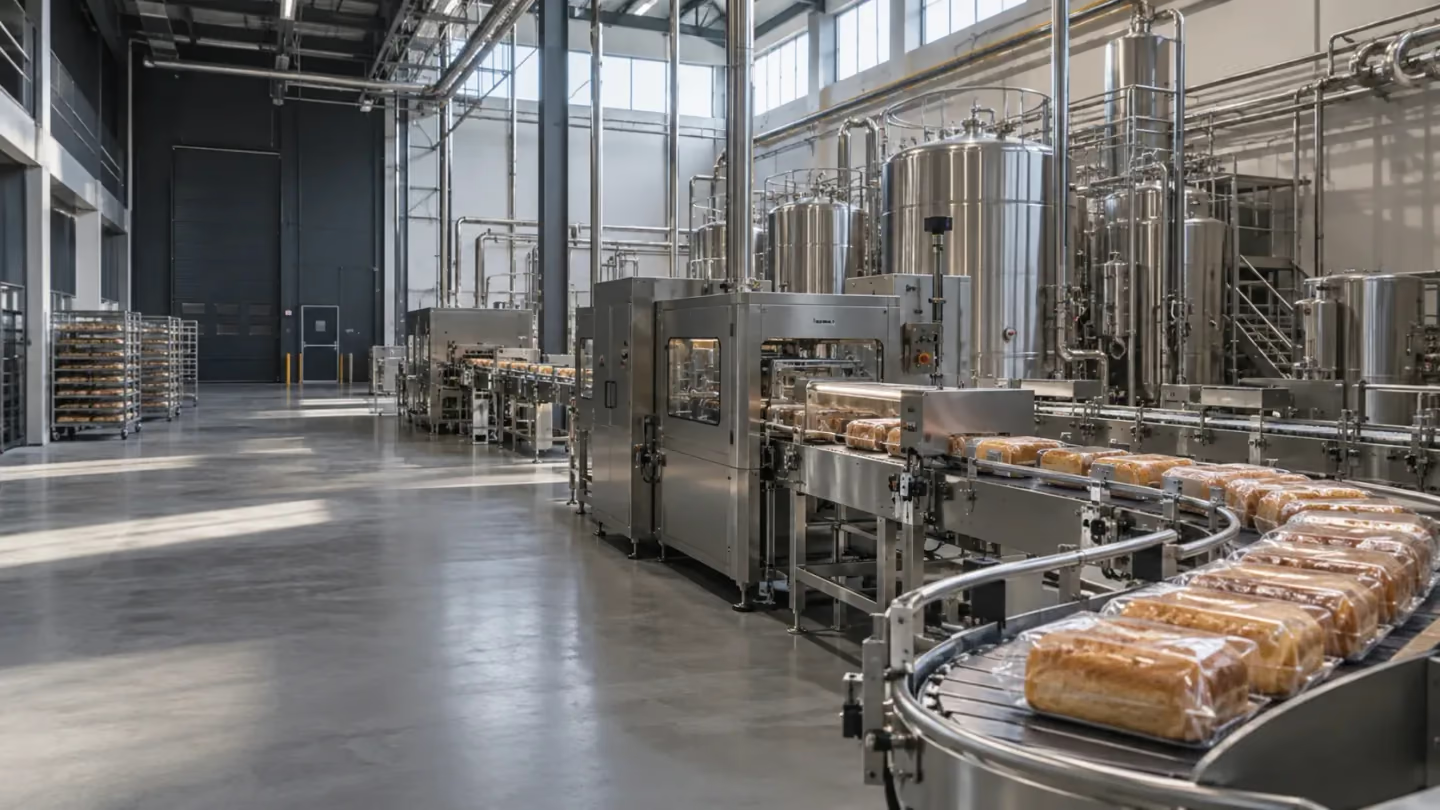
In food and beverage operations, snack fryer oil turnover ffa polar compound blend control often fails when floor sheets, laboratory checks, and ERP entries record the same batch at different times or in different units. Separating physical observation from commercial or quality release keeps the stock ledger accurate and gives supervisors a clear exception queue.
How should food businesses govern snack fryer oil turnover ffa polar compound blend control?
Standardize snack fryer oil turnover ffa polar compound blend control around explicit lot, revision, and unit-of-measure checkpoints before automating ERP postings. Separate physical floor observations from commercial or quality release decisions so discrepancies remain visible.
- 01Capture batch contextLot, unit, timestamp and source reference
- 02Verify against rulesActive specification, tolerance and cut-off
- 03Reconcile variancesSeparate physical events from timing gapsDo the batch records and tolerances agree?YesApprove ledger postingNoKeep the disputed quantity in a visible hold status and route to the designated owner.
- 04Approve ledger postingRetain signed-off evidence and history
Illustrative information flow. The article explains the evidence, exceptions and responsible decisions. Diagram: NextEdge Labs.
1. Why Frying Oil Is Simultaneously a Heat-Transfer Medium and a $25\%\text{–}38\%$ Major Ingredient
In continuous snack food manufacturing—producing sliced potato chips, tortilla chips, extruded corn curls, pellet snacks, and coated nuts, the frying oil circulating through the multi-zone continuous fryer ($172^\circ\text{C}\text{ to }190^\circ\text{C}$) is not merely a cooking utility like steam or hot air. Because capillary suction draws frying oil into the porous starch matrix as water flashes to steam, frying oil constitutes $24\%$ to $38\%$ of the finished weight of a potato chip and $35\%$ to $45\%$ of the total raw material cost on the plant P&L!
Despite this massive financial and sensory footprint, standard batch-oriented ERP systems struggle to govern continuous snack lines for three structural reasons:
Continuous Oil Holdup vs. Batch Work Order Cutoffs: A $2,500\text{ kg/hr}$ potato chip fryer system holds $4,500\text{ kg}$ of hot RBD palm olein or high-oleic sunflower oil across the fryer kettle, external shell-and-tube heat exchanger, continuous fines belt filter, and day-makeup tank. Fresh oil is continuously metered in via a level-control valve as the exiting chips carry oil out of the fryer. If the ERP only backflushes oil at month-end tank inventory counts, plant management cannot tell which shift or potato lot absorbed $37.2\%$ oil (destroying oil margin and creating greasy chips) versus $32.5\%$ oil. Oil Turnover Time ($\tau_{\text{oil}}$) Stagnation and Rancidity: When line throughput slows down (due to VFFS packaging stops or low potato solids) or when a low-oil-uptake product runs in a high-volume fryer pan, the Oil Turnover Time stretches from the healthy $5\text{ to }8\text{ hours}$ out to $14\text{ to }20\text{ hours}$. Prolonged thermal residence at $182^\circ\text{C}$ in the presence of steam and oxygen accelerates hydrolysis (Free Fatty Acids, $\text{FFA}$) and polymerization (Total Polar Compounds, $\text{TPC}$), causing cardboard off-notes within 6 weeks of shelf life. Seasoning Drum Slurry / Powder Slip: After the fryer, chips pass over an optical sorter into rotating seasoning drums where electrostatic dry powder ($6\%\text{ to }8\%$) or oil-based cheese slurry ($14\%\text{ to }18\%$) is sprayed/metered against a continuous loss-in-weight base-chip belt scale. A $\pm 1.5\%$ calibration drift on the seasoning auger either starves flavor or wastes hundreds of thousands of dollars in expensive cheese and spice blends.
Scroll horizontally to see all columns.
| Chemical Degradation Pathway | Primary Analytical Metric | Fresh Refined Oil Baseline | In-Fryer Equilibrium Target | Hard Action / Dump Limit | Sensory & Regulatory Impact |
|---|---|---|---|---|---|
| **1. Hydrolytic Cleavage** (Water/Steam splitting triglycerides into diglycerides + free fatty acids) | **Free Fatty Acids ($\text{FFA}$, as $\%$ Oleic Acid)** | $\le 0.05\%\text{–}0.08\%$ | $0.18\%\text{–}0.32\%$ | **$\ge 0.50\%$** (Internal QA Hold) / $\ge 0.75\%$ (Discard) | Lower smoke point (blue haze in plant), soapy/acidic off-taste, accelerated oxidation in bag. |
| **2. Primary & Secondary Oxidation** (Oxygen reaction at unsaturated double bonds $\rightarrow$ hydroperoxides $\rightarrow$ hexanal/aldehydes) | **Peroxide Value ($\text{PV}$) & $p$-Anisidine Value ($p\text{-AV}$)** | $\text{PV} \le 1.0\text{ meq/kg}$ | $\text{PV}$ unstable at $180^\circ\text{C}$; track **TOTOX** $= 2\text{PV} + p\text{-AV}$ | Finished Bag Shelf-Life Release: **$\text{PV} \le 3.0\text{ meq/kg}$** | Rancid "painty" or "cardboard" odor developing 30–60 days into retail shelf life (especially if nitrogen flush $>1.5\%\text{ O}_2$). |
| **3. Thermal Polymerization & Dimers** (Non-volatile oxidized triglycerides, dimers, cyclic monomers) | **Total Polar Compounds ($\text{TPC}$, $\%$) & Polymerized Triglycerides ($\text{PTG}$)** | $2.0\%\text{–}4.0\%$ | $9.0\%\text{–}14.0\%$ | **$\ge 18.0\%$** (Sweetener/Dilution Trigger) / **$\ge 24.0\%\text{–}25.0\%$** (EU Statutory Max) | Dark chip color, excessive oil viscosity causing $+3\%$ higher oil pickup, statutory food safety violation above $24\%\text{–}25\%\text{ TPC}$. |
Source: GS1 · Lot identification and movement event records. Reference details
2. Thermodynamics of Continuous Potato & Extruded Snack Frying: Moisture Flash vs. Capillary Oil Uptake
Consider a raw potato slice ($1.35\text{ mm}$ thickness) entering the fryer at $80.0\%$ moisture ($20.0\%$ dry matter / specific gravity $1.080$). Inside the fryer ($182^\circ\text{C}$ inlet, $164^\circ\text{C}$ outlet, $150\text{ seconds}$ residence time): Almost $98\%$ of the initial cellular water flashes violently into superheated steam, escaping through microscopic intercellular pores and leaving behind a rigid, crisp gelatinized starch skeleton at $1.35\%$ to $1.65\%$ finished moisture. Why does oil enter the chip? While steam is actively jetting out of the pores inside the fryer, positive internal steam pressure largely prevents oil penetration ($<20\%$ of total oil uptake occurs during immersion). The remaining $80\%$ of oil uptake is a surface-cooling capillary phenomenon that occurs in the first $10\text{ to }20\text{ seconds}$ after the chip lifts out of the oil bath onto the drain conveyor: as residual steam inside the pores cools and condenses, it creates a partial vacuum that sucks adhered surface oil into the porous crust!
Consequently, finished chip oil content ($O_{\text{chip}}\%$, typically $33.0\%\text{ to }35.5\%$ for atmospheric fryers and $22.0\%\text{ to }26.0\%$ for vacuum/batch-kettle sweep fryers) is governed by three controllable process variables monitored by online NIR sensors above the fryer outfeed belt: Raw Potato Dry Matter / Specific Gravity ($\text{SG}$): Every $+0.005$ increase in tuber specific gravity (e.g., from $1.075$ to $1.080$, equivalent to $+1.1\%$ dry solids) reduces finished chip oil absorption by $-1.2\%$ to $-1.5\%$ and increases finished chip yield by $+2.8\%$ per tonne of raw potatoes! Slice Thickness & Surface Starch Washing: Thinner slices ($1.20\text{ mm}$ vs. $1.45\text{ mm}$) have a higher surface-area-to-volume ratio and absorb $+2.5\%$ more oil. Unwashed free starch from torn cells forms a glassy surface film that traps surface oil. Fryer Outfeed Temperature & Steam Hood Suction Knife: If fryer outfeed temperature drops below $160^\circ\text{C}$ or the superheated steam blow-off knife at the fryer exit fails, excess surface oil is sucked into the cooling chip before it can drain back into the pan.
Source: Frappe / ERPNext · Material movement and reconciliation controls. Reference details
3. The Oil Turnover Time Equation ($\tau_{\text{oil}}$) and Thermal-Oxidative Degradation Kinetics
The single most important engineering metric governing frying oil freshness is the Oil Turnover Time ($\tau_{\text{oil}}$, in hours)—defined as the ratio of the total mass of hot oil circulating in the fryer system ($M_{\text{system}}$, in $\text{kg}$) to the continuous mass rate of fresh makeup oil added to replace oil absorbed by the snack product ($\dot{m}_{\text{makeup}}$, in $\text{kg/hr}$):
$$\tau_{\text{oil}} \text{ (hours)} = \frac{M_{\text{system}}}{\dot{m}_{\text{makeup}}} = \frac{M_{\text{pan}} + M_{\text{HX}} + M_{\text{filter}} + M_{\text{pipes}}}{\dot{m}_{\text{base\_chip}} \cdot f_{\text{oil\_chip}}}$$
Let us plug in the numbers for a $2,500\text{ kg/hr}$ finished potato chip line (producing $\dot{m}_{\text{base\_chip}} = 2,325\text{ kg/hr}$ of unseasoned base chips before $7.0\%$ dry seasoning): At a base-chip oil content of $f_{\text{oil\_chip}} = 34.0\%$, the chips remove $\dot{m}_{\text{makeup}} = 2,325 \times 0.340 = 790.5\text{ kg/hr}$ of oil from the fryer. If the fryer system holds $M_{\text{system}} = 4,350\text{ kg}$ of oil, the Oil Turnover Time is: $$\tau_{\text{oil}} = \frac{4,350\text{ kg}}{790.5\text{ kg/hr}} = 5.50\text{ hours}$$
What Breaks the Equilibrium?
When packaging machines jam or upstream slicers stop for blade changes, operators often leave the fryer in "Hot Idle Circulation" at $175^\circ\text{C}$ with $\dot{m}_{\text{makeup}} = 0\text{ kg/hr}$ ($\tau_{\text{oil}} \rightarrow \infty$). Thirty minutes of hot idle circulation with aerated oil cascading over empty return weirs degrades the oil more than 12 hours of full-load production! Therefore, the PLC/MES interlock enforces an automatic Hot-Idle Temperature Setback (dropping heat-exchanger setpoint to $135^\circ\text{C}$ and purging the fryer hood with steam/nitrogen blanket if infeed stops for $>4\text{ minutes}$).
4. Chemical Quality Thresholds: Free Fatty Acids ($\text{FFA}$), Peroxide Value ($\text{PV}$), and Total Polar Compounds ($\text{TPC}$)
Three distinct chemical pathways degrade frying oil, and each must be tracked against hard ERP/LIMS thresholds:
The "Sweetener" Bleed-and-Feed Protocol
If an extended downtime event or a low-turnover pellet product pushes fryer $\text{FFA}$ to $0.46\%$ and $\text{TPC}$ to $17.5\%$, the MES calculates the exact Sweetener Bleed-and-Feed Volume required to restore equilibrium before the next batch: bleeding $800\text{ kg}$ of degraded fryer oil into the used-oil biofuel/soap recovery tank (BYPROD-USED-FRY-OIL) and injecting $800\text{ kg}$ of fresh oil (MAT-OIL-OLEIN), while attributing the $800\text{ kg}$ oil downgrade cost directly to the downtime event or low-turnover SKU rather than smearing it across all products.
Summary
Reliable snack fryer oil turnover ffa polar compound blend control depends on consistent lot identity, shared cut-off times, and explicit exception ownership across production, quality, and finance. When teams verify physical evidence before posting adjustments, both traceability and margin reporting remain defensible.
What to do next
- Audit one recent week of snack fryer oil turnover ffa polar compound blend control transactions to identify unrecorded movements, unit mismatches, or late entries.
- Define the mandatory lot, unit, and approval fields required before an operator or integration can post a status change.
- Pilot the exception queue on one product line and review unresolved variances at a fixed daily cut-off.
Compare this workflow with your current setup
Share the step that takes the most manual work, the systems involved and the exceptions your team handles. That gives us a concrete starting point for comparing approaches.
Sources and further reading
Sources checked 15 October 2026. The worked examples and software evaluation suggestions are NextEdge Labs’ editorial analysis.
- GS1 Global Traceability StandardGS1 · Release 2.0, August 2017
Reference framework for identification and traceability data. Citing it does not imply that a proposed system is GS1 certified.
- Stock EntryFrappe / ERPNext · Online product documentation, accessed October 2026
Examples of distinct material receipt, issue, transfer and manufacturing transactions, including transit handling.
Visual credits
AI-generated illustration created for NextEdge Labs; it does not depict a client facility. Workflow diagram by NextEdge Labs. Icons from Lucide (ISC licence).

