Central Commissary Butcher & Seafood Yield Testing: AP-to-EP Weight Conversion, Usable Trim Credits, and Recipe Cost Revaluation
For HR managers, plant administrators and operations heads · Understand the problem
TL;DR — what you’ll learn
- Standardize central commissary yield test butcher trim cost revaluation around explicit lot, revision, and unit-of-measure checkpoints before automating ERP postings.
- Separate physical floor observations from commercial or quality release decisions so discrepancies remain visible.
- Route out-of-tolerance variances to a named owner with mandatory supporting evidence and timestamped sign-off.
- Reconcile physical counts, laboratory or inspection records, and financial ledgers at a shared cut-off.
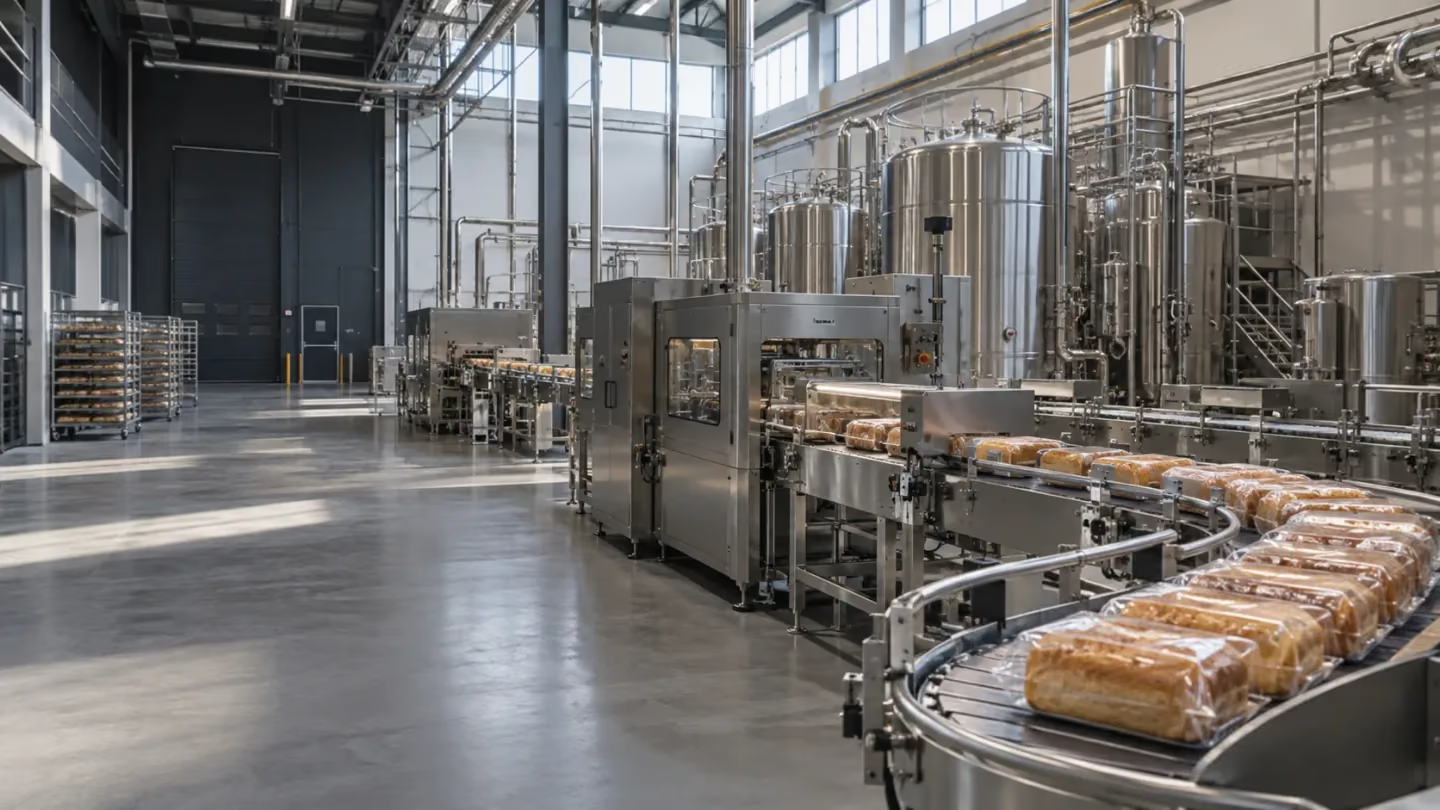
In food and beverage operations, central commissary yield test butcher trim cost revaluation often fails when floor sheets, laboratory checks, and ERP entries record the same batch at different times or in different units. Separating physical observation from commercial or quality release keeps the stock ledger accurate and gives supervisors a clear exception queue.
How should food businesses govern central commissary yield test butcher trim cost revaluation?
Standardize central commissary yield test butcher trim cost revaluation around explicit lot, revision, and unit-of-measure checkpoints before automating ERP postings. Separate physical floor observations from commercial or quality release decisions so discrepancies remain visible.
- 01Capture batch contextLot, unit, timestamp and source reference
- 02Verify against rulesActive specification, tolerance and cut-off
- 03Reconcile variancesSeparate physical events from timing gapsDo the batch records and tolerances agree?YesApprove ledger postingNoKeep the disputed quantity in a visible hold status and route to the designated owner.
- 04Approve ledger postingRetain signed-off evidence and history
Illustrative information flow. The article explains the evidence, exceptions and responsible decisions. Diagram: NextEdge Labs.
1. Why Static Cookbook Yields Destroy Gross Margin in Central Kitchens, Hotel Commissaries, and Steakhouse Chains
Unlike primary slaughterhouses and meatpacking plants (which purchase live cattle, hogs, or poultry and disassemble warm carcasses onto commodity primal trading markets), Central Commissaries, Multi-Unit Restaurant Groups, Airline/Hotel Central Kitchens, and Meal-Kit Processors purchase boxed sub-primals (USDA Choice Beef Striploin 0x1, Peeled Side-Muscle-On Tenderloin PSMO, Lamb Racks) and iced whole/headed-and-gutted fish (Whole Atlantic Salmon, Yellowfin Tuna Loins). Inside the commissary's temperature-controlled butcher shop ($+2^\circ\text{C}\text{ to }+4^\circ\text{C}$), skilled cutters portion these sub-primals into vacuum-sealed, exact-weight Edible Portions (EP) ($225\text{ g}$ center-cut filet mignon, $180\text{ g}$ skinless salmon supreme) distributed daily to satellite restaurant kitchens or assembled into ready-to-cook meal kits.
In over $70\%$ of foodservice and commissary ERP implementations, the recipe costing module suffers from a fatal flaw: it relies on static, single-output textbook yield percentages entered once by an executive chef three years ago (for example: "Beef Tenderloin Yield = 65%" or "Whole Salmon Yield = 58%").
This static textbook approach creates three severe financial distortions:
Scroll horizontally to see all columns.
| Disassembly Output Bucket | ERP Target SKU | Measured Weight ($\text{kg}$) | $\%$ of AP Weight | Valuation Basis / Market Replacement ($V_{\text{mkt}}$) | Credit / Allocated Value ($\$$) | Unit Cost in ERP ($\$/\text{kg}$) |
|---|---|---|---|---|---|---|
| **0. Gross AP Input (10 PSMO Loins)** | `RAW-BEEF-PSMO-189A` | **$30.00\text{ kg}$** | **$100.00\%$** | Purchase Invoice Cost ($\$24.00/\text{kg}$) | **$\$720.00$** | $\$24.00/\text{kg}$ |
| **1. Cryovac Bag Purge (Blood Drip)** | *(Loss — Purge Variance)* | $0.66\text{ kg}$ | $2.20\%$ | Zero-Value Moisture Loss | $\$0.00$ | — |
| **2. Heavy External Fat & Silver Skin** | *(Loss — Inedible Scrap)* | $4.14\text{ kg}$ | $13.80\%$ | Zero-Value Waste (Rendering) | $\$0.00$ | — |
| **3. Sinew & Tendon for Stock Kettle** | `WIP-BONE-SINEW-JUS` | $1.80\text{ kg}$ | $6.00\%$ | Stock Bone Replacement ($\alpha=1.0$) | $-\$3.60$ | $\$2.00/\text{kg}$ |
Source: GS1 · Lot identification and movement event records. Reference details
2. The Anatomy of a Standardized Butcher & Fishmonger Yield Test: AP Weight to EP Weight
A formal commissary Butcher Yield Test decomposes the gross invoiced As Purchased ($\text{AP}$) Weight ($W_{\text{AP}}$) into five mutually exclusive physical buckets that must sum to $100.0\%$ of $W_{\text{AP}}$ (within $\pm 0.2\%$ scale tolerance):
$$W_{\text{AP}} = W_{\text{EP, primary}} + \sum_{k=1}^{m} W_{\text{trim}, k} + W_{\text{stock\_bone}} + W_{\text{purge}} + W_{\text{waste\_fat}}$$
Cryovac Bag Purge / Ice Glaze Weep ($W_{\text{purge}}$): Measured by weighing the unopened vacuum bag (or drained fish box), removing the meat, blotting surface drip, and subtracting the dry plastic bag tare weight. High purge ($>2.5\%$ on boxed beef) indicates temperature abuse during transit or excessive wet-aging dwell. Primary Edible Portion ($W_{\text{EP, primary}}$): The exact-weight target steaks, chops, or fillets meeting the culinary specification (e.g., $225\text{ g} \pm 5\text{ g}$ thickness/diameter spec). Recoverable Culinary Trim Co-Products ($\sum W_{\text{trim}, k}$): Clean meat/fish pieces that fail primary portion geometry (tail tips, side-muscle chain, kebab cubes, tartare scrape, burger grind lean/fat trim) transferred into specific ERP semi-finished inventory SKUs (WIP-BEEF-TIPS, WIP-TRIM-80-20). Culinary Stock Bones / Shells / Heads ($W_{\text{stock\_bone}}$): Transferred to the kettle commissary only up to the actual batch demand for Jus, Fumet, or Ramen Broth. Unrecoverable Scrap, Silver Skin, Heavy Fat & Cutting Loss ($W_{\text{waste\_fat}}$): Zero-value (or minimal rendering-tallow credit) inedible connective tissue, elastin silver skin, viscera, scales, and evaporative moisture loss on the cutting board.
Source: Frappe / ERPNext · Material movement and reconciliation controls. Reference details
3. First-Principles Cost Math: Gross Yield Factor vs. By-Product Trim Credit Net Cost per Kilogram
Let us compare the two mathematical methods used in culinary cost accounting and show why every multi-output commissary must use Method B (By-Product Market Replacement Credit Valuation):
Method A: Simple Single-Output Yield Factor (Used Only When Trim Has Zero Value)
When trimming whole vegetables (e.g., peeling onions or trimming asparagus spears where trim goes to compost), the Edible Portion Yield Percentage ($Y_{\text{EP}}$) and Cost Factor ($\text{CF}$) are simply:
$$Y_{\text{EP}} = \frac{W_{\text{EP}}}{W_{\text{AP}}}, \qquad \text{CF} = \frac{1}{Y_{\text{EP}}}, \qquad C_{\text{EP}} \left(\frac{\$}{\text{kg}}\right) = \frac{C_{\text{AP}}}{Y_{\text{EP}}} = C_{\text{AP}} \times \text{CF}$$
Method B: Multi-Output Butcher Yield with Replacement-Value Trim Credits
When fabricating expensive sub-primals or whole fish, each recoverable trim stream $k$ ($W_{\text{trim}, k}$) replaces a commodity ingredient that the commissary would otherwise have to buy on the open market at Market Replacement Cost $V_{\text{mkt}, k}$ (for example, $85/15$ lean beef trim replaces boxed boneless chuck trim worth $V_{\text{mkt}} = \$8.50\text{/kg}$, and tenderloin tips for stir-fry/stroganoff replace sirloin flap meat worth $V_{\text{mkt}} = \$14.20\text{/kg}$).
Therefore, the Net Material Cost of the Primary Edible Portion ($C_{\text{EP, net}}$) per kilogram is:
$$C_{\text{EP, net}} \left(\frac{\$}{\text{kg}}\right) = \frac{\left( W_{\text{AP}} \cdot C_{\text{AP}} \right) - \sum_{k=1}^{m} \left( W_{\text{trim}, k} \cdot \alpha_k \cdot V_{\text{mkt}, k} \right)}{W_{\text{EP, primary}}}$$
4. Worked Butcher Yield Test #1: Whole Peeled Beef Tenderloin (PSMO) to Center-Cut Filet Mignon Steaks
Let us walk through a live commissary butcher yield test (YTEST-BEEF-2026-104) on a 10-piece master case of USDA Choice Whole Peeled Beef Tenderloin, Side-Muscle On (IMPS/NAMP #189A / PSMO): Gross AP Case Weight ($W_{\text{AP}}$): $30.00\text{ kg}$ AP Invoice Price ($C_{\text{AP}}$): $\$24.00\text{/kg}$ ($\text{Total AP Case Cost} = \$720.00$) Target Primary Output: $225\text{ g}$ ($8\text{ oz}$) Center-Cut Filet Mignon Steaks (SKU-STEAK-FILET-225G) Direct Butcher Labor: $0.75\text{ hours}$ at $\$28.00\text{/hr}$ ($=\$21.00$) + $72$ vacuum pouches at $\$0.08$ ($=\$5.76$)
Look at the financial precision of this reconciliation: If an amateur chef simply divided the $\$24.00\text{/kg}$ AP price by the $54.0\%$ steak yield without accounting for the $\$83.61$ of usable trim credits ($-\$3.60 - \$33.15 - \$46.86$), they would price the raw steak at $\$44.44\text{/kg}$ while giving away $7.20\text{ kg}$ of free burger meat and stroganoff tips to the banquet kitchen! Conversely, if they treated all $76.0\%$ of edible meat ($54\%$ steaks + $13\%$ grind + $11\%$ tips) as having the same cost per kilogram ($\$31.58\text{/kg}$), the center-cut filet mignon would be under-costed by $-\$7.70\text{/kg}$ and the humble commissary burger patty would be billed for $\$31.58\text{/kg}$ trim! With the By-Product Market Replacement Credit Model, the burger grind enters inventory at exactly $\$8.50\text{/kg}$, the tenderloin tips enter at $\$14.20\text{/kg}$, the stock sinew enters at $\$2.00\text{/kg}$, and the 72 center-cut Filet Mignon steaks absorb the exact residual cost of $\$39.28\text{/kg}$ material ($\$40.94\text{/kg}$ landed with butcher labor and vacuum pouch, or $\$9.21\text{ per }225\text{ g portion}$).
Summary
Reliable central commissary yield test butcher trim cost revaluation depends on consistent lot identity, shared cut-off times, and explicit exception ownership across production, quality, and finance. When teams verify physical evidence before posting adjustments, both traceability and margin reporting remain defensible.
What to do next
- Audit one recent week of central commissary yield test butcher trim cost revaluation transactions to identify unrecorded movements, unit mismatches, or late entries.
- Define the mandatory lot, unit, and approval fields required before an operator or integration can post a status change.
- Pilot the exception queue on one product line and review unresolved variances at a fixed daily cut-off.
Recognise this problem in your operation?
Tell us where the records or handovers break down. We can discuss the process, data and software questions worth examining first.
Sources and further reading
Sources checked 15 October 2026. The worked examples and software evaluation suggestions are NextEdge Labs’ editorial analysis.
- GS1 Global Traceability StandardGS1 · Release 2.0, August 2017
Reference framework for identification and traceability data. Citing it does not imply that a proposed system is GS1 certified.
- Stock EntryFrappe / ERPNext · Online product documentation, accessed October 2026
Examples of distinct material receipt, issue, transfer and manufacturing transactions, including transit handling.
Visual credits
AI-generated illustration created for NextEdge Labs; it does not depict a client facility. Workflow diagram by NextEdge Labs. Icons from Lucide (ISC licence).