Food Allergen Label & Artwork Interlocks: Blocking Packing Orders on Unmatched Supplier Sub-Ingredient Declarations
For Owners, COOs and business systems leaders · Compare approaches
TL;DR — what you’ll learn
- Standardize food allergen label artwork ingredient change interlock around explicit lot, revision, and unit-of-measure checkpoints before automating ERP postings.
- Separate physical floor observations from commercial or quality release decisions so discrepancies remain visible.
- Route out-of-tolerance variances to a named owner with mandatory supporting evidence and timestamped sign-off.
- Reconcile physical counts, laboratory or inspection records, and financial ledgers at a shared cut-off.
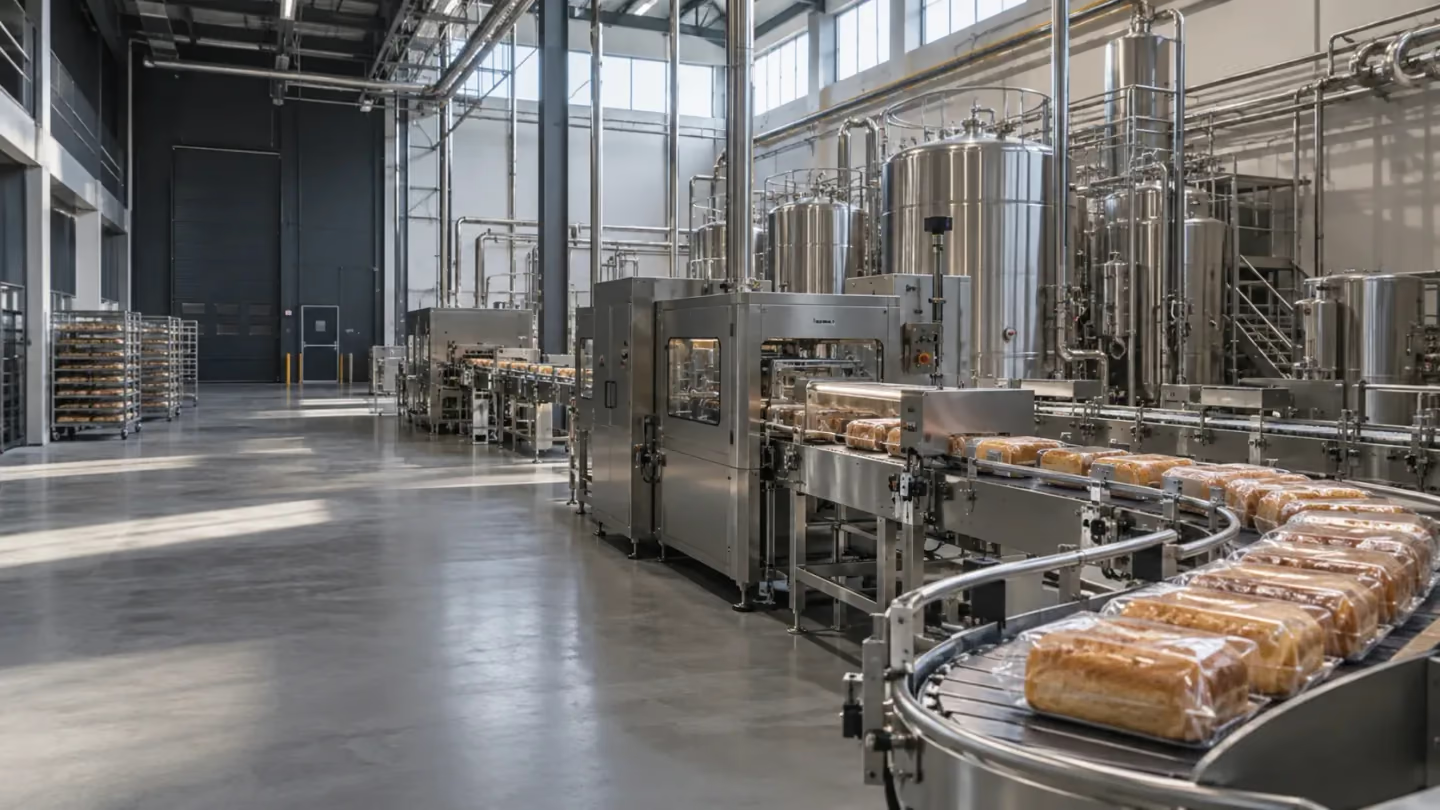
In food and beverage operations, food allergen label artwork ingredient change interlock often fails when floor sheets, laboratory checks, and ERP entries record the same batch at different times or in different units. Separating physical observation from commercial or quality release keeps the stock ledger accurate and gives supervisors a clear exception queue.
How should food businesses govern food allergen label artwork ingredient change interlock?
Standardize food allergen label artwork ingredient change interlock around explicit lot, revision, and unit-of-measure checkpoints before automating ERP postings. Separate physical floor observations from commercial or quality release decisions so discrepancies remain visible.
- 01Capture batch contextLot, unit, timestamp and source reference
- 02Verify against rulesActive specification, tolerance and cut-off
- 03Reconcile variancesSeparate physical events from timing gapsDo the batch records and tolerances agree?YesApprove ledger postingNoKeep the disputed quantity in a visible hold status and route to the designated owner.
- 04Approve ledger postingRetain signed-off evidence and history
Illustrative information flow. The article explains the evidence, exceptions and responsible decisions. Diagram: NextEdge Labs.
1. Why Undeclared Allergens Account for Nearly Half of All Class I Food Recalls
Across the United States (FDA FALCPA / FASTER Act covering the "Big 9" allergens: Milk, Eggs, Fish, Crustacean Shellfish, Tree Nuts, Peanuts, Wheat, Soybeans, and Sesame), the European Union (Regulation (EU) No 1169/2011 Annex II covering 14 mandatory allergens including Celery, Mustard, Lupin, Molluscs, and Sulphites $>10\text{ mg/kg}$), and UK/ANZ jurisdictions (Natasha's Law / FSANZ PEAL), undeclared allergens remain the single largest cause of Class I food recalls—accounting for $42\%$ to $48\%$ of all life-safety withdrawals annually.
Crucially, regulatory audits of allergen recalls reveal that less than $15\%$ of these incidents are caused by physical cross-contact on poorly cleaned processing equipment (which is governed by wet/dry CIP allergen matrices). Over $85\%$ of allergen recalls are packaging and information-architecture failures:
Wrong Roll / Wrong Carton Loaded on the Packaging Line: Putting garlic bread containing milk and wheat into an outer carton printed for a vegan gluten-free SKU, or loading the back-label roll of a peanut-butter cookie onto a chocolate-chip line. Supplier Compound Sub-Ingredient Drift: A compound ingredient supplier (supplying a savory seasoning premix, natural flavor carrier, or release agent) updates their sub-ingredient specification—for example, switching an anti-caking carrier or flavor emulsion from corn maltodextrin to wheat-derived maltodextrin or soy lecithin, or adding mustard seed flour for functionality—while the buyer continues running a 6-month inventory of pre-printed rotogravure laminate film (REV-04) whose ingredient statement does not declare Contains: Soy, Mustard. Uncontrolled Emergency R&D / Procurement Substitutions: When a primary raw material lot stocks out mid-week, procurement approves an alternate vendor lot (LOT-ALT-902) under a temporary deviation waiver, unaware that the alternate vendor's certificate of analysis (CoA) carries a mandatory allergen declaration that invalidates the packaging film already staged at the vertical form-fill-seal (VFFS) machine.
Scroll horizontally to see all columns.
| Bit Position ($k$) | Binary Weight ($2^k$) | Allergen Code | Regulatory Scope |
|---|---|---|---|
| $0$ | $1$ | `ALG_MILK` | Global (US Big 9 / EU 14 / Codex) |
| $1$ | $2$ | `ALG_EGG` | Global (US Big 9 / EU 14 / Codex) |
| $2$ | $4$ | `ALG_FISH` | Global (US Big 9 / EU 14 / Codex) |
| $3$ | $8$ | `ALG_CRUSTACEAN` | Global (US Big 9 / EU 14 / Codex) |
Source: GS1 · Lot identification and movement event records. Reference details
2. The Three Structural Disconnects Between Supplier CoAs, PLM Formulations, and Pre-Printed Film
Why do traditional ERP and Product Lifecycle Management (PLM) implementations fail to stop an allergen-mismatched pouch from leaving the factory? Because three data structures live in isolated silos:
Silo 1: PLM Theoretical Recipe (BOM-THEORETICAL): R&D formulates SKU-CURRY-SAUCE-400G using generic item master codes (e.g., ING-MOD-STARCH-01, ING-GARAM-MASALA-04). R&D generates the nutrition facts and allergen statement once during new product launch based on the primary approved supplier's spec sheet. Silo 2: Receiving Dock Vendor Lot (LOT-VENDOR-SPECIFIC): In the real warehouse, ING-GARAM-MASALA-04 is dual-sourced from Vendor A (whose facility is 100% nut- and sesame-free) and Vendor B (whose revised spec declares intentional Mustard and precautionary May Contain Sesame). If the allergen attribute is stored only at the generic item-master level rather than the Vendor-Item-Lot level, the ERP remains blind when Vendor B's lot is weighed into the batch kettle. Silo 3: Pre-Printed Packaging Film Inventory (PKG-FILM-REV): Flexible packaging film is ordered in $15,000\text{-meter}$ minimum order quantities (MOQs) to capture rotogravure cylinder economies. At any given time, the warehouse holds rolls of PKG-FILM-CURRY-REV03 (old artwork) and PKG-FILM-CURRY-REV04 (new artwork). In a standard ERP, both rolls sit under the same item number (MAT-FILM-CURRY-400G) so MRP does not have to create a new SKU number!
When old and new artwork revisions share the same ERP item code—or when a BOM allows substituting a new ingredient lot without checking the exact artwork revision staged at the packaging line, an undeclared allergen recall is guaranteed.
Source: Frappe / ERPNext · Material movement and reconciliation controls. Reference details
3. Boolean Allergen Bitmask Algebra: Comparing Computed WIP Allergen Vectors Against Packaging Artwork
To make allergen-to-label verification deterministic at the database and PLC level, every allergen regulated across the plant's domestic and export markets is assigned a fixed bit position in a 16-bit (or 32-bit) Allergen Bitmask Vector ($\mathbf{A}$):
Dynamic Bitwise OR Propagation from Raw Lots to Bulk WIP
When a mixing kettle or blending batch (WIP_LOT_ID) consumes $n$ specific weighed raw material lots ($L_1, L_2, \dots, L_n$), the ERP does not look at the theoretical recipe allergen list. Instead, it computes the Actual Bulk WIP Intentional Allergen Vector ($\mathbf{A}_{\text{WIP, int}}$) and Precautionary Cross-Contact Vector ($\mathbf{A}_{\text{WIP, pal}}$) via bitwise union ($\bigvee$) across the exact supplier lots dispensed at the weigh-dispense scale:
$$\mathbf{A}_{\text{WIP, int}} = \bigvee_{i=1}^{n} \mathbf{A}_{\text{lot, int}}(L_i), \qquad \mathbf{A}_{\text{WIP, pal}} = \left( \bigvee_{i=1}^{n} \mathbf{A}_{\text{lot, pal}}(L_i) \right) \lor \mathbf{A}_{\text{line\_matrix\_pal}}$$
Simultaneously, every packaging film roll, pre-printed pouch lot, or back-label lot (PKG_LOT_ID) carries an immutable Artwork Revision Allergen Declaration Vector ($\mathbf{A}_{\text{art, int}}$ and $\mathbf{A}_{\text{art, pal}}$) extracted from the approved PLM artwork proof PDF and encoded into the roll's barcode metadata.
The Fundamental Allergen Packaging Interlock Equation
Before a packing work order can transition to READY_TO_RUN—and every time a new WIP tank or new packaging film roll is scanned at the filler, the MES evaluates the bitwise difference ($\mathbf{A}_{\text{WIP}} \land \neg \mathbf{A}_{\text{art}}$):
$$\text{Undeclared Intentional Allergen Mask } (\mathbf{U}_{\text{int}}) = \mathbf{A}_{\text{WIP, int}} \land \left( \neg \mathbf{A}_{\text{art, int}} \right)$$
Rule 1 (Hard Safety Block — Undeclared Allergen): If $\mathbf{U}_{\text{int}} \ne 0$, at least one intentional allergen present in the physical food batch is missing from the packaging artwork declaration. The system immediately trips a non-bypassable PLC stop (ERR_UNDECLARED_ALLERGEN_ARTWORK_MISMATCH). Rule 2 (Strict Regulatory Match — Over-Declaration Block): What if $\mathbf{U}_{\text{int}} = 0$, but $\mathbf{A}_{\text{art, int}} \land (\neg \mathbf{A}_{\text{WIP, int}}) \ne 0$ (meaning the label declares an allergen that is not in the food)? Under FDA and EU food labeling regulations, declaring an allergen in the "Contains" statement that is not actually an ingredient in the product is illegal false/misleading labeling (an illegal defensive "alibi" declaration). Therefore, for intentional allergens, the ERP enforces strict equality: $$\mathbf{A}_{\text{WIP, int}} = \mathbf{A}_{\text{art, int}}$$
4. Emergency Substitution & Supplier Sub-Ingredient Change Workflows
Notice the critical architectural timing shown in the diagram above: the ERP blocks the mismatch at the Weigh-Dispense Scale before the ingredient is dumped into the $2,000\text{ kg}$ sauce kettle! If the ERP waited until the packaging line to detect that Kettle Batch #K-408 contained Soy while the warehouse only had Wheat-only film (REV-03), the $2,000\text{ kg}$ cooked batch would already be contaminated with Soy and would have to be frozen or dumped while waiting 4 weeks for new film rolls. By running a Pre-Dispense Packaging Artwork Lookahead when the operator scans the raw spice bag at the weigh booth, the system checks whether released packaging film matching the resulting bitmask actually exists in the warehouse and is allocated to the downstream packing order.
Summary
Reliable food allergen label artwork ingredient change interlock depends on consistent lot identity, shared cut-off times, and explicit exception ownership across production, quality, and finance. When teams verify physical evidence before posting adjustments, both traceability and margin reporting remain defensible.
What to do next
- Audit one recent week of food allergen label artwork ingredient change interlock transactions to identify unrecorded movements, unit mismatches, or late entries.
- Define the mandatory lot, unit, and approval fields required before an operator or integration can post a status change.
- Pilot the exception queue on one product line and review unresolved variances at a fixed daily cut-off.
Compare this workflow with your current setup
Share the step that takes the most manual work, the systems involved and the exceptions your team handles. That gives us a concrete starting point for comparing approaches.
Sources and further reading
Sources checked 15 October 2026. The worked examples and software evaluation suggestions are NextEdge Labs’ editorial analysis.
- GS1 Global Traceability StandardGS1 · Release 2.0, August 2017
Reference framework for identification and traceability data. Citing it does not imply that a proposed system is GS1 certified.
- Stock EntryFrappe / ERPNext · Online product documentation, accessed October 2026
Examples of distinct material receipt, issue, transfer and manufacturing transactions, including transit handling.
Visual credits
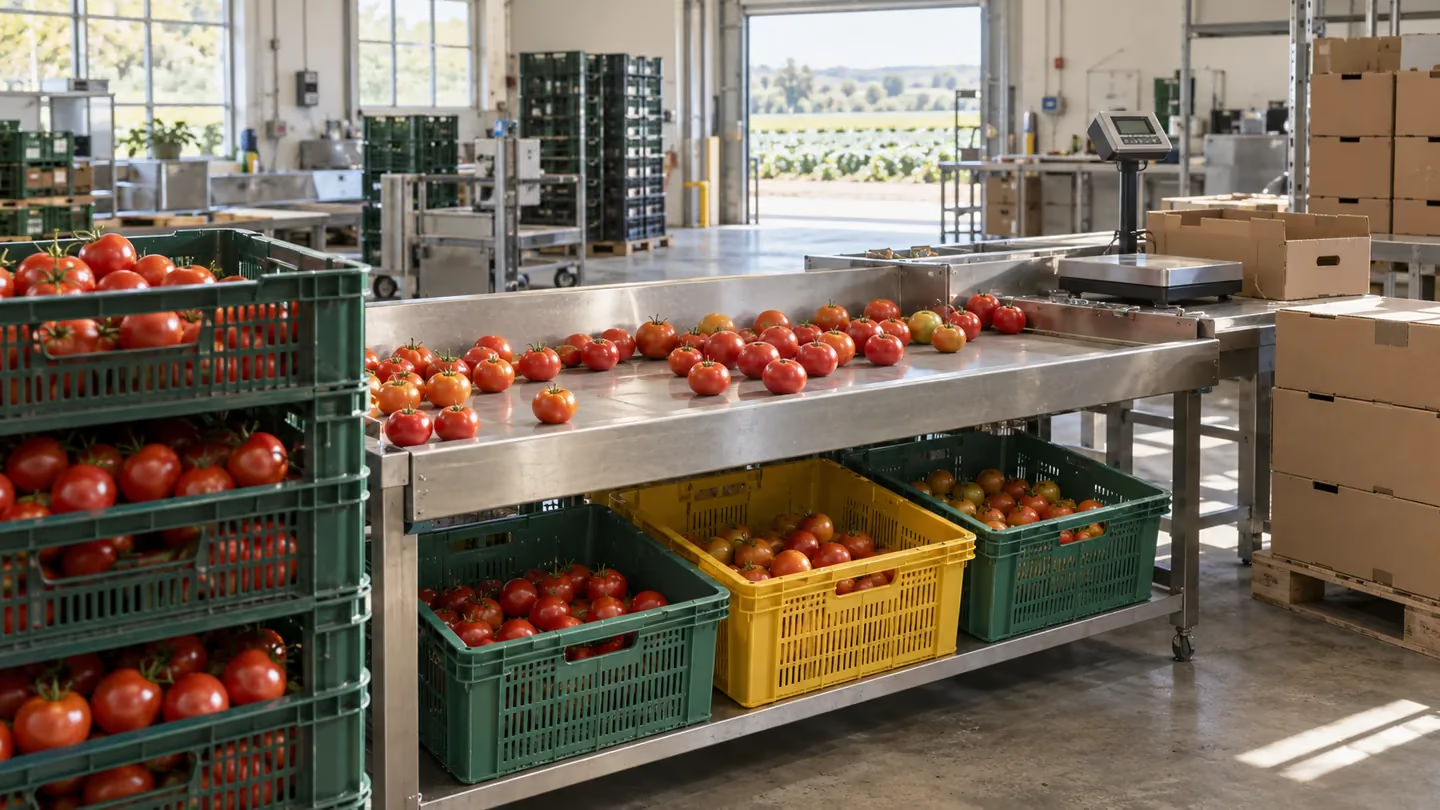
AI-generated illustration created for NextEdge Labs; it does not depict a client facility. Workflow diagram by NextEdge Labs. Icons from Lucide (ISC licence).