Retort Pouch Thermal Processing: F0 Lethality Sterilisation, Seam Integrity, and Incubation Quarantine Release
For Logistics heads, warehouse leads and distribution managers · Compare approaches
TL;DR — what you’ll learn
- Standardize retort pouch f0 lethality incubation quarantine release around explicit lot, revision, and unit-of-measure checkpoints before automating ERP postings.
- Separate physical floor observations from commercial or quality release decisions so discrepancies remain visible.
- Route out-of-tolerance variances to a named owner with mandatory supporting evidence and timestamped sign-off.
- Reconcile physical counts, laboratory or inspection records, and financial ledgers at a shared cut-off.

In food and beverage operations, retort pouch f0 lethality incubation quarantine release often fails when floor sheets, laboratory checks, and ERP entries record the same batch at different times or in different units. Separating physical observation from commercial or quality release keeps the stock ledger accurate and gives supervisors a clear exception queue.
How should food businesses govern retort pouch f0 lethality incubation quarantine release?
Standardize retort pouch f0 lethality incubation quarantine release around explicit lot, revision, and unit-of-measure checkpoints before automating ERP postings. Separate physical floor observations from commercial or quality release decisions so discrepancies remain visible.
- 01Capture batch contextLot, unit, timestamp and source reference
- 02Verify against rulesActive specification, tolerance and cut-off
- 03Reconcile variancesSeparate physical events from timing gapsDo the batch records and tolerances agree?YesApprove ledger postingNoKeep the disputed quantity in a visible hold status and route to the designated owner.
- 04Approve ledger postingRetain signed-off evidence and history
Illustrative information flow. The article explains the evidence, exceptions and responsible decisions. Diagram: NextEdge Labs.
1. Commercial Sterility Economics and Low-Acid Canned Food (LACF) Liability
Shelf-stable ready-to-eat (RTE) curries, wet pet food pouches, tuna fillets, infant purees, and military rations packaged in flexible 4-ply laminate pouches (PET / Al-Foil / Nylon / CPP) operate in the highest-risk regulatory boundary of the food industry: Low-Acid Canned Foods (LACF), defined by equilibrium $\text{pH} > 4.6$ and water activity $a_w > 0.85$. Under FDA 21 CFR Part 113, USDA FSIS canning regulations, and Codex Alimentarius Code of Hygienic Practice for Low-Acid and Acidified Low-Acid Canned Foods (CAC/RCP 23-1979), a processor cannot rely on cold chains or chemical preservatives to inhibit Clostridium botulinum proteolytic types A and B spores. Commercial sterility depends entirely on two physical barriers:
Validated Thermal Lethality ($F_0$): Delivering sufficient heat penetration to the slowest-heating zone (cold spot) of every pouch inside every retort basket to achieve at least a $12\text{D}$ log reduction of C. botulinum spores (and typically a $5\text{D}$ reduction of more heat-resistant mesophilic and thermophilic spoilage organisms like Clostridium sporogenes PA 3679 or Geobacillus stearothermophilus). Hermetic Post-Retort Seal Integrity: Maintaining a fusion-welded cast polypropylene (CPP) inner heat seal across the filling, thermal expansion, cooling overpressure, and mechanical handling stages so that post-process cooling water or ambient air cannot re-contaminate the sterilised contents.
When an ERP treats retort sterilisation as a simple routing step ("Operation 30: Autoclave Sterilisation — 45 minutes, Complete") without capturing batch-specific $F_0$ accumulation curves, retort basket layer mappings, come-up time (CUT) compliance, cooling water residual chlorine ppm, and mandatory 7-to-14-day thermophilic/mesophilic incubation quarantine holds, the plant faces catastrophic failure modes:
Scroll horizontally to see all columns.
| Retort Cycle Phase | Time Window ($\text{min}$) | Chamber Temp ($^\circ\text{C}$) | Cold-Spot Temp ($^\circ\text{C}$) | Saturated Steam $P_{\text{sat}}$ ($\text{bar g}$) | Target Chamber Overpressure $P_{\text{chamber}}$ ($\text{bar g}$) | Net Overpressure Margin $\Delta P$ ($\text{bar}$) | Accumulated $F_0$ ($\text{min}$) |
|---|---|---|---|---|---|---|---|
| **1. Fill & Pre-Heat** | $0.0 - 4.0$ | $58.0 \rightarrow 85.0$ | $56.5 \rightarrow 62.1$ | $0.00$ | $0.45$ | $+0.45$ | $0.00$ |
| **2. Come-Up Ramp (CUT)** | $4.0 - 14.0$ | $85.0 \rightarrow 121.5$ | $62.1 \rightarrow 104.8$ | $1.08$ | $2.10$ | $+1.02$ | $0.08$ |
| **3. Sterilisation Hold (Start)** | $14.0 - 24.0$ | $121.5$ | $104.8 \rightarrow 118.4$ | $1.08$ | $2.25$ | $+1.17$ | $1.94$ |
| **4. Sterilisation Hold (End)** | $24.0 - 38.0$ | $121.5$ | $118.4 \rightarrow 121.0$ | $1.08$ | $2.25$ | $+1.17$ | $7.62$ |
Source: GS1 · Lot identification and movement event records. Reference details
2. The $F_0$ Lethality Integral and Cold-Spot Thermal Accumulation Architecture
Thermal sterilisation is governed by exponential microbial inactivation kinetics rather than linear clock time. The lethality rate $L(t)$ at any instant $t$ depends on the instantaneous temperature $T(t)$ at the pouch's geometric cold spot, referenced to a baseline sterilisation temperature $T_{\text{ref}} = 121.1^\circ\text{C}$ ($250^\circ\text{F}$) and a thermal resistance constant $z = 10^\circ\text{C}$ ($18^\circ\text{F}$) characteristic of Clostridium botulinum spores:
The cumulative sterilisation value $F_0$ (expressed in equivalent minutes at $121.1^\circ\text{C}$) across the heating and early cooling cycle from $t = 0$ to $t = t_{\text{end}}$ is the numerical integral of the lethality rate:
$$F_0 = \int_{0}^{t_{\text{end}}} 10^{\frac{T(t) - 121.1}{10}} \, dt \approx \sum_{i=1}^{n} 10^{\frac{T_i - 121.1}{10}} \cdot \Delta t$$
Source: Frappe / ERPNext · Material movement and reconciliation controls. Reference details
Critical Factors Controlled in the Master Scheduled Process (MSP)
A valid ERP thermal process specification cannot simply store "Cook at $121.1^\circ\text{C}$ for $32\text{ min}$." In accordance with thermal process authority filings (e.g., FDA Form 2541d / 2541f for water spray or cascading water retorts), the ERP Master Scheduled Process (MSP_ID) must validate every critical factor prior to and during the cycle:
Minimum Initial Temperature ($IT_{\min}$): If the scheduled process assumes product enters the retort at $IT \ge 55.0^\circ\text{C}$ from a hot-fill manifold, a line stoppage that allows queued pouches on rotary accumulation tables to cool to $41.0^\circ\text{C}$ invalidates the conduction heating curve. Any basket waiting longer than the maximum staging dwell time (MAX_BASKET_HOLD_MIN = 45) must be flagged for elevated-level initial temperature verification or routed to an extended-hold thermal schedule. Maximum Fill Weight and Solid-to-Liquid Ratio: Overfilling a $250\text{ g}$ pouch to $268\text{ g}$ increases pouch thickness from $18\text{ mm}$ to $21\text{ mm}$ inside the retort tray pocket. Because conduction heat transfer time scales roughly with the square of the half-thickness ($l^2 / \alpha$), a $16\%$ increase in thickness slows cold-spot heating by over $30\%$. Headspace Residual Gas Volume: Excessive residual air inside a vacuum-sealed pouch acts as a thermal insulator during water-spray retorting and causes internal pressure spikes that rupture seals. Come-Up Time (CUT) and Venting / Circulation Flow: Water-cascading and steam-air retorts require validated circulation pump flow rates (measured via magnetic flowmeters in $\text{m}^3\text{/hr}$) and minimum come-up times to ensure uniform temperature distribution across all trays from top to bottom.
3. Autoclave Basket Genealogy: Bridging Filling Lots to Sterilisation Cycles
In a modern high-speed pouch line, a rotary filler-sealer operates continuously at $120\text{ pouches/min}$ ($7,200\text{ pouches/hr}$), while horizontal batch retorts process discrete loads of $4\text{ to }6\text{ baskets}$ per cycle ($2,400\text{ to }3,600\text{ pouches}$ per retort load) over a $75\text{-minute}$ turnaround. Consequently, one continuous filling lot spans multiple retort cycles, and a single retort cycle may occasionally contain the tail end of one filling lot and the start of the next (if separated by physical divider trays).
The Sub-Lot Identity Law
To maintain airtight traceability without destroying entire kettle batches when a single autoclave malfunctions: Every basket (BASKET_ID) is scanned at the loader stacker with an RFID tag or stainless-steel barcode plate. The loader logs fill_lot_id, first_pouch_timestamp, last_pouch_timestamp, pouch_count, and measured_it_celsius. When baskets #101–#104 are pushed into RETORT-01, the PLC interlock verifies that current_time - first_pouch_timestamp <= MAX_BASKET_HOLD_MIN and that the retort recipe loaded on the PLC matches the MSP_ID linked to FILL-2026-0814-A. Upon cycle completion, the ink-jet or laser coder on the post-retort pouch dryer prints both the Filling Lot and the Retort Cycle Sub-Lot (L260814A R1C412 14:32) onto the pouch gusset, and the ERP creates a distinct inventory sub-lot (FILL-2026-0814-A-R01).
4. Overpressure Profile Control and Pouch Seal Creep Prevention
Unlike rigid tinplate cans that withstand high internal pressure differentials, flexible retort pouches contain $2\text{ to }8\text{ mL}$ of residual headspace gas plus water vapor pressure that expands rapidly as product temperature rises toward $121.1^\circ\text{C}$. At $121.1^\circ\text{C}$, the saturated vapor pressure of water alone is $2.05\text{ bar absolute}$ ($1.05\text{ bar gauge}$). Simultaneously, at $121^\circ\text{C}$, the tensile modulus of the inner cast polypropylene (CPP) sealant layer softens significantly.
If the external chamber pressure inside the autoclave is lower than the internal pouch pressure during heating, hold, or early cooling, the pouch inflates like a balloon. This inflation causes seal creep (partial delamination of the softened $8\text{ to }10\text{ mm}$ top fusion seal, narrowing the effective intact seal width to $<3\text{ mm}$) or catastrophic burst at the side-gusset triple-junction points. Conversely, if external compressed-air overpressure rises too abruptly during the transition to cooling water injection, pouches can be crushed or creased sharply, creating flex-cracks (pinholes) in the $7\text{ }\mu\text{m}$ aluminum foil barrier layer.
Therefore, the ERP SCADA historian integration must capture and validate the Differential Overpressure Envelope ($\Delta P = P_{\text{chamber}} - P_{\text{saturation}}(T_{\text{retort}})$) across every phase of the cycle:
Summary
Reliable retort pouch f0 lethality incubation quarantine release depends on consistent lot identity, shared cut-off times, and explicit exception ownership across production, quality, and finance. When teams verify physical evidence before posting adjustments, both traceability and margin reporting remain defensible.
What to do next
- Audit one recent week of retort pouch f0 lethality incubation quarantine release transactions to identify unrecorded movements, unit mismatches, or late entries.
- Define the mandatory lot, unit, and approval fields required before an operator or integration can post a status change.
- Pilot the exception queue on one product line and review unresolved variances at a fixed daily cut-off.
Compare this workflow with your current setup
Share the step that takes the most manual work, the systems involved and the exceptions your team handles. That gives us a concrete starting point for comparing approaches.
Sources and further reading
Sources checked 15 October 2026. The worked examples and software evaluation suggestions are NextEdge Labs’ editorial analysis.
- GS1 Global Traceability StandardGS1 · Release 2.0, August 2017
Reference framework for identification and traceability data. Citing it does not imply that a proposed system is GS1 certified.
- Stock EntryFrappe / ERPNext · Online product documentation, accessed October 2026
Examples of distinct material receipt, issue, transfer and manufacturing transactions, including transit handling.
Visual credits
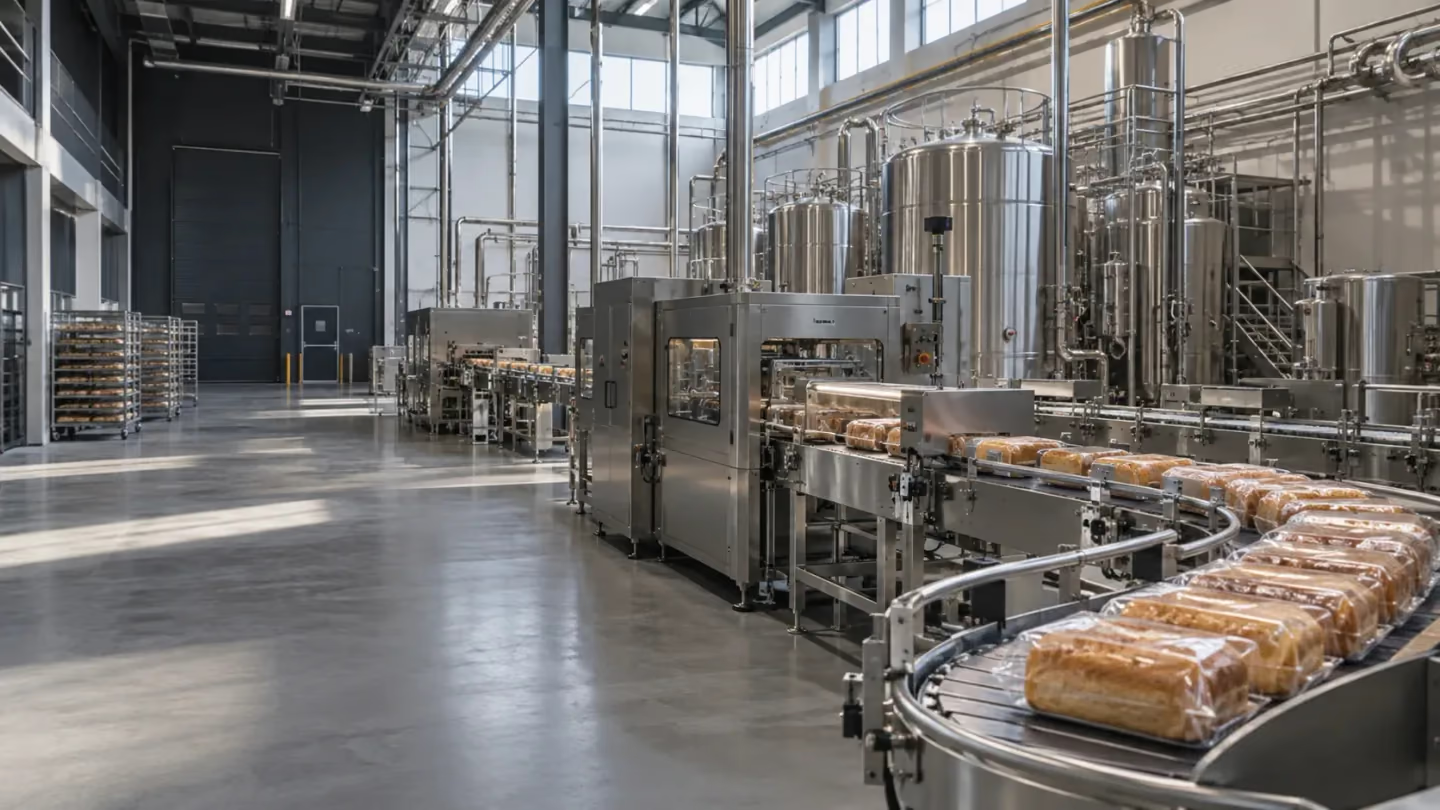
AI-generated illustration created for NextEdge Labs; it does not depict a client facility. Workflow diagram by NextEdge Labs. Icons from Lucide (ISC licence).