More safety stock can create the next shortage problem
For Inventory managers and supply-chain heads · Understand the problem
TL;DR — what you’ll learn
- Identify whether the buffer covers demand variation, variable deliveries or a recurring process failure.
- Convert proposed stock into days of realistic consumption and compare it with usable life on receipt.
- Include supplier minimums, delivery frequency and order multiples in the calculation.
- Judge a revised policy using availability and leftover stock together.

Purchasing increases the buffer after a missed delivery. A few weeks later, the cold room is full of the same ingredient approaching its cutoff. Both decisions came from sensible concerns: avoid a stoppage and avoid a write-off. The missing calculation was whether the additional inventory could do both.
How do you set safety stock for perishable food without creating excess waste?
Size a buffer against the uncertainty it is meant to cover, then check whether the resulting stock can be consumed within its usable selling window. If those constraints conflict, change delivery frequency, order size or service policy rather than quietly accepting more expiry risk.
- 01Define the service needLead time and uncertainty
- 02Calculate the proposalDemand and eligible supply
- 03Check usable lifeLot windows and consumptionCan the proposed stock be used?YesApprove the quantityNoRevisit the buffer or supply arrangement; do not hide expiry exposure.
- 04Approve the quantityKeep the assumptions visible
Illustrative information flow. The article explains the evidence, exceptions and responsible decisions. Diagram: NextEdge Labs.
Name the uncertainty before adding a buffer
Demand that varies every day is different from a supplier that is consistently late. A seasonal order spike is different again. Keep requested, confirmed and actual delivery dates so the planner can distinguish lead-time variation from a poorly maintained lead-time setting. Record shortages caused by quality holds separately from shortages caused by late transport.
For an illustrative ingredient used at 80 kilograms a day, an extra 400 kilograms represents five days of average consumption. That statement does not establish a safe or optimal buffer. Weekend closures, changing recipes and the usable life remaining on receipt can substantially alter when those kilograms will be used.
Test the purchase order, not just the formula
A recommendation for 250 kilograms may become a 500-kilogram purchase because of the supplier's minimum. Include that rounding before judging the likely closing stock. Compare a larger delivery with two smaller drops, including freight and receiving work. Where the supplier is unreliable, a second qualified source may address the problem better than additional short-lived stock.
Customer sellable-day requirements can shorten the commercial window for finished goods. Microsoft documents this distinction in its shelf-life planning model. Keep product expiry, internal dispatch policy and customer acceptance requirements separate in your own data.
Source: Microsoft Learn · Shelf-life dates and customer sellable days. Reference details
Separate cycle stock from the protective buffer
Stock held between planned deliveries has a different purpose from stock held for uncertainty. Suppose a kitchen uses an illustrative 80 kilograms per operating day and receives a scheduled delivery every three operating days. The planned consumption between deliveries is 240 kilograms before any buffer. Calling all 240 kilograms safety stock makes it harder to understand what should change when the delivery schedule changes.
If the proposed extra buffer is 160 kilograms, the delivery cycle plus buffer can expose the business to 400 kilograms immediately after receipt, before allowing for what was left from the previous delivery. Check that peak position against actual consumption opportunities and usable life. An average stock figure can hide the point at which too much material enters the business.
When a standard deviation calculation is misleading
A statistical safety-stock formula can be useful when its assumptions fit the operation. It becomes difficult to interpret when sales include several stockout days, the product is new, a promotion changed demand or the supplier changed its delivery pattern. Those are different regimes, not merely more random variation around one stable average.
Keep a simple event log beside the history. Identify unavailable days, one-off functions, unusual closures and quality-related interruptions. A planner can then compare like periods and explain which uncertainty the buffer is addressing. If the data is too sparse for a stable estimate, use explicit scenarios and review dates instead of presenting a precise model output as a proven optimum.
Compare three workable responses to an unreliable delivery
The choices have different costs. Holding more stock consumes cash and usable life. Receiving more often increases delivery and receiving activity. Qualifying another supplier adds purchasing and quality work. Price those consequences using the business's own information rather than assuming one policy is always cheapest.
| Option | Check before choosing it |
|---|---|
| Increase the buffer | Will the oldest stock still be consumed within its approved window? |
| Split the delivery | Can the supplier and receiving team reliably support the extra drop? |
| Add a qualified source | Are specification, pack size and approval requirements workable? |
| Change the service commitment | Which demand can be deferred without making a promise the business cannot keep? |
Keep the review small enough to explain
For the first review, use one ingredient group and show each proposed order beside the current policy. Capture a reason when the planner changes it. After several relevant cycles, compare shortages, remaining stock and manual interventions. A recommendation that looks economical only because the planner keeps correcting it has not yet demonstrated a dependable replenishment policy.
Review availability and leftovers together
Trial the revised policy on a small group of products over comparable trading periods. Track unfilled demand, emergency orders, stock remaining at the cutoff and write-offs. Record unusual events so an apparent improvement is not simply a quieter month.
A forecast can improve the estimate of consumption, but it cannot resolve an uneconomic pack size or an unavailable delivery slot. Ask a planner to explain the suggested order in those terms. If the explanation stops at a model score, the replenishment policy is not yet ready for routine use.
Summary
A perishable buffer has to cover uncertainty within a limited consumption window. When a larger order cannot be used in time, the answer is an operational tradeoff: smaller deliveries, a different source, a changed service commitment or less variety. A more elaborate forecast does not remove that constraint.
What to do next
- Choose one ingredient with both emergency purchases and regular leftovers.
- Collect actual delivery variation, consumption and usable life on receipt for comparable periods.
- Compare two practical order schedules before approving a larger buffer.
Recognise this problem in your operation?
Tell us where the records or handovers break down. We can discuss the process, data and software questions worth examining first.
Sources and further reading
Sources checked 15 October 2026. The worked examples and software evaluation suggestions are NextEdge Labs’ editorial analysis.
- Shelf life planningMicrosoft Learn · Dynamics 365 Supply Chain Management documentation, accessed October 2026
Product documentation explaining shelf life and customer sellable-day requirements. A software example, not a food safety specification.
Visual credits
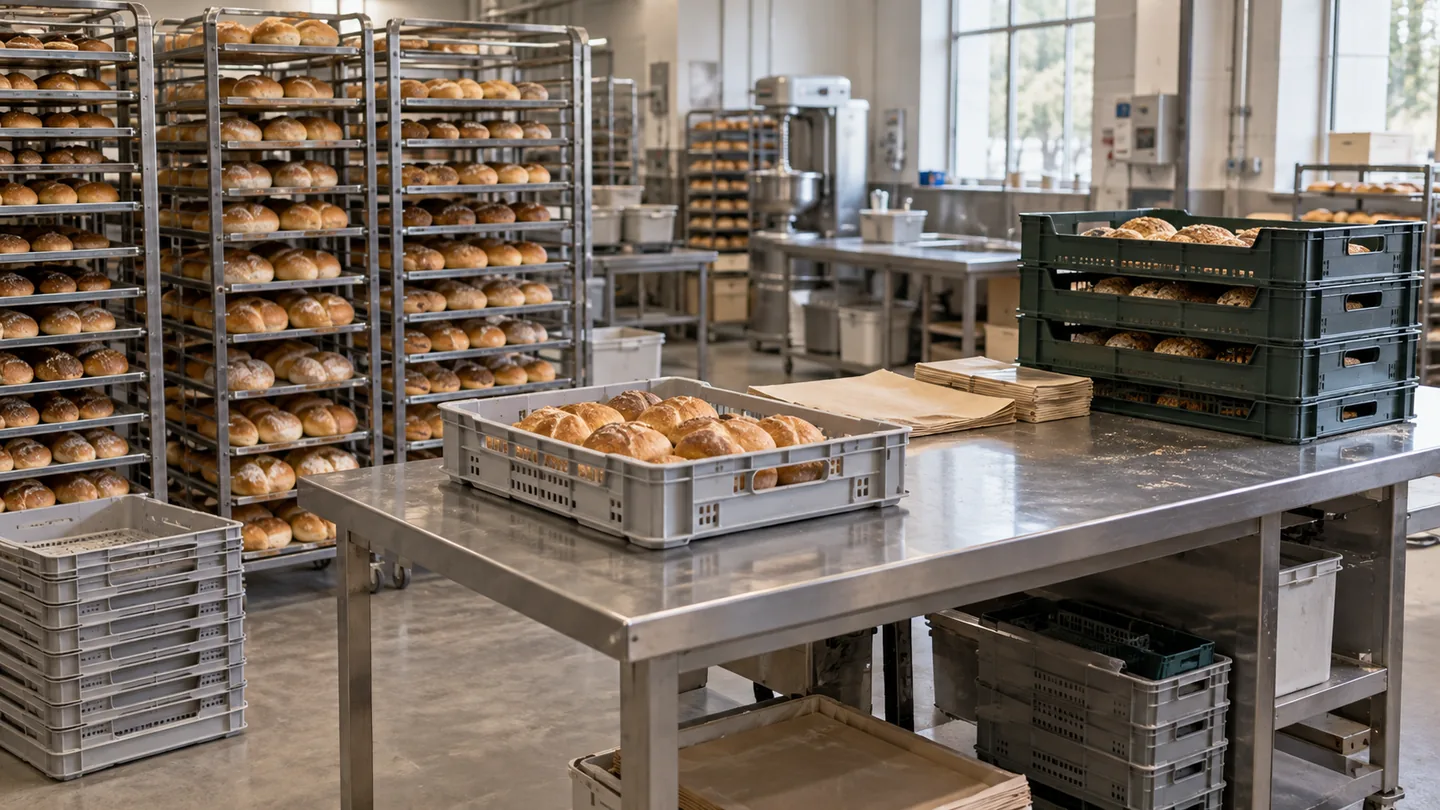
AI-generated illustration created for NextEdge Labs; it does not depict a client facility. Workflow diagram by NextEdge Labs. Icons from Lucide (ISC licence).