Imported food clearance records: gate residual shelf life, bonded relabeling, and regulatory NOC release
For Procurement heads, buyers and materials planners · Compare approaches
TL;DR — what you’ll learn
- Calculate residual shelf-life percentage per manufacturing batch before vessel arrival or Bill of Entry filing; block commercial inventory allocation for any sub-lot arriving below the destination regulator's residual shelf-life floor (such as India's $60\%$ requirement under FSSAI Import Regulations).
- Separate port container demurrage decisions from commercial stock release: moving a multi-lot reefer container to a customs bonded cold warehouse stops daily port terminal demurrage while keeping the stock locked in a non-allocatable BONDED_NOC_PENDING ERP warehouse.
- Track rectifiable labeling deficiencies (such as importer name/address, FSSAI license logo, or veg/non-veg symbol stickers) via controlled bonded-warehouse rework orders with photo evidence prior to Authorized Officer visual re-inspection.
- Release imported batches to allocatable FREE_FOR_SALE stock only when the Batch Master links a verified laboratory test report, a signed regulatory Non-Objection Certificate (NOC), and an Out-of-Charge customs clearance record.
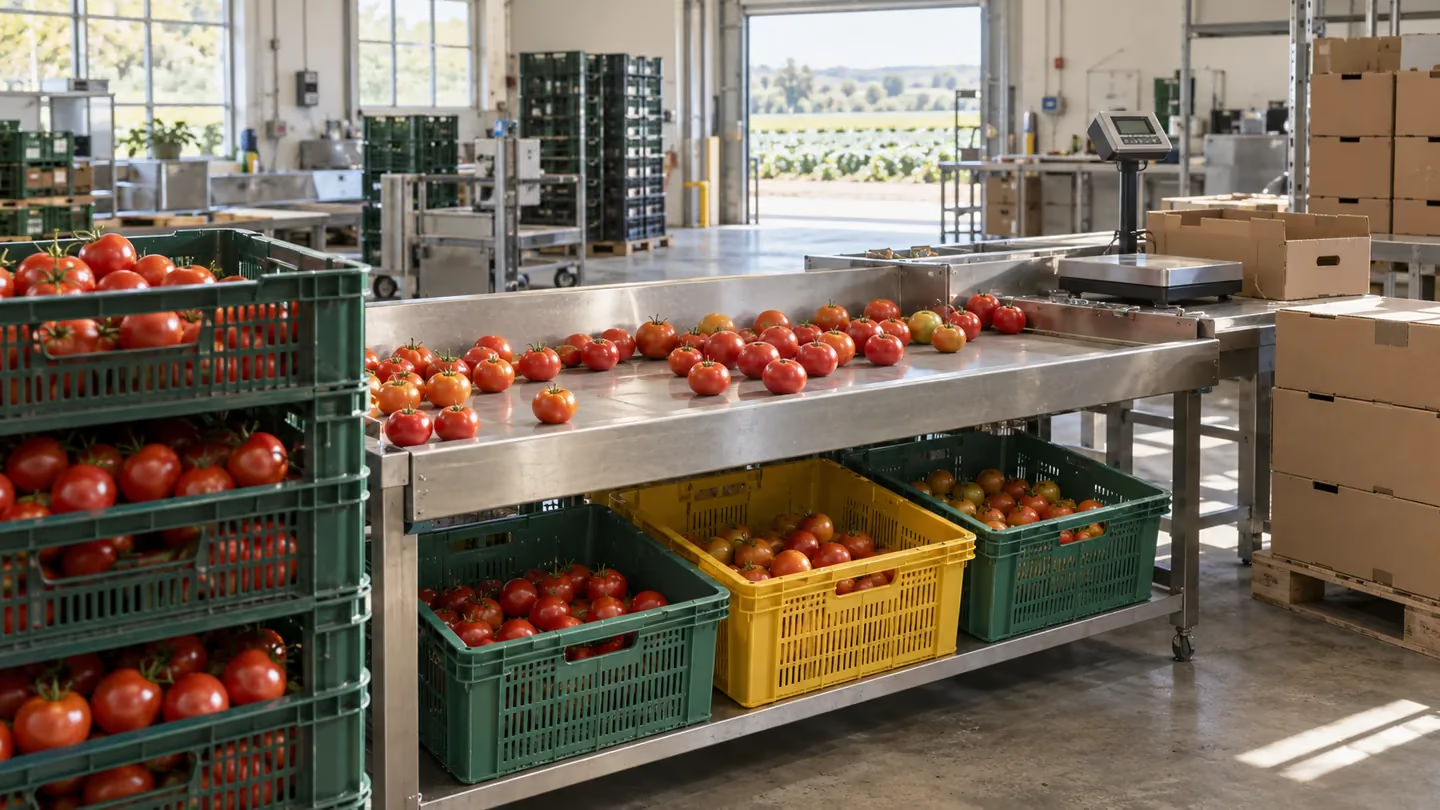
Imported-food distributors and specialty retail importers frequently lose margin in two ways at port entry: paying steep port reefer plug-in and container demurrage charges while waiting 7 to 14 days for regulatory lab testing, or accidentally pre-allocating incoming container quantities to supermarket purchase orders before discovering that one manufacturer batch inside the container violates residual shelf-life or labeling rules. Distinct from general freight forwarding, this guide (FB-130) governs batch-level residual shelf-life validation, customs bonded-warehouse sticker rectification, and regulatory Non-Objection Certificate (NOC) ERP inventory holds.
How should imported-food distributors coordinate bonded-warehouse reefer demurrage, shelf-life remaining rules (>=60%), lab sampling holds, and regulatory Non-Objection Certificate (NOC) release?
Calculate residual shelf-life percentage per manufacturing batch before vessel arrival or Bill of Entry filing; block commercial inventory allocation for any sub-lot arriving below the destination regulator's residual shelf-life floor (such as India's $60\%$ requirement under FSSAI Import Regulations). Separate port container demurrage decisions from commercial stock release: moving a multi-lot reefer container to a customs bonded cold warehouse stops daily port terminal demurrage while keeping the stock locked in a non-allocatable BONDED_NOC_PENDING ERP warehouse.
- 01Capture batch contextLot, unit, timestamp and source reference
- 02Verify against rulesActive specification, tolerance and cut-off
- 03Reconcile variancesSeparate physical events from timing gapsDo the batch records and tolerances agree?YesApprove ledger postingNoKeep the disputed quantity in a visible hold status and route to the designated owner.
- 04Approve ledger postingRetain signed-off evidence and history
Illustrative information flow. The article explains the evidence, exceptions and responsible decisions. Diagram: NextEdge Labs.
Scope and regulatory boundary
This article specifies the ERP batch-governance, bonded-warehouse rework, and inventory-status architecture for imported food consignments:
What this workflow governs: Pre-arrival batch shelf-life arithmetic, segregating bonded vs duty-paid ERP warehouses, tracking permitted in-bond sticker rectification, comparing port-stay vs bonded-transfer holding costs, and gating sales-order picking on regulatory NOC document IDs. What this workflow does not replace: It does not constitute customs brokerage advice, legal interpretation of tariff classifications, or laboratory food-safety testing. Importers must comply with official statutory frameworks including the FSSAI Food Safety and Standards (Import) Regulations, 2017 and FICS portal rules, CBIC ICEGATE / SWIFT customs bonded procedures, and international inspection principles under Codex Alimentarius CXG 26-1997 and CXG 47-2003.
Scroll horizontally to see all columns.
| Clearance Stage | ERP Warehouse Bin | Allocatable to Sales Orders? | Required Gate Evidence | Failure / Rejection Disposition |
|---|---|---|---|---|
| **1. Pre-Arrival / Port Terminal** | `IN-TRANSIT-PORT-REEFER` | **No** | Pre-shipment packing list with lot-wise `mfg_date` and `expiry_date` | Flag any lot $<60\%$ residual shelf life before filing home-consumption Bill of Entry |
| **2. In-Bond Transfer & Labeling** | `BONDED-COLD-QUARANTINE` | **No** | Customs In-Bond Bill of Entry + Bonded Rework Order (`STK-RECT`) | Hold visual re-inspection request until 100% case-count sticker QA check is signed |
| **3. Regulatory Lab & NOC Hold** | `BONDED-SAMPLE-PENDING` | **No** | Lab sample draw receipt + accredited lab test report + FICS/PGA `NOC_NUMBER` | If `NOC-REJECT` issued, move lot to `CUSTOMS-REEXPORT-OR-DESTROY` bin |
| **4. Duty-Paid Commercial Release** | `DC-AMBIENT-OR-CHILLED-SALEABLE` | **Yes** | Verified `NOC_NUMBER` + Customs Ex-Bond Out-of-Charge (`OOC_ID`) | Open batch for FEFO sales picking; enforce customer minimum-remaining-life rules |
Source: GS1 · Lot identification and movement event records. Reference details
Three lot-level gates that must clear before imported food enters saleable stock
When an overseas supplier packs multiple production dates into a single 40-foot refrigerated container, recording the shipment as a single PO receipt line in ERP hides critical compliance exceptions. Configuring batch-level attributes in the ERP (such as ERPNext Batch Master linked to quarantined warehouse bins) enforces three mandatory gates per production lot:
Residual Shelf-Life Gate at Import General Manifest (IGM) / Port Arrival: Under regulations such as India's FSSAI Import Regulations, imported food articles must possess at least $60\%$ residual shelf life (or a minimum regulatory period before expiry) on the date of import clearance: $$\text{Residual Shelf Life \%} = \left(\frac{D_{\text{expiry}} - D_{\text{arrival}}}{D_{\text{expiry}} - D_{\text{mfg}}}\right) \times 100\%$$ If a supplier ships mixed production lots in one container, a lot at $49.9\%$ residual shelf life will receive a Non-Conforming Report (NCR) and rejection order even if the rest of the container is at $70\%$. Rectifiable vs Non-Rectifiable Labeling Gate in Customs Bonded Warehouse: Certain missing local statutory declarations (for example, importer name and address, statutory food-safety license number, or vegetarian/non-vegetarian mark under FSSAI rules) may be rectified by affixing non-detachable stickers inside a licensed customs warehouse before visual re-inspection. Core manufacturer identity, lot number, and manufacturing/expiry dates cannot be altered or stickered over. Laboratory Sampling and Regulatory NOC Release Gate: Even after physical container movement into a bonded cold store, no sales delivery note or retail dispatch may pull from the batch until the Authorized Officer issues the formal Non-Objection Certificate (NOC) (NOC-PASS) and customs grants Out-of-Charge clearance.
Source: Frappe / ERPNext · Material movement and reconciliation controls. Reference details
Illustrative worked example: mixed-lot reefer arrival and bonded-transfer demurrage decision
Illustrative import-clearance scenario using synthetic figures to demonstrate shelf-life and demurrage arithmetic; not a client case study or legal customs ruling.
An imported-food distributor receives a 40-foot refrigerated container (CONT-REEF-902, $1,200\text{ cases}$ of European specialty cheese) arriving at port on 20 October 2026 (2026-10-20). Because bilingual importer/FSSAI sticker rectification and accredited laboratory microbiological testing will require 12 days beyond the port's 3 free days, the operations lead evaluates both batch-level shelf-life eligibility and port terminal vs customs bonded cold-store holding costs.
Step 1: Compute lot-wise residual shelf life on arrival (`2026-10-20`)
The supplier packed two distinct production batches inside CONT-REEF-902, both carrying a 365-day total declared shelf life:
$$\text{Residual Shelf Life } (\text{LOT-CHS-04A}) = \frac{182\text{ days}}{365\text{ days}} \times 100\% = 49.86\% < 60.0\%$$
$$\text{Residual Shelf Life } (\text{LOT-CHS-07B}) = \frac{255\text{ days}}{365\text{ days}} \times 100\% = 69.86\% \ge 60.0\%$$
Step 2: Compare 12-day port reefer demurrage vs bonded cold-warehouse transfer
After the 3-day port free period expires, holding the container at the port terminal vs transferring the consignment under bond to an approved customs bonded cold store for the 12-day sticker-and-lab window compares as follows:
Option 1 — Leave container plugged in at port terminal for 12 chargeable days: Port terminal demurrage + shipping-line detention: $\$210\text{/day}$ Port reefer electricity & monitoring plug-in charge: $\$95\text{/day}$ Combined daily port cost: $\$210 + \$95 = \$305\text{/day}$ $$\text{Total 12-Day Port Holding Cost} = 12\text{ days} \times \$305\text{/day} = \$3,660$$
Option 2 — File In-Bond Bill of Entry and move to customs bonded cold store for 12 days: One-time bonded reefer drayage, customs escort, and bond documentation fee: $\$420$ Bonded cold-storage pallet fee (incorporating sticker-rework bay access): $\$85\text{/day}$ $$\text{Total 12-Day Bonded Storage Cost} = \$420 + (12\text{ days} \times \$85\text{/day}) = \$420 + \$1,020 = \$1,440$$
Bounded pilot and implementation check
Test imported-lot compliance gating across 3 consecutive imported container consignments before automating ERP warehouse locks across all import categories:
Pilot boundary: Cover one temperature-controlled imported product category, tracking pre-shipment ASN batch dates, bonded-warehouse sticker rework orders, port vs bonded holding costs, and NOC release timestamps. Baseline measurement: Review the prior 10 imported containers for port demurrage days paid, sticker re-inspection delays, and any short-shelf-life batches discovered after customs duty payment. Acceptance criteria: 100% of arriving batches have residual shelf-life percentages computed prior to vessel berthing; zero cases in BONDED-COLD-QUARANTINE can be allocated to customer delivery notes before NOC_NUMBER entry; bonded-transfer cost comparison is logged before free time expires. Stop condition: If supplier ASNs lack batch-level manufacturing dates prior to arrival, enforce mandatory pre-shipment batch-manifest upload in the vendor portal before issuing letter-of-credit or shipping release approval.
Summary
Reliable food import customs fssai noc port demurrage lot hold depends on consistent lot identity, shared cut-off times, and explicit exception ownership across production, quality, and finance. When teams verify physical evidence before posting adjustments, both traceability and margin reporting remain defensible.
What to do next
- Audit one recent week of food import customs fssai noc port demurrage lot hold transactions to identify unrecorded movements, unit mismatches, or late entries.
- Define the mandatory lot, unit, and approval fields required before an operator or integration can post a status change.
- Pilot the exception queue on one product line and review unresolved variances at a fixed daily cut-off.
Compare this workflow with your current setup
Share the step that takes the most manual work, the systems involved and the exceptions your team handles. That gives us a concrete starting point for comparing approaches.
Sources and further reading
Sources checked 15 October 2026. The worked examples and software evaluation suggestions are NextEdge Labs’ editorial analysis.
- GS1 Global Traceability StandardGS1 · Release 2.0, August 2017
Reference framework for identification and traceability data. Citing it does not imply that a proposed system is GS1 certified.
- Stock EntryFrappe / ERPNext · Online product documentation, accessed October 2026
Examples of distinct material receipt, issue, transfer and manufacturing transactions, including transit handling.
Visual credits
AI-generated illustration created for NextEdge Labs; it does not depict a client facility. Workflow diagram by NextEdge Labs. Icons from Lucide (ISC licence).