Dairy effluent records: connect CIP events, samples and authorised discharge decisions
For Quality managers and laboratory leads · Compare approaches
TL;DR — what you’ll learn
- Link cleaning and product-diversion events to identified effluent records, sampling scope and approved result versions.
- Concentration and pollutant load answer different questions. A simple average of concentrations can be misleading when volumes differ.
- Keep online measurements, laboratory results, instrument status and authorised disposition separate. Missing or invalid evidence must remain visible.
- EHS and qualified plant owners determine limits, methods and actions. A records dashboard cannot guarantee prevention of exceedances or authorise discharge.
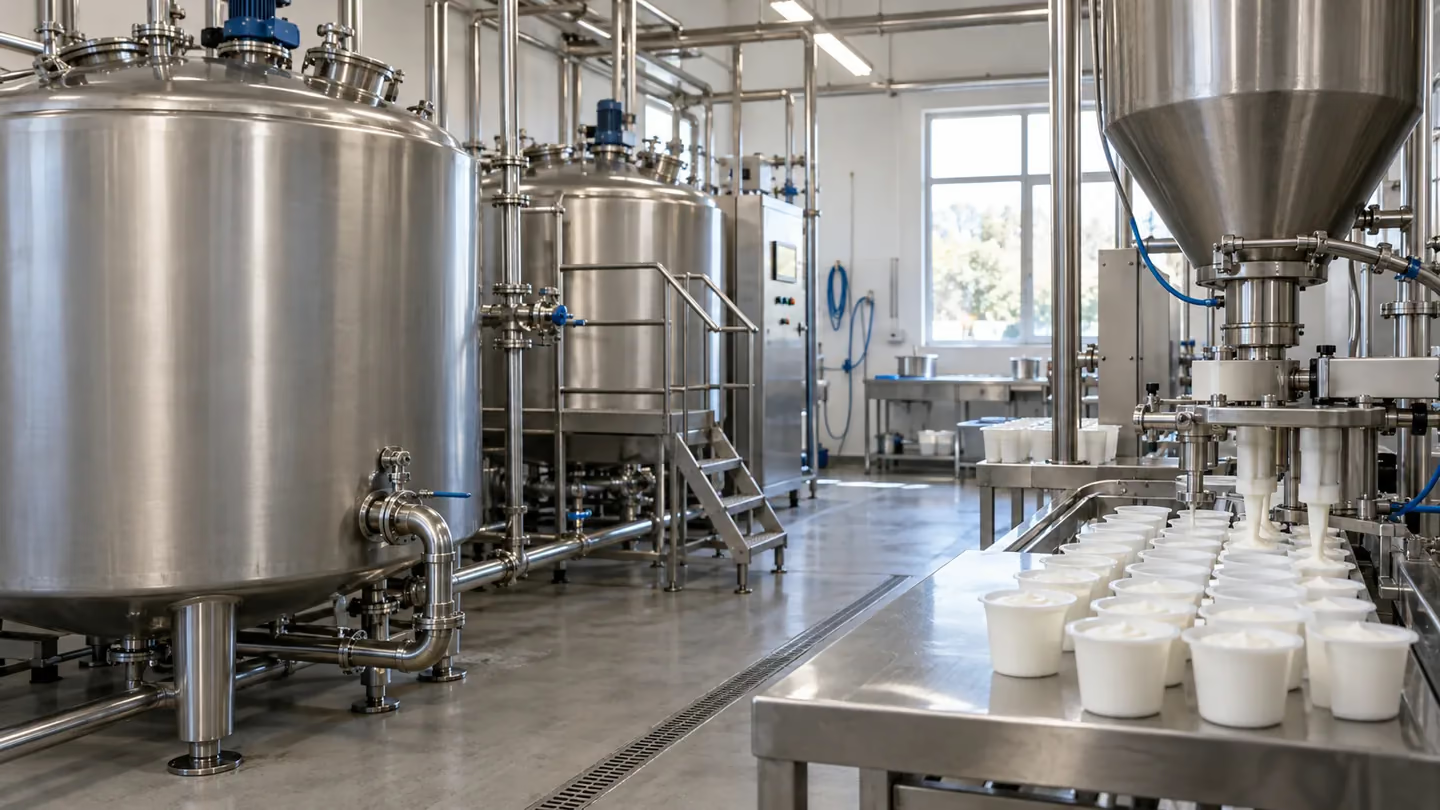
A dairy's production log records a cleaning event, the effluent system records an inlet volume, and a lab report arrives later with a sample number that is not linked to the same interval. The dashboard displays the most recent result beside the most recent volume. Both values may be correct individually while describing different material.
How should dairy processing plants link CIP caustic/acid flush schedules, whey/curd drain diversion logs, and Effluent Treatment Plant (ETP) COD/BOD/pH batch release records to prevent environmental exceedance?
Link cleaning and product-diversion events to identified effluent records, sampling scope and approved result versions. Concentration and pollutant load answer different questions. A simple average of concentrations can be misleading when volumes differ.
- 01Capture batch contextLot, unit, timestamp and source reference
- 02Verify against rulesActive specification, tolerance and cut-off
- 03Reconcile variancesSeparate physical events from timing gapsDo the batch records and tolerances agree?YesApprove ledger postingNoKeep the disputed quantity in a visible hold status and route to the designated owner.
- 04Approve ledger postingRetain signed-off evidence and history
Illustrative information flow. The article explains the evidence, exceptions and responsible decisions. Diagram: NextEdge Labs.
Define what each measurement represents
The European Commission's Food, Drink and Milk BREF covers food processing, including milk, in European installations. It is a sector reference, not an Indian plant's consent condition or a universal discharge standard. Use the actual site's permit/consent, applicable requirements and qualified owners for legal and technical decisions. JRC Food, Drink and Milk reference.
Record the parameter and method rather than storing everything as “water quality”. COD means chemical oxygen demand; BOD means biochemical oxygen demand. EPA's loading-tool material treats both as organic-enrichment indicators.
Their different measurements are not interchangeable, and neither can be substituted for pH or another required parameter. This guide supplies no conversion between COD and BOD and no test procedure. EPA pollutant-category methodology.
Scroll horizontally to see all columns.
| Inlet record | Volume | COD concentration | Calculated COD-equivalent load |
|---|---|---|---|
| A | 8 m³ | 1,500 mg/L | 8 × 1,500 × 0.001 = 12 kg |
| B | 12 m³ | 500 mg/L | 12 × 500 × 0.001 = 6 kg |
| Combined fixture | 20 m³ | Derived below | 18 kg |
Source: GS1 · Lot identification and movement event records. Reference details
Worked example: 18 kg COD-equivalent load, not an arithmetic 1,000 mg/L average
All figures are illustrative and are not operating or discharge limits. Assume two distinct inlet intervals for a teaching fixture. Their validated representative COD concentrations and measured volumes are compatible, with no overlap, missing flow or unit discrepancy. A qualified owner would need to establish that representativeness in an actual plant.
The unit factor is 1,000 L/m³ divided by 1,000,000 mg/kg, or 0.001. The resulting kg describe COD-equivalent load, not kilograms of a specific food or chemical constituent.
The volume-weighted concentration is (8 × 1,500 + 12 × 500) ÷ 20 = 900 mg/L. The simple average (1,500 + 500) ÷ 2 = 1,000 mg/L would incorrectly give the two different-volume intervals equal weight.
Source: Frappe / ERPNext · Material movement and reconciliation controls. Reference details
Join records without granting operating authority
The production/CIP record should supply only authorised event references and relevant approved metadata. A whey/curd diversion record identifies the actual source, destination event and quantity basis where captured; it does not certify that a route was appropriate. ETP records identify the received/monitored scope and status.
Laboratory and instrument records retain method, validity, calibration-status evidence and revisions. The EHS/discharge decision links the applicable requirement version, relevant evidence and authorised outcome.
Production owns its source events. Qualified process/ETP owners validate the technical interpretation and any action under approved procedures. The laboratory/quality owner validates results and method applicability.
Exceptions that should stop confident reporting
A result names another sampling point. Preserve the received record and route the identity mismatch. Do not associate it with the nearest timestamp automatically.
A sensor has invalid or unresolved calibration status. Display its validity state and affected records. The qualified owner determines the permitted interpretation and response; the application must not substitute a last-known-good value as a new observation.
A laboratory result is rejected or amended. Retain both versions and identify which reports or decisions used the earlier one. Reopen affected review without deleting the original evidence.
Choose a record-control improvement that can be verified
A controlled log and sample register may solve a small plant's identification gap. Configure the existing historian/LIMS/ETP reporting tools where they support the necessary context. Integrate read-only event and result references when the actual gap lies between systems. Build a bounded review workspace only if those tools cannot expose evidence validity and applicability together.
Use deterministic unit, interval and version checks. AI may help locate a cited event note for a reviewer, but cannot set treatment conditions, invent limits or approve environmental release.
Assess one inlet/sampling-point family in shadow mode using authorised minimised or synthetic records. Baseline unmatched sample/event records, incomplete volume intervals and reports using unresolved instrument status. Acceptance includes reproducing 12 kg, 6 kg, 18 kg and 900 mg/L, rejecting the unsupported simple-average result, and preserving the distinction between inlet reporting and discharge authority.
Make the reported result describe the material it actually measured
Dairy effluent integration helps when reviewers can reconstruct which event, interval, sample and approved result support a report. Better evidence routing can support accountable decisions; it does not replace the technical and environmental authority behind them.
Map one CIP/diversion event family to its actual ETP locations and sampling references. Agree parameter units, interval coverage and validity ownership before calculating loads. Link reports to the applicable authorised environmental decision and requirement version. Rehearse invalid, partial and amended evidence before relying on a new reporting interface.
Summary
Reliable dairy effluent etp cod bod discharge compliance records depends on consistent lot identity, shared cut-off times, and explicit exception ownership across production, quality, and finance. When teams verify physical evidence before posting adjustments, both traceability and margin reporting remain defensible.
What to do next
- Audit one recent week of dairy effluent etp cod bod discharge compliance records transactions to identify unrecorded movements, unit mismatches, or late entries.
- Define the mandatory lot, unit, and approval fields required before an operator or integration can post a status change.
- Pilot the exception queue on one product line and review unresolved variances at a fixed daily cut-off.
Compare this workflow with your current setup
Share the step that takes the most manual work, the systems involved and the exceptions your team handles. That gives us a concrete starting point for comparing approaches.
Sources and further reading
Sources checked 15 October 2026. The worked examples and software evaluation suggestions are NextEdge Labs’ editorial analysis.
- GS1 Global Traceability StandardGS1 · Release 2.0, August 2017
Reference framework for identification and traceability data. Citing it does not imply that a proposed system is GS1 certified.
- Stock EntryFrappe / ERPNext · Online product documentation, accessed October 2026
Examples of distinct material receipt, issue, transfer and manufacturing transactions, including transit handling.
Visual credits
AI-generated illustration created for NextEdge Labs; it does not depict a client facility. Workflow diagram by NextEdge Labs. Icons from Lucide (ISC licence).