Refinery catalyst and precious-metal pool accounting: reconcile reactor loading, cycle amortization, and spent-catalyst smelter assays
For Finance lead, operations manager and ERP/EAM owner
TL;DR — what you’ll learn
- Split every noble-metal refinery catalyst (catalytic reformer Pt/Re, isomerization Pt, hydrocracker Pd/Pt) into two distinct ERP accounting objects: a **depreciable base-carrier & fabrication asset** amortized over the reactor run cycle, and a **recoverable Precious Group Metal (PGM) bullion inventory/lease pool** tracked in fine troy ounces ($\text{oz t}$).
- Reconcile reactor dense-loading weights by deducting unloaded sock/hopper remainders and screened catalyst fines from shipped drum weights before establishing the baseline reactor metal ledger.
- Never settle spent-catalyst reclamation on gross wet/coked drum weight; enforce tripartite split-sample Loss on Ignition (LOI), moisture, and fine-metal assays with defined umpire triggers when refiner and independent lab assays diverge by more than contractual splitting limits (e.g., $\pm 0.005\%$ Pt).
- Separate physical reactor attrition losses (fines lost in dust collectors or reactor unloading) from contractual smelter retention percentages so metal-lease financing charges and turnaround expense accruals hit the correct general-ledger accounts.
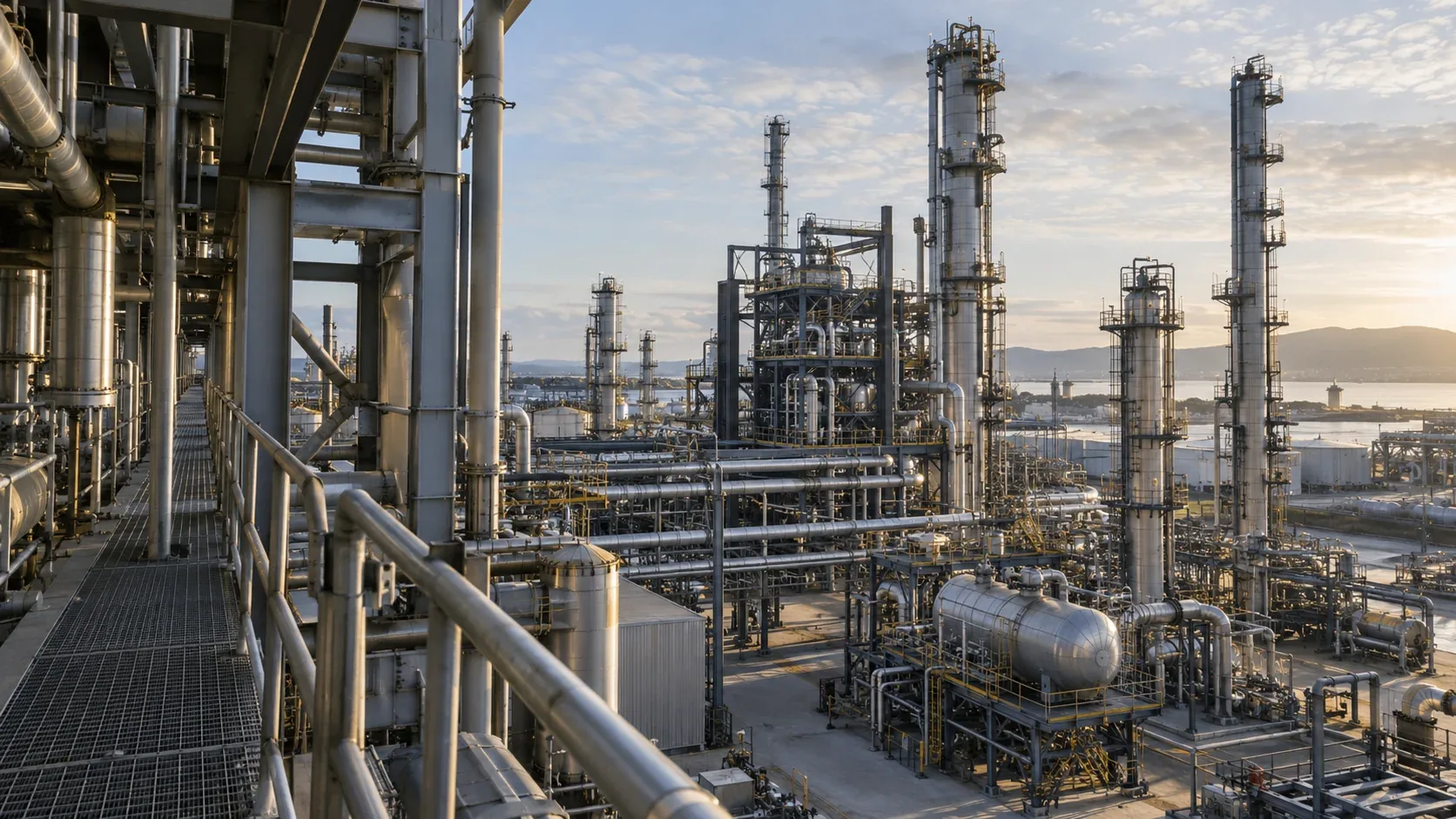
Topics: refinery operations software, petrochemical erp, process industry asset management.
Refineries operate fixed-bed and continuous-catalyst-regeneration (CCR) units loaded with millions of dollars of hydroprocessing, reforming, and isomerization catalysts. Treating a platinum-rhenium reformer catalyst charge as a single consumable maintenance expense distorts unit profitability: the alumina support carrier and chemical impregnation work are consumed over a 24-to-60-month run cycle, whereas 96%–99% of the intrinsic Platinum Group Metal (PGM) bullion is physically recovered at a specialized smelter and rolled into the next catalyst batch or returned to a bank metal lease pool. While O046 covers standard oilfield fixed-asset capitalization, this guide (O114) defines the bifurcated ERP accounting, reactor dense-loading weight reconciliation, sulfiding/activation capitalization, and spent-catalyst smelter assay settlement workflow.
Scope and governance boundary
This article establishes the financial, materials, and laboratory control architecture for refinery catalyst lifecycles:
- What this workflow governs: Dual-component catalyst accounting under IAS 16 and IAS 2, reactor loading mass balances (fresh drums vs loaded bed density vs screened dust), in-situ DMDS sulfiding chemical capitalization, pyrophoric spent-catalyst manifesting (40 CFR Part 266 Subpart F), and tripartite smelter assay reconciliation in fine troy ounces (LPPM rules).
- What this workflow does not replace: It does not govern inert-entry reactor diving safety permits, chemical engineering weighted-average bed temperature (WABT) kinetic modeling, or statutory hazardous-waste transport licensing.
- Step 1 — Record intake & baseline identification: Split every noble-metal refinery catalyst (catalytic reformer Pt/Re, isomerization Pt, hydrocracker Pd/Pt) into two distinct ERP accounting objects: a **depreciable base-carrier & fabrication asset** amortized over the reactor run cycle, and a **recoverable Precious Group Metal (PGM) bullion inventory/lease pool** tracked in fine troy ounces ($\text{oz t}$).
- Step 2 — Cross-system reference & custody linkage: Reconcile reactor dense-loading weights by deducting unloaded sock/hopper remainders and screened catalyst fines from shipped drum weights before establishing the baseline reactor metal ledger.
- Step 3 — Exception quarantine & authority check: Never settle spent-catalyst reclamation on gross wet/coked drum weight; enforce tripartite split-sample Loss on Ignition (LOI), moisture, and fine-metal assays with defined umpire triggers when refiner and independent lab assays diverge by more than contractual splitting limits (e.g., $\pm 0.005\%$ Pt).
- Step 4 — Verified disposition & audit trail closure: Separate physical reactor attrition losses (fines lost in dust collectors or reactor unloading) from contractual smelter retention percentages so metal-lease financing charges and turnaround expense accruals hit the correct general-ledger accounts.
Why single-SKU catalyst accounting fails turnaround and treasury audits?
When a refinery books catalyst purchases as a single inventory item in kilograms, three financial and operational blind spots emerge:
- Distorted Depreciation of Recoverable Bullion: Under IAS 16, the precious metal component ($80%+$ of total invoice value on a Pt/Re catalyst) has an indeterminate physical life because it is reclaimed at end-of-run; only the expected physical attrition loss ($1.5%\text{–}3.5%$) and the alumina carrier fabrication cost should be amortized over the run cycle (by time or throughput barrels).
- Unreconciled Reactor Loading Density and Screened Fines: Dense-loading contractors pour catalyst from UN-rated steel drums through screening tables into reactors
R-101,R-102, andR-103. If $450\text{ kg}$ of broken extrudates/fines and $1,200\text{ kg}$ of unused heel drums are not weighed back into quarantine stores, the reactor metal ledger starts overstated. - Smelter Moisture, Coke, and Assay Disputes: Unloaded spent catalyst contains $10%\text{–}20%$ carbon coke, residual hydrocarbons, and atmospheric moisture absorbed during unloading. Without an independent surveyor witnessing homogenisation, Loss on Ignition (LOI) testing, and split-packet fire/ICP assays, a $0.01%$ assay variance on a $50\text{ tonne}$ batch costs tens of thousands of dollars in unrecovered platinum.
- Primary control scope: refinery operations software across finance and connected ERP/EAM records.
- Segregation boundary: Operational status updates never auto-close engineering, safety, or finance sign-off gates.
- Verification cadence: Reconcile open exceptions, overrides, and late adjustments at each shift or period close.
Bifurcated catalyst lifecycle control matrix
Scroll horizontally to see all columns.
| Lifecycle Stage | ERP Record & Unit of Measure | Accounting & Technical Rule | Exception / Hold Trigger | Accountable Owner & Action |
|---|---|---|---|---|
| 1. Fresh Catalyst Receipt & Metal Transfer | Asset (Carrier Fabrication) + Metal Pool Ledger ($\text{oz t}$ fine Pt/Re) |
$1\text{ troy oz} = 31.1034768\text{ g}$; separate carrier fee from metal bullion | Vendor certificate of analysis (CoA) Pt weight differs from metal transfer order | Treasury & Materials Controller block vendor invoice release |
| 2. Reactor Dense Loading & Sulfiding | Turnaround Loading Log (R-101..R-103) + DMDS Sulfiding Issue |
$\text{Loaded Dry kg} = \text{Issued kg} - \text{Heel Drums} - \text{Screened Fines}$ | Loaded bed density outsidelicensed vendor target band ($\pm 3%$) | Process Engineer & Turnaround QA sign bed-level outage certificate |
| 3. Cycle Amortization & Activity Decay | Monthly Depreciation Run (Asset Depreciation) |
Amortize carrier + estimated $3.0%$ metal loss over projected cycle $\text{MMbbl}$ | Unscheduled poison event (arsenic/sulfur spike) forces early EOR shutdown | Refinery Controller records accelerated impairment on remaining carrier life |
| 4. Spent Unloading & Smelter Sampling | Hazardous Manifest (K171/K172) + Surveyor Sampling Report |
$\text{Net Dry Spent kg} = \text{Gross Spent kg} \times (1 - \text{LOI/Moisture%})$ | Smelter gross scale weight differs from refinery weighbridge by $>0.5%$ | Environmental & Materials Lead freezes drum lot opening until surveyor witness |
| 5. Assay Settlement & Pool Roll-Forward | Tripartite Assay Certificate + Metal Lease Settlement | $\text{Credited oz t} = \text{Dry kg} \times \text{Agreed Assay%} \times \text{Recovery%}$ | Refiner vs Independent Lab Pt assay gap $>0.005\text{ wt%}$ | Commercial & Lab Manager invoke binding Umpire Lab packet |
Illustrative worked example: catalytic reformer Pt/Re cycle and smelter settlement reconciliation
Illustrative operating scenario with synthetic figures to demonstrate precious-metal mass balance and assay settlement arithmetic; not a client case study or accounting opinion.
Consider a refinery completing a 48-month cycle on its semi-regenerative Catalytic Reformer Unit (CRU-1) across three reactors (R-201, R-202, R-203).
Step 1: Establish fresh loaded metal baseline
At the start of the cycle, the refinery loaded $48,000.0\text{ kg}$ (net dry basis after deducting $320.0\text{ kg}$ of screened loading dust and $880.0\text{ kg}$ of unopened heel drums sent directly to the reclaim store) of fresh bi-metallic $\text{Pt-Re}/\gamma\text{-Al}_2\text{O}_3$ catalyst:
- Certified fresh platinum content: $0.3000\text{ wt%}$ Pt on dry basis.
- Total fine platinum loaded into reactors ($M_{\text{Pt_loaded}}$): $$M_{\text{Pt_loaded}} = 48,000.0\text{ kg} \times 0.003000 = 144.0000\text{ kg} = 144,000.0\text{ g}$$
- Convert to fine troy ounces ($\text{oz t}$ at $31.1034768\text{ g/oz t}$): $$\text{Pt}_{\text{loaded_oz}} = \frac{144,000.0\text{ g}}{31.1034768\text{ g/oz t}} = 4,629.71\text{ oz t}$$
- Base carrier fabrication + impregnation cost: $$24.50/\text{kg} \times 48,000\text{ kg} = $1,176,000$ (amortized across the 48-month run cycle at $$24,500/\text{month}$).
- Platinum bullion pool value: Leased from a bullion bank at $4,629.71\text{ oz t}$ (non-depreciable metal pool asset; monthly lease fee accrued separately plus a $3.0%$ estimated physical attrition reserve).
Step 2: Reconcile end-of-run spent unloading, LOI, and smelter recovery
At turnaround, vacuum unloading extracts $56,200.0\text{ kg}$ of gross coked/wet spent catalyst into nitrogen-blanketed tote bins shipped to an LPPM-accredited precious-metal refiner:
Scroll horizontally to see all columns.
| Reclamation Parameter | Measured / Contractual Figure | Calculation & Verification Basis |
|---|---|---|
| Gross unloaded spent catalyst weight ($M_{\text{gross_spent}}$) | $56,200.0\text{ kg}$ | Verified weighbridge & smelter receiving scale |
| Combined Loss on Ignition (coke/hydrocarbons) & moisture | $15.80\text{ wt%}$ | Witnessed rotary-divider composite sample at $850^\circ\text{C}$ |
| Net dry spent catalyst weight ($M_{\text{dry_spent}}$) | $47,320.4\text{ kg}$ | $56,200.0\text{ kg} \times (1 - 0.1580) = 47,320.4\text{ kg}$ |
| Smelter Pt assay vs Refinery independent lab Pt assay | $0.2965%$ vs $0.3005%$ | Gap $= 0.0040%$ ($\le 0.0050%$ splitting limit $\rightarrow$ settlement mean $0.2985%$) |
| Assayed fine Pt contained in spent lot ($M_{\text{Pt_assayed}}$) | $141.2514\text{ kg}$ ($4,541.34\text{ oz t}$) | $47,320.4\text{ kg} \times 0.002985 = 141.2514\text{ kg}$ ($/ 0.0311034768 = 4,541.34\text{ oz t}$) |
| Contractual smelter payable recovery rate | $98.50%$ | $1.50%$ smelter retention ($68.12\text{ oz t}$) per reclamation tolling contract |
| Net fine Pt credited to refinery metal pool ($\text{Pt}_{\text{credited}}$) | $4,473.22\text{ oz t}$ | $4,541.34\text{ oz t} \times 0.9850 = 4,473.22\text{ oz t}$ |
Step 3: Partition physical reactor attrition vs smelter retention and settle lease shortfall
- Physical in-unit mechanical attrition & unloading dust loss: $$\text{Attrition Loss} = 4,629.71\text{ oz t} - 4,541.34\text{ oz t} = 88.37\text{ oz t}\quad (1.91%\text{ of loaded Pt})$$
- Smelter tolling retention loss: $$\text{Smelter Retention} = 4,541.34\text{ oz t} - 4,473.22\text{ oz t} = 68.12\text{ oz t}\quad (1.47%\text{ of loaded Pt})$$
- Total cycle platinum depletion requiring purchase settlement: $$\Delta\text{Pt}_{\text{shortfall}} = 88.37\text{ oz t} + 68.12\text{ oz t} = 156.49\text{ oz t}\quad (3.38%\text{ total cycle loss})$$ At a settlement spot price of $$980.00/\text{oz t}$, the refinery pays $$153,360.20$ ($156.49\text{ oz t} \times $980.00$) to top up its leased bullion pool back to $4,629.71\text{ oz t}$ for the next catalyst manufacturing campaign, reversing its in-cycle $3.0%$ ($138.89\text{ oz t}$) attrition accrual and booking only the remaining $17.60\text{ oz t}$ ($$17,248.00$) true-up variance at turnaround close.
Acceptance tests and operational readiness criteria
ACT-O114-01(Dual-Ledger Carrier vs Bullion Separation): Given a precious-metal catalyst purchase order, the ERP must block posting to a single consumable expense account and require separate booking of the depreciable carrier asset ($\text{kg}$) and the non-depreciable metal pool ledger ($\text{oz t}$ fine metal).ACT-O114-02(Turnaround Loading Mass Reconciliation): Before closing a reactor loading work order, the sum of loaded reactor bed weights, screened loading fines, and returned unopened heel drums must reconcile within $\pm 0.2%$ of shipped drum net weights.ACT-O114-03(Smelter LOI & Splitting-Limit Interlock): When recording spent-catalyst reclamation assays, the system must compute dry weight from certified LOI/moisture percentages and automatically place settlement on Umpire Assay Hold if the smelter and independent laboratory fine-metal assays diverge by more than the contractual splitting limit.ACT-O114-04(Metal Pool Roll-Forward & Attrition True-Up): Upon final assay settlement, the ERP must separately account for physical reactor attrition ounces and smelter retention ounces before generating the bullion purchase top-up voucher.
Next steps
- Establish separate ERP sub-ledgers for fine troy ounces of Pt, Pd, and Re: Track metal held in fresh warehouse drums, active reactors, spent quarantine bins, and external smelter tolling accounts.
- Mandate independent surveyor witnessing for spent-catalyst sampling and LOI testing: Never accept unverified wet/coked weights or unilateral smelter moisture deductions.
- Encode assay splitting limits and umpire escalation rules into reclamation contracts and ERP workflows: Automate the hold gate when lab assays diverge beyond $\pm 0.005\text{ wt%}$ Pt.
- Accrue estimated physical catalyst attrition monthly across the run cycle: Avoid surprise turnaround P&L hits by accruing $2.5%\text{–}3.5%$ metal depletion per million barrels processed.
Frequently Asked Questions
How should refineries account for hydrocracker/reformer catalyst loading weights, platinum/palladium precious-metal lease pools, EOR activity decay, and spent-catalyst smelter assay settlements?
Teams should govern refinery operations software by linking every transaction to its source evidence, timestamp, and assigned owner before permitting downstream posting. Distinct from O046 (fixed asset capitalization); O114 governs dual accounting for base catalyst carrier amortization vs leased/owned troy-ounce platinum-group-metal (PGM) recovery assays and smelter loss tolerances. Rather than relying on informal spreadsheet overrides, the workflow enforces a documented verification gate and preserves the original observation whenever a correction is recorded.
How does petrochemical erp handle exceptions and mismatches?
When a discrepancy occurs during petrochemical erp, the system routes the blocked record into an owned exception queue rather than silently dropping or auto-adjusting the balance. Assigned operational, quality, and finance owners must review and approve exceptions before posting. Each exception retains the original quantity, date, and counterparty reference until the designated reviewer resolves the variance with supporting evidence.
What should teams test before automating process industry asset management?
Before scaling process industry asset management, run a bounded pilot using historical records that include partial receipts, late updates, duplicate messages, and rejected lines. Verify that the integration preserves idempotency, maintains a clear segregation of duties between operational entry and financial approval, and produces an auditable trail for every state transition.
Summary and next actions
- Map the current refinery operations software record boundaries, system of record, and named approval owners before changing workflow rules.
- Separate operational status updates from engineering, safety, or financial disposition sign-off.
- Validate exception queues, duplicate handling, and cutoff reconciliation in a bounded pilot before production rollout.
Assess your refinery operations software controls
Map the record states, evidence links, exception routing and review owners for refinery operations software. Technical and regulatory sign-off stays with the site authority.
Prepare a focused assessmentReferences
Sources checked 15 October 2026. Vendor examples retain their stated release scope. Catalogue entries do not replace the full applicable standards.
- https://www.ifrs.org/issued-standards/list-of-standards/ias-16-property-plant-and-equipment/ — (Accessed 2026-10-20).
- https://www.lppm.com/good-delivery-rules/ — (Accessed 2026-10-20).
- https://www.ecfr.gov/current/title-40/chapter-I/subchapter-I/part-266/subpart-F — (Accessed 2026-10-20).
- https://docs.frappe.io/erpnext/user/manual/en/asset-depreciation — (Accessed 2026-10-20).

