Bitumen and PMB heated terminal controls: thermal-oil energy allocation, polymer curing logs, boil-over interlocks, and gantry temperature gates
For Operations lead, operations manager and ERP/EAM owner
TL;DR — what you’ll learn
- Never apply ambient white-oil terminal dispatch logic (`O025`) to bitumen and Polymer Modified Bitumen (PMB) depots: govern **minimum pumping viscosity temperatures ($145^\circ\text{C–}175^\circ\text{C}$)** alongside **maximum thermal-degradation exposure clocks** and **heater-tube low-level immersion interlocks** ([Eurobitume](https://www.eurobitume.eu/publications/health-safety/)).
- Enforce a mandatory **Boil-Over Moisture & Previous-Cargo Gate** before any road tanker enters the bitumen gantry: one litre of liquid water trapped in a tanker heel flashes into $\sim 1,600\text{ litres}$ of superheated steam upon contact with $170^\circ\text{C}$ bitumen, causing violent foam-over eruptions.
- Track Polymer Modified Bitumen (PMB) production by **high-shear colloid-mill turnover passes**, **cross-linking curing dwell hours**, and **hot-storage recirculation decay clocks**; force a laboratory Softening Point ([ASTM D36](https://www.astm.org/d0005_d0005m-20.html)) and Elastic Recovery re-test if a cured PMB batch sits at $>165^\circ\text{C}$ beyond its stability window (e.g., $48\text{ hours}$).
- Allocate thermal-oil heater natural-gas/FO energy to specific grades (`VG-10`, `VG-30`, `VG-40`, `PMB-40`) based on tank temperature-hours ($\text{MT} \times \Delta T \times \text{Hours}$) rather than flat tonnage, and reconcile hot volumetric flowmeters against certified weighbridges using [ASTM D4311](https://www.astm.org/d0005_d0005m-20.html) thermal expansion factors.
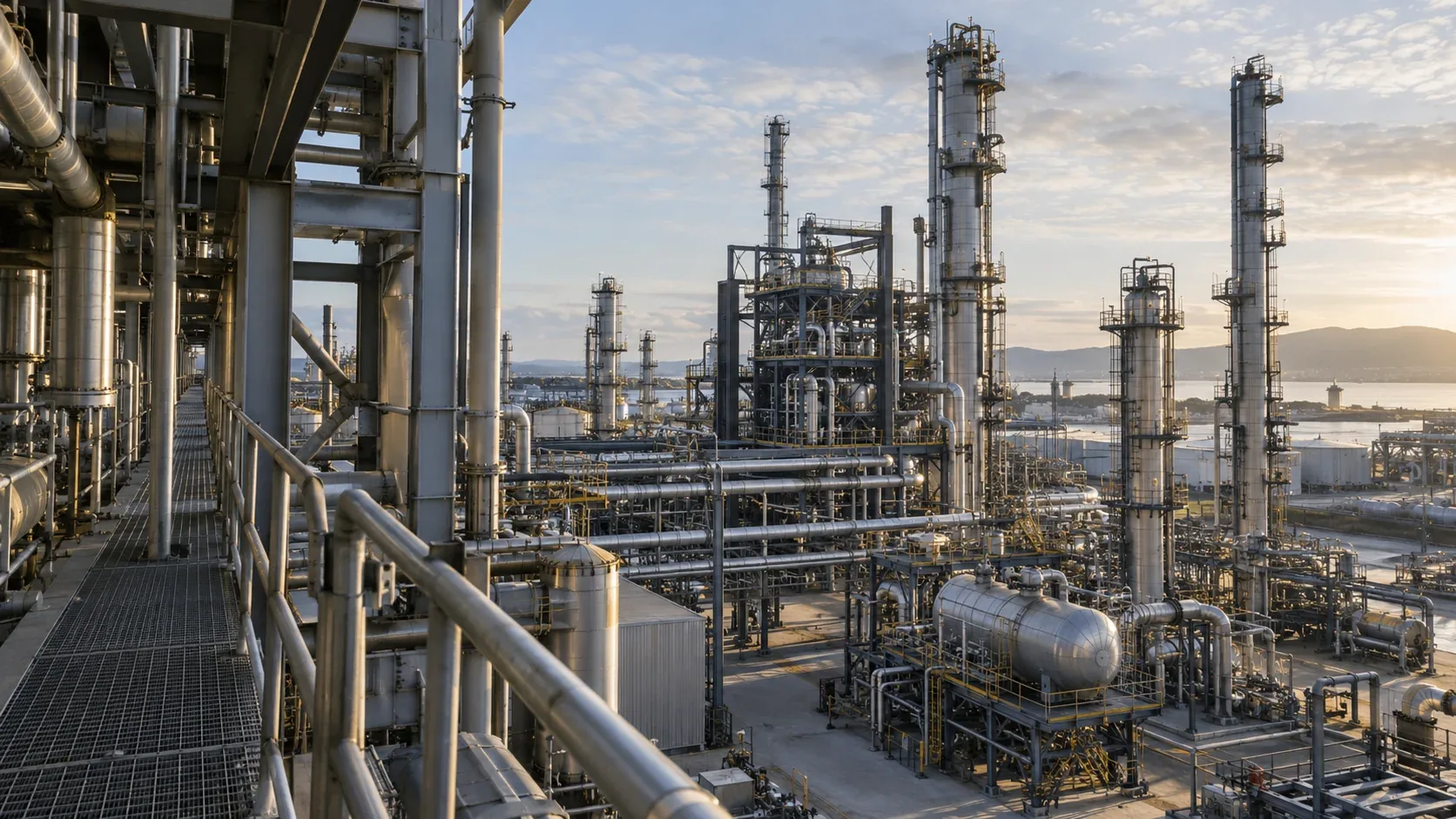
Topics: terminal automation system, petroleum terminal software, oil and gas dispatch software.
Bitumen (asphalt binder) terminals operate in a tight thermal corridor. If storage or loading lines drop below $135^\circ\text{C}$, high-viscosity binder solidifies inside pumps, Coriolis meters, and gantry arms; if held above $180^\circ\text{C}$ for prolonged periods—or if tank levels drop below internal thermal-oil heating coils, light maltenes oxidize into asphaltenes, prematurely hardening the binder (reducing needle penetration under ASTM D5) or triggering pyrophoric coke crusting on exposed heater tubes. This guide (O118) defines the heated storage energy accounting, SBS Polymer Modified Bitumen (PMB) milling/curing state machine, water boil-over safety interlock, and gantry temperature/weighbridge reconciliation architecture.
Scope and governance boundary
This article specifies the Terminal Automation System (TAS), PLC, LIMS, and ERP control architecture for heated black-oil and specialty binder depots:
- What this workflow governs: Tank heating-mode state management (
Slump/Dormant 110°C,Standby 135°C,Active Pumping/Blending 165–180°C), low-level heater-coil shutoff logs, SBS polymer batch dosing and colloid-mill pass counters, post-cure thermal stability clocks, road-tanker dry-interior/previous-cargo safety signoffs, and weighbridge-to-hot-Coriolis reconciliation. - What this workflow does not replace: It does not replace physical overfill/high-temperature safety thermostats on thermal-oil boilers, H2S scavenger dosing in sour vacuum residues, or civil highway engineering Superpave PG binder mix design.
- Step 1 — Record intake & baseline identification: Never apply ambient white-oil terminal dispatch logic (`O025`) to bitumen and Polymer Modified Bitumen (PMB) depots: govern **minimum pumping viscosity temperatures ($145^\circ\text{C–}175^\circ\text{C}$)** alongside **maximum thermal-degradation exposure clocks** and **heater-tube low-level immersion interlocks** ([Eurobitume](https://www.eurobitume.eu/publications/health-safety/)).
- Step 2 — Cross-system reference & custody linkage: Enforce a mandatory **Boil-Over Moisture & Previous-Cargo Gate** before any road tanker enters the bitumen gantry: one litre of liquid water trapped in a tanker heel flashes into $\sim 1,600\text{ litres}$ of superheated steam upon contact with $170^\circ\text{C}$ bitumen, causing violent foam-over eruptions.
- Step 3 — Exception quarantine & authority check: Track Polymer Modified Bitumen (PMB) production by **high-shear colloid-mill turnover passes**, **cross-linking curing dwell hours**, and **hot-storage recirculation decay clocks**; force a laboratory Softening Point ([ASTM D36](https://www.astm.org/d0005_d0005m-20.html)) and Elastic Recovery re-test if a cured PMB batch sits at $>165^\circ\text{C}$ beyond its stability window (e.g., $48\text{ hours}$).
- Step 4 — Verified disposition & audit trail closure: Allocate thermal-oil heater natural-gas/FO energy to specific grades (`VG-10`, `VG-30`, `VG-40`, `PMB-40`) based on tank temperature-hours ($\text{MT} \times \Delta T \times \text{Hours}$) rather than flat tonnage, and reconcile hot volumetric flowmeters against certified weighbridges using [ASTM D4311](https://www.astm.org/d0005_d0005m-20.html) thermal expansion factors.
Why ambient terminal software fails in heated bitumen and PMB depots?
Standard bulk liquid terminal systems built for diesel and gasoline (O025) lack controls for four bitumen-specific operational hazards:
- Steam Boil-Over from Emulsion or Wet Tanker Heels: If a road tanker that previously hauled cationic bitumen emulsion (which contains $30%\text{–}40%$ water) or had rain enter an open manlid is loaded with $170^\circ\text{C}$ neat bitumen, the water flashes instantaneously into steam ($1,600\times$ volume expansion), erupting molten bitumen over the gantry.
- PMB Phase Separation and Thermal Degradation: Producing SBS Polymer Modified Bitumen requires dispersing $3.0%\text{–}4.5%$ styrene-butadiene-styrene crumb/pellets through a high-shear rotor-stator mill at $180^\circ\text{C–}185^\circ\text{C}$ followed by sulfur cross-linking cure. If the cured batch is held at $175^\circ\text{C}$ without gentle agitation or stored longer than $48\text{–}72\text{ hours}$ at high heat, the polymer network degrades and elastic recovery drops out of spec.
- Exposed Heater-Tube Coking and Vapour Space Auto-Ignition: When a bitumen tank is drawn down during peak paving season, the liquid level must never fall below at least $150\text{–}250\text{ mm}$ above the top skin of the internal thermal-oil heating coils while hot oil is circulating; otherwise, the thin bitumen film bakes into insulating carbon coke and overheats the vapour space.
- Unallocated Thermal Heating Energy Costs: Holding $2,000\text{ MT}$ of
PMB-40at $170^\circ\text{C}$ with continuous agitator circulation consumes $3\times$ to $4\times$ more thermal-oil energy per tonne than holding neatVG-30in slumped standby at $125^\circ\text{C}$.
- Primary control scope: terminal automation system across operations and connected ERP/EAM records.
- Segregation boundary: Operational status updates never auto-close engineering, safety, or finance sign-off gates.
- Verification cadence: Reconcile open exceptions, overrides, and late adjustments at each shift or period close.
Heated storage, PMB blending, and gantry dispatch control matrix
Scroll horizontally to see all columns.
| Operational Stage | Primary Sensor / ERP Record | Technical & Safety Rule | Hard Interlock / Hold Trigger | Accountable Owner & Action |
|---|---|---|---|---|
| 1. Tank Heating & Coil Immersion | Radar Level (LT-TK) + Heater Skin Temp (TI-SKIN) |
Liquid level must remain $\ge 200\text{ mm}$ above top heating coil whenever thermal oil valve is open | Level approaches coil top + $200\text{ mm}$ OR tank bulk temp $>190^\circ\text{C}$ | TAS PLC automatically closes thermal-oil supply valve (TV-HO-101) |
| 2. PMB High-Shear Milling & Cure | Batch Manufacturing Order (BMO-PMB) + Mill Flow Totalizer |
$\text{Mill Passes} = (\text{Mill Flow MT/h} \times \text{Hours}) / \text{Batch MT} \ge 3.0\text{ passes}$ | Mill passes $<3.0$ or curing dwell time $<6.0\text{ hours}$ at $170^\circ\text{C}$ | Plant Operator cannot advance batch status to Ready for Lab Release |
| 3. Thermal Aging & Stability Clock | Batch Quality Release (COA-PMB) + Timer |
Valid for $48\text{ hours}$ at dispatch temp ($165^\circ\text{C–}175^\circ\text{C}$); continuous slow agitation required | Batch held $>48\text{ hours}$ at $>165^\circ\text{C}$ or agitator tripped $>2\text{ hours}$ | ERP expires batch release token; forces new Softening Point & DSR/Elastic test |
| 4. Road Tanker Boil-Over Check | Gantry Pre-Loading Inspection (CHK-BOIL) |
Verify last cargo certificate (forbid cationic/anionic emulsion without certified dry-out) + visual dry dip | Last cargo was water/emulsion without dry certificate, or moisture detected in sump | Loading Master locks gantry RFID card and rejects vehicle |
| 5. Weighbridge & VCF Settlement | Certified Weighbridge (WB-01) + Hot Coriolis/PD Meter |
Invoiced in metric tonnes ($\text{MT}$); hot volume cross-checked via ASTM D4311 VCF | Weighbridge net $\text{MT}$ vs $\text{Hot Litres} \times \rho_{15} \times \text{VCF}$ diverges $>0.5%$ | Dispatch Supervisor halts invoice generation and inspects scale/entrained air |
Illustrative worked example: 200 MT PMB-40 batch production, thermal energy allocation, and hot dispatch reconciliation
Illustrative operating scenario with synthetic figures to demonstrate PMB formulation, thermal energy costing, and hot-density volume reconciliation arithmetic; not a client case study.
Consider a specialty asphalt terminal producing a $200.00\text{ MT}$ batch of elastomeric PMB-40 in heated maturation kettle MK-02 and dispatching a $25\text{ MT}$ insulated road tanker.
Step 1: Reconcile PMB-40 formulation, colloid-mill passes, and curing release
- Batch recipe charged into
MK-02:- Base paving-grade bitumen (
VG-30at $165^\circ\text{C}$): $191.60\text{ MT}$ ($95.80\text{ wt%}$) - Radial Styrene-Butadiene-Styrene (
SBSpolymer pellets): $6.80\text{ MT}$ ($3.40\text{ wt%}$) - Aromatic process/compatibilizer oil: $1.40\text{ MT}$ ($0.70\text{ wt%}$)
- Elemental/donor sulfur cross-linking agent: $0.20\text{ MT}$ ($0.10\text{ wt%}$)
- Total batch mass: $191.60 + 6.80 + 1.40 + 0.20 = 200.00\text{ MT}$.
- Base paving-grade bitumen (
- High-shear colloid milling and curing verification:
- The high-shear mill circulates at $80.0\text{ MT/hour}$ at $182^\circ\text{C}$ for $7.50\text{ hours}$: $$\text{Total Milled Mass} = 80.0\text{ MT/h} \times 7.50\text{ h} = 600.0\text{ MT} \implies \text{Turnover Passes} = \frac{600.0\text{ MT}}{200.0\text{ MT}} = 3.00\text{ passes}$$
- Following milling, the sulfur cross-linker is dosed and the batch cures in
MK-02under continuous paddle agitation at $172^\circ\text{C}$ for $6.0\text{ hours}$. - Lab release results: Penetration @ $25^\circ\text{C} = 44\text{ dmm}$ (spec $30\text{–}50\text{ dmm}$, ASTM D5); Ring-and-Ball Softening Point $= 64.2^\circ\text{C}$ (spec $\ge 60.0^\circ\text{C}$, ASTM D36); Elastic Recovery @ $25^\circ\text{C} = 78.5%$ (spec $\ge 75.0%$). The ERP stamps batch
PMB40-2610-08as Released with a 48-hour hot-dispatch expiry clock.
Step 2: Allocate thermal-oil heating energy to the batch cost sheet
The terminal meters thermal-oil heat delivery ($\Delta T$ across tank supply/return coils $\times$ thermal oil flow rate) for MK-02 across the batch cycle:
- Standby pre-heat phase: $42.0\text{ hours}$ holding at $135^\circ\text{C}$ consumes $18.50\text{ GJ}$.
- High-temperature milling, curing, and active dispatch phase: $38.0\text{ hours}$ at $172^\circ\text{C–}182^\circ\text{C}$ consumes $46.30\text{ GJ}$.
- Total thermal energy allocated to the $200.00\text{ MT}$ batch:
$$E_{\text{total}} = 18.50\text{ GJ} + 46.30\text{ GJ} = 64.80\text{ GJ}\quad \left(\frac{64.80\text{ GJ}}{200.00\text{ MT}} = 0.324\text{ GJ/MT}\right)$$ At a natural-gas boiler fuel cost of $$15.00/\text{GJ}$, the ERP Process Energy Allocation posts $$972.00$ (or $$4.86/\text{MT}$) directly to
PMB40-2610-08's landed manufacturing cost—preventing high-temperature PMB heating costs from being subsidized by ambient or low-heat grades.
Step 3: Reconcile gantry hot-volume loading against weighbridge net mass
Road tanker MH-04-JK-9921 passes the dry-interior boil-over inspection (Last Cargo: Neat VG-30, zero moisture) and loads from MK-02 at $T_{\text{load}} = 168.0^\circ\text{C}$:
Scroll horizontally to see all columns.
| Measurement Parameter | Recorded Value | Reconciliation Formula / Standard |
|---|---|---|
Standard density of PMB40-2610-08 @ $15^\circ\text{C}$ ($\rho_{15}$) |
$1,032.0\text{ kg/m}^3$ | Certified lab pycnometer reading |
| Loading line temperature ($T_{\text{load}}$) | $168.0^\circ\text{C}$ | Gantry RTD (TT-GAN-02, within $160^\circ\text{C–}175^\circ\text{C}$ window) |
| Volume Correction Factor ($\text{VCF}_{168\rightarrow 15}$) | $0.9108$ | ASTM D4311 table for $\Delta T = 153^\circ\text{C}$ |
| Hot density at loading temperature ($\rho_{\text{hot}}$) | $939.95\text{ kg/m}^3$ | $1,032.0\text{ kg/m}^3 \times 0.9108 = 939.95\text{ kg/m}^3$ |
| Gantry hot volumetric preset delivered ($V_{\text{hot}}$) | $26,500\text{ L}$ ($26.500\text{ m}^3$) | Heated positive-displacement / Coriolis gantry meter |
| Calculated mass from hot volume ($M_{\text{meter}}$) | $24.909\text{ MT}$ | $26.500\text{ m}^3 \times 0.93995\text{ MT/m}^3 = 24.909\text{ MT}$ |
| Certified weighbridge net mass ($M_{\text{wb}}$) | $24.920\text{ MT}$ | Gross $40.140\text{ MT} - \text{Tare } 15.220\text{ MT} = 24.920\text{ MT}$ |
| Meter-to-weighbridge variance | $-0.011\text{ MT}$ ($-0.044%$) | Within $\pm 0.50%$ tolerance; invoice released on $24.920\text{ MT}$ |
Acceptance tests and operational readiness criteria
ACT-O118-01(Boil-Over Moisture & Previous-Cargo Gantry Interlock): The TAS/ERP gantry workflow must block loading-arm activation unless a signedBoil-Over Safety Checkconfirms the road tanker's previous cargo was not water or bitumen emulsion (or attaches a certified steam-dry certificate) and verifies dry visual tank inspection.ACT-O118-02(Low-Level Heater-Coil Immersion Lockout): Whenever a heated bitumen tank's radar level approaches within $200\text{ mm}$ of the upper heating coil bundle, the TAS must lock the thermal-oil control valve closed and inhibit manual heating overrides.ACT-O118-03(PMB Colloid-Mill Pass & 48-Hour Thermal Aging Gate): APMBbatch cannot be released to gantry dispatch unless the batch record confirms $\ge 3.0$ colloid-mill turnover passes and curing completion, and any released batch held $>48\text{ hours}$ at $>165^\circ\text{C}$ must automatically revert to Recertification Required.ACT-O118-04(Hot Litres to Weighbridge Mass Cross-Check): Every gantry dispatch must cross-check hot metered litres converted via ASTM D4311 VCF against certified weighbridge net weight and place the delivery note on hold if variance exceeds $\pm 0.50%$.
Next steps
- Enforce previous-cargo emulsion blocks at the terminal entry gate: Require drivers hauling bitumen emulsion to present a verified hot-air drying certificate before switching the compartment back to hot neat bitumen or PMB.
- Automate 48-hour thermal stability clocks on cured PMB batches: Prevent thermally degraded, phase-separated polymer binder from shipping to highway paving sites without a fresh Softening Point and Elastic Recovery check.
- Sub-meter thermal-oil heat consumption by tank temperature band: Allocate natural-gas/fuel-oil heating costs accurately between high-temperature PMB agitator kettles and slumped base-bitumen storage tanks.
- Link tank radar levels to heater-coil elevation maps in the PLC and ERP: Eliminate exposed heater-tube coking and vapour-space overheating risks during end-of-batch drawdowns.
Frequently Asked Questions
How do bitumen/asphalt terminals manage thermal-oil tank heating energy, Penetration/Viscosity grade polymer modification (PMB) curing logs, and minimum safe pumping-temperature gantry interlocks?
Teams should govern terminal automation system by linking every transaction to its source evidence, timestamp, and assigned owner before permitting downstream posting. Distinct from O025 (ambient white-oil terminal dispatch); O118 addresses heated heavy-product storage (150–180°C), thermal degradation/crusting prevention, PMB SBS-polymer milling cure times, and water-in-tank boil-over safety interlocks. Rather than relying on informal spreadsheet overrides, the workflow enforces a documented verification gate and preserves the original observation whenever a correction is recorded.
How does petroleum terminal software handle exceptions and mismatches?
When a discrepancy occurs during petroleum terminal software, the system routes the blocked record into an owned exception queue rather than silently dropping or auto-adjusting the balance. Assigned operational, quality, and finance owners must review and approve exceptions before posting. Each exception retains the original quantity, date, and counterparty reference until the designated reviewer resolves the variance with supporting evidence.
What should teams test before automating oil and gas dispatch software?
Before scaling oil and gas dispatch software, run a bounded pilot using historical records that include partial receipts, late updates, duplicate messages, and rejected lines. Verify that the integration preserves idempotency, maintains a clear segregation of duties between operational entry and financial approval, and produces an auditable trail for every state transition.
Summary and next actions
- Map the current terminal automation system record boundaries, system of record, and named approval owners before changing workflow rules.
- Separate operational status updates from engineering, safety, or financial disposition sign-off.
- Validate exception queues, duplicate handling, and cutoff reconciliation in a bounded pilot before production rollout.
Assess your terminal automation system controls
Map the record states, evidence links, exception routing and review owners for terminal automation system. Technical and regulatory sign-off stays with the site authority.
Prepare a focused assessmentReferences
Sources checked 15 October 2026. Vendor examples retain their stated release scope. Catalogue entries do not replace the full applicable standards.
- https://www.eurobitume.eu/publications/health-safety/ — (Accessed 2026-10-20).
- https://www.astm.org/d0005_d0005m-20.html — (Accessed 2026-10-20).
- https://www.asphaltinstitute.org/ — (Accessed 2026-10-20).
- https://docs.frappe.io/erpnext/user/manual/en/bom-stock-report — (Accessed 2026-10-20).
