Coffee-roastery ERP controls: reconcile green-bean roast shrinkage, degassing silo holds and post-roast blend genealogy
For Finance controllers, CFOs and accounts teams · Compare approaches
TL;DR — what you’ll learn
- Record thermal roast shrinkage per batch (green charge weight minus destoned roasted discharge weight) rather than applying a static BOM scrap percentage across origins with different green moisture and roast levels.
- Distinguish pre-roast blending (green origins combined before the drum) from post-roast blending (single-origin roasts combined after discharge); different origin shrinkage rates change the final roasted mass ratio unless the BOM accounts for component-specific yield.
- Enforce a time-stamped degassing silo dwell hold in the ERP/MES so whole-bean and ground-coffee packing orders cannot draw from a silo lot before its minimum $\text{CO}_2$ off-gassing window clears or after its maximum staleness window expires.
- Separate thermal roast loss, destoner foreign-matter rejects, QC cupping samples and packing-scale giveaway into distinct variance buckets so roaster performance and packaging fill accuracy are never conflated.
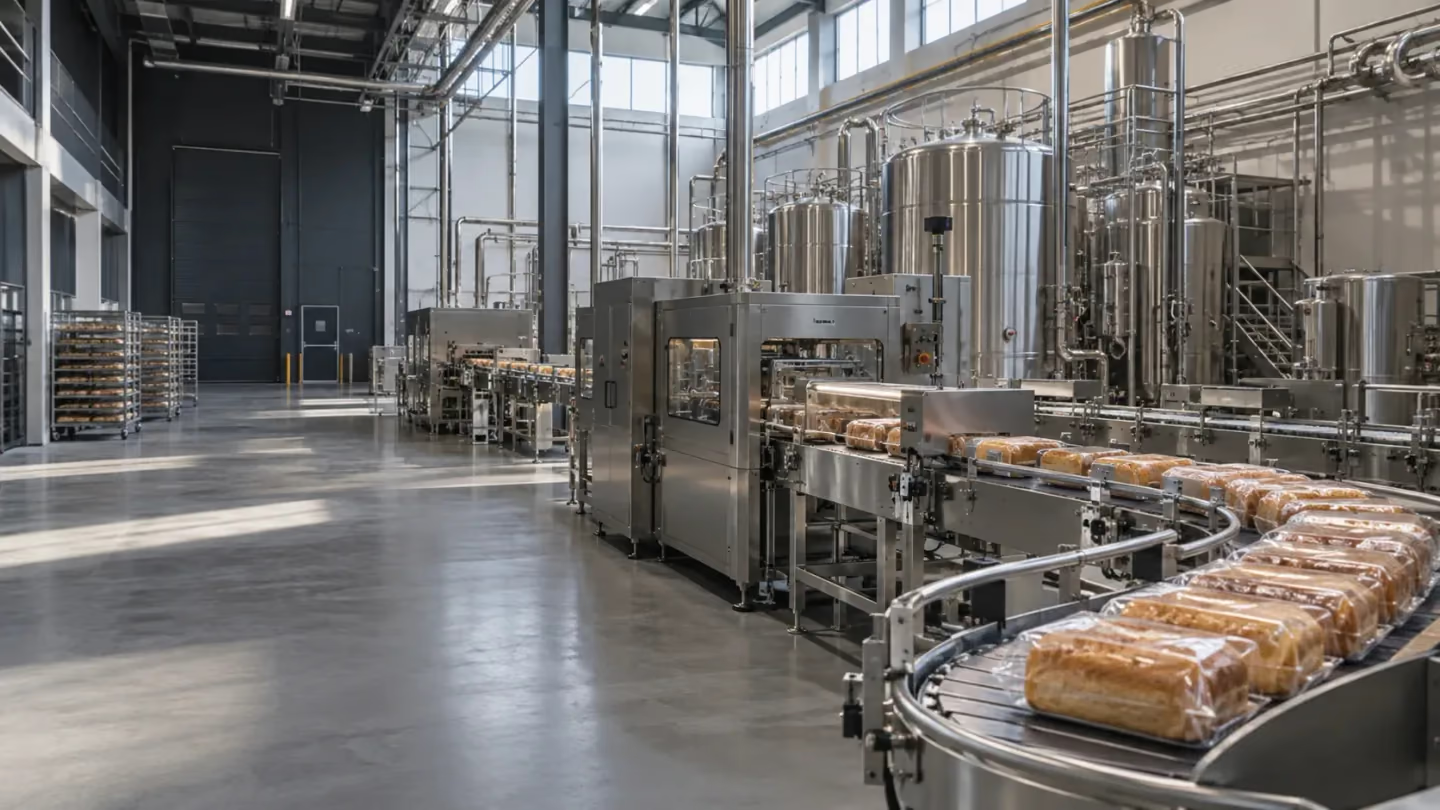
A commercial coffee roastery sets a flat 15.0% BOM scrap factor across all roasted SKUs in its ERP. After a month of high-volume production, the warehouse physical count shows a 680 kg deficit in roasted dark-roast inventory and an unexplained surplus in light-roast single-origin stock. At the same time, a retail customer reports bloated foil pouches from a ground-coffee lot that bypassed its degassing dwell window during a weekend rush. The flat BOM scrap factor hid real 14.2% to 18.4% batch shrinkage variations, and the ERP treated roasted beans leaving the cooling tray as immediately packable finished stock.
How should commercial coffee roasteries track green-bean moisture loss (roast shrinkage), degassing silo dwell holds, and post-roast blend genealogy?
Record thermal roast shrinkage per batch (green charge weight minus destoned roasted discharge weight) rather than applying a static BOM scrap percentage across origins with different green moisture and roast levels. Distinguish pre-roast blending (green origins combined before the drum) from post-roast blending (single-origin roasts combined after discharge); different origin shrinkage rates change the final roasted mass ratio unless the BOM accounts for component-specific yield.
- 01Capture batch contextLot, unit, timestamp and source reference
- 02Verify against rulesActive specification, tolerance and cut-off
- 03Reconcile variancesSeparate physical events from timing gapsDo the batch records and tolerances agree?YesApprove ledger postingNoKeep the disputed quantity in a visible hold status and route to the designated owner.
- 04Approve ledger postingRetain signed-off evidence and history
Illustrative information flow. The article explains the evidence, exceptions and responsible decisions. Diagram: NextEdge Labs.
Scope and evidence boundary: ERP lot and yield governance vs roasting and packaging SOPs
This guide covers the ERP, MES and quality-record architecture for green-bean inventory depletion, roast-batch yield reconciliation, degassing silo state control and blend traceability. It does not prescribe drum charge temperatures, rate-of-rise (RoR) thermal profiles, airflow damper settings, quench-water volumes, specific degassing hours or modified-atmosphere packaging (MAP) gas mixtures.
Green-coffee sample preparation, moisture determination and physical grading context follow recognized standards such as ISO 6668 (Green coffee — Preparation of samples for use in sensory analysis) and the Specialty Coffee Association (SCA) Coffee Standards. The head roaster, green-coffee buyer and QA/cupping lead define the approved roast colour targets, permissible quench rules, degassing dwell windows and packaging specifications.
Scroll horizontally to see all columns.
| Component / stage | Batches run | Green coffee issued (kg) | Roasted discharge before destoner (kg) | Thermal roast shrinkage (kg) | Thermal roast shrinkage (%) | Post-roast blend mass share (%) |
|---|---|---|---|---|---|---|
| **Origin Lot A (Washed Arabica)** | 6 × 120.0 kg | 720.00 | 608.40 | 111.60 | 15.50% | 60.43% |
| **Origin Lot B (Natural Arabica)** | 4 × 120.0 kg | 480.00 | 398.40 | 81.60 | 17.00% | 39.57% |
| **Combined blend roasts** | **10 batches** | **1,200.00** | **1,006.80** | **193.20** | **16.10%** | **100.00%** |
Source: GS1 · Lot identification and movement event records. Reference details
1. Green-coffee intake tare and moisture-linked batch charging
Green coffee arrives in jute, sisal or high-barrier liner bags (typically 60 kg or 69 kg nominal) or 1,000 kg bulk supersacks. Between port arrival and roasting, green beans can gain or lose moisture depending on warehouse humidity. Green lot receipt: Record supplier/importer lot ID, ICO mark or farm/washing-station reference, gross weight, bag/liner tare, net green weight, intake moisture percentage and water activity ($a_w$). Roaster charge: Weigh the exact net green charge per batch on the green-hopper load cell. Never backflush a nominal 60 kg bag weight if actual net bag weights vary between 59.4 kg and 60.3 kg.
Source: Frappe / ERPNext · Material movement and reconciliation controls. Reference details
2. Thermal roast shrinkage vs destoner rejects and chaff
During roasting, green coffee loses 13% to 19% of its mass through moisture evaporation, pyrolysis of organic dry matter and detachment of silverskin (chaff). If the roaster uses water quenching in the drum or cooling tray, residual moisture—and therefore apparent weight yield, changes. In the ERP batch record, record: Green charge weight (kg) per batch. Roasted discharge weight (kg) measured after the cooling tray and destoner. Destoner reject mass (kg) (stones, metal fragments or dense unroasted defects removed pneumatically). Calculated thermal roast shrinkage (%): $$\text{Roast Shrinkage (\%)} = \frac{\text{Green Charge (kg)} - \text{Roasted Discharge before Destoner (kg)}}{\text{Green Charge (kg)}} \times 100$$
Chaff collected in the cyclone or incinerated in the afterburner is part of thermal roast shrinkage; however, if pelletized chaff is weighed for composting/disposal manifests, record it as a non-valued environmental disposal stream rather than subtracting it a second time from roasted yield.
3. Pre-roast vs post-roast blend genealogy
Roasteries build multi-origin blends in one of two ways: Pre-roast blend: Green lots are weighed into a batching hopper in target proportions, mixed and roasted together in a single drum cycle. Post-roast (melange) blend: Each origin is roasted separately to its own profile and discharged into separate roasted-WIP silos; the blend is then proportioned after roasting (or by combining whole-bean roast batches in a rotary mixer).
Notice the mathematical difference: if a recipe specifies a 60% Origin A / 40% Origin B green input ratio, but Origin A loses 15.50% during a medium roast while Origin B loses 17.00% during a slightly deeper roast, the resulting roasted beans do not have a 60:40 roasted mass ratio—they have a 60.43% : 39.57% roasted mass ratio. The ERP BOM must state clearly whether blend percentages are defined on a pre-roast green mass basis or a post-roast finished mass basis, and must link every contributing single-origin roast batch to the composite blend lot ID.
4. Degassing silo dwell gates and packaging release
Freshly roasted coffee releases trapped carbon dioxide ($\text{CO}_2$) for days after roasting, and grinding accelerates that release dramatically. Packing too early—especially for ground coffee or pods—causes package pillowing/bursting or channeling during extraction. Holding too long in an un-blanketed silo increases oxidative staling before the barrier film seals the product.
Accordingly, each roasted-WIP silo or tote lot in the ERP should carry a two-sided time gate: EARLIEST_PACK_RELEASE_AT = Roast completion timestamp + approved minimum degassing dwell hours (distinct for whole-bean vs ground SKUs). LATEST_PACK_EXPIRY_AT = Roast completion timestamp + approved maximum silo holding hours before mandatory QA re-cupping.
Illustrative worked example: 1,200 kg post-roast blend run across 10 batches
All figures below are illustrative and synthetic. Assume a roastery executes 10 batches of 120.0 kg green coffee (6 batches of Lot A washed Arabica and 4 batches of Lot B natural Arabica) to produce a post-roast espresso blend packed into 1 kg and 250 g valve bags.
Summary
Reliable coffee roastery green bean shrinkage degassing lot control depends on consistent lot identity, shared cut-off times, and explicit exception ownership across production, quality, and finance. When teams verify physical evidence before posting adjustments, both traceability and margin reporting remain defensible.
What to do next
- Audit one recent week of coffee roastery green bean shrinkage degassing lot control transactions to identify unrecorded movements, unit mismatches, or late entries.
- Define the mandatory lot, unit, and approval fields required before an operator or integration can post a status change.
- Pilot the exception queue on one product line and review unresolved variances at a fixed daily cut-off.
Compare this workflow with your current setup
Share the step that takes the most manual work, the systems involved and the exceptions your team handles. That gives us a concrete starting point for comparing approaches.
Sources and further reading
Sources checked 15 October 2026. The worked examples and software evaluation suggestions are NextEdge Labs’ editorial analysis.
- GS1 Global Traceability StandardGS1 · Release 2.0, August 2017
Reference framework for identification and traceability data. Citing it does not imply that a proposed system is GS1 certified.
- Stock EntryFrappe / ERPNext · Online product documentation, accessed October 2026
Examples of distinct material receipt, issue, transfer and manufacturing transactions, including transit handling.
Visual credits
AI-generated illustration created for NextEdge Labs; it does not depict a client facility. Workflow diagram by NextEdge Labs. Icons from Lucide (ISC licence).

